

Finding the right model size for a deployment target has traditionally meant picking an architecture, training it, testing it against latency and accuracy requirements, and repeating if it falls short. Neural Architecture Search (NAS), now available in Roboflow Train, replaces that trial-and-error cycle by evaluating thousands of candidate configurations, including image resolution, patch size, and decoder layers, in a single training run. The result is a set of optimized models tuned to your specific dataset and hardware, letting you choose the best speed-and-accuracy tradeoff at deployment time without running multiple separate experiments.
Today we’re announcing that Neural Architecture Search (NAS) is now available in Roboflow Train. This new training engine helps you find the optimal balance of inference speed and accuracy required for your specific deployment needs.
It achieves this by evaluating thousands of candidate architectures in a single training run. Instead of manually guessing the right configuration, you can automatically design and train the best vision models for your dataset.
When training a custom vision model, you often need to balance model accuracy with inference speed for your deployment environment. Traditionally, finding that sweet spot meant picking an existing architecture and training a model. If it didn't satisfy your latency or accuracy needs, you would select another size and train again. This approach restricted you to a handful of predefined architecture sizes, limiting your options for finding the right performance mix. Ultimately, this cycle of repeated trial and error consumed valuable time and computing resources during model development.
NAS solves this by exploring thousands of options to deliver the optimal model for your specific data and hardware. The engine simultaneously evaluates different configurations and trains multiple models from which you can choose at deployment time. Whether you plan to deploy your model on local edge hardware or want to reduce the compute cost of running it in the cloud, NAS allows your vision application to run at the lowest possible latency without sacrificing the accuracy you need.
Train the right model the first time
When using NAS, the system optimizes a range of settings, such as image resolution, patch size, and the number of decoder layers. This eliminates the need for you to manually configure different image resolutions and hyperparameters when initiating a training job.
Peter Robicheaux, Machine Learning Lead at Roboflow, highlighted the real-world impact of this capability: “I’ve seen situations where people select a large image resolution and spend valuable time training at that scale. When it’s time to test and deploy, they discover the model doesn’t hit their performance targets and they have to start over. Neural Architecture Search preempts that by removing the need to experiment with those settings yourself. You get the best model for your data the first time.”
Better accuracy and better latency
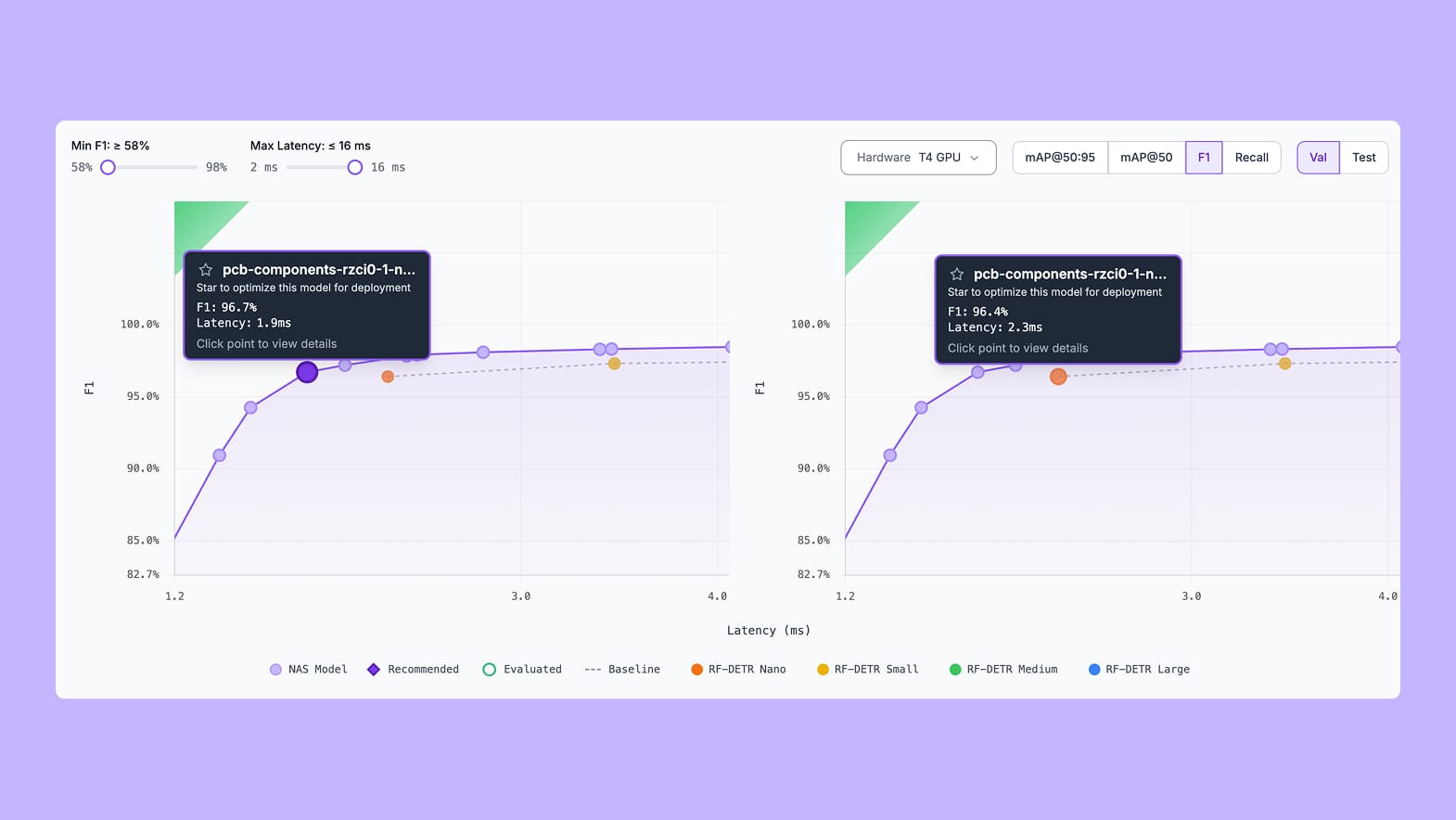
NAS doesn't only reduce the amount of time you spend tuning settings, but it generally delivers better models compared to fine-tuning on an existing architecture. In the example below, when training a model to detect components on a PCB board, the models generated with NAS offer not only better accuracy but also better latency than the models generated using standard, single-architecture exploration.
In the Model Explorer chart, the purple dots represent the NAS-generated models. Notice how several of them push further up and to the left (indicating higher accuracy and lower latency) than the baseline RF-DETR Nano model (the orange dot) trained on the exact same data.
For example, one NAS-discovered model achieves a 96.7% F1 score with a latency of just 1.9ms, beating the baseline Nano model's 96.4% F1 score and 2.3ms latency.
How to train a custom vision model with NAS
Ready to find the optimal mix of accuracy and latency on your next project? For detailed instructions, see the documentation Start a NAS training run or the quick guide below.
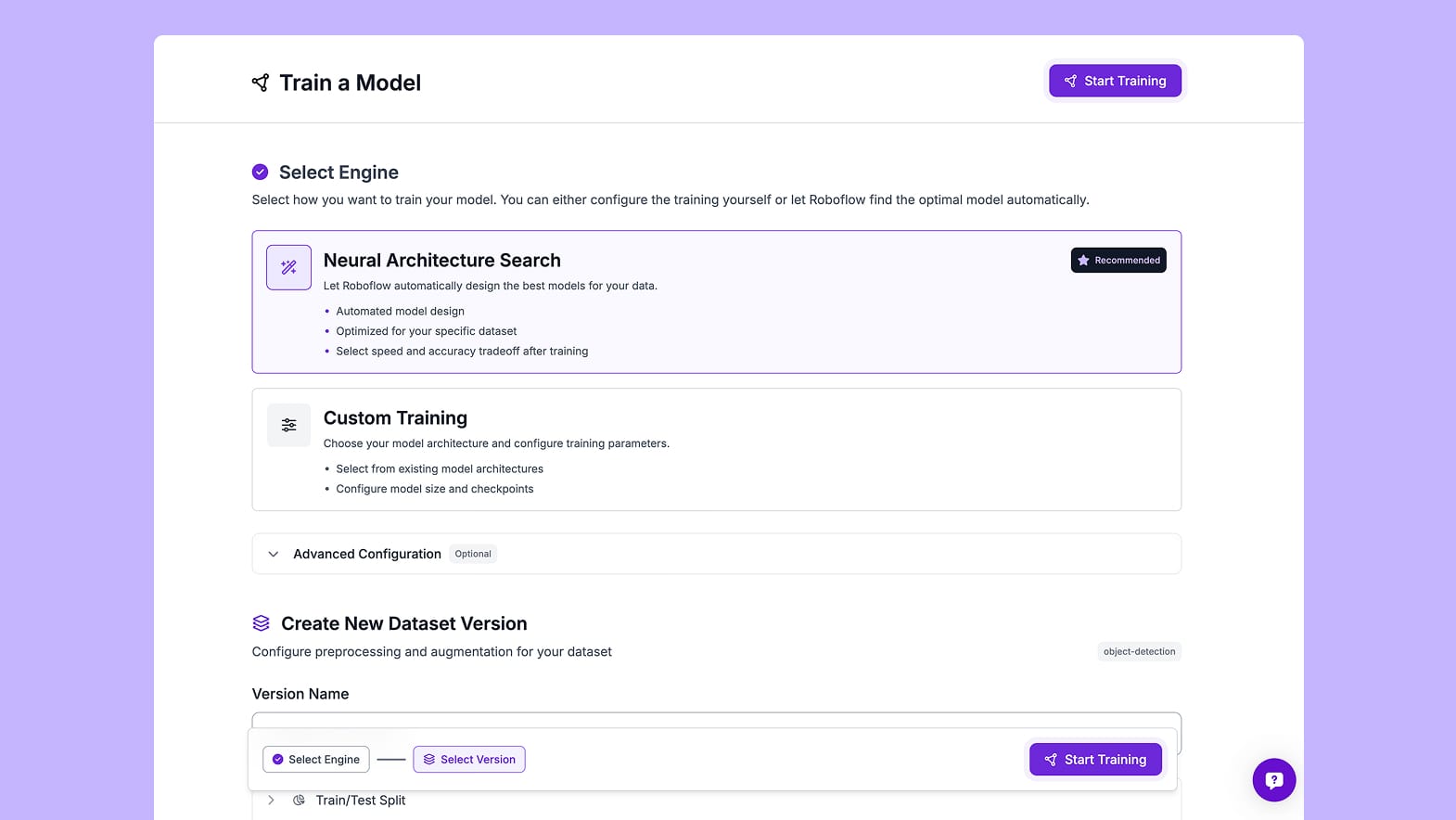
1. Log into Roboflow and find an object detection or instance segmentation project. On the Train tab, select Neural Architecture Search as your training engine. Adjust other settings depending on your needs and click Start Training.
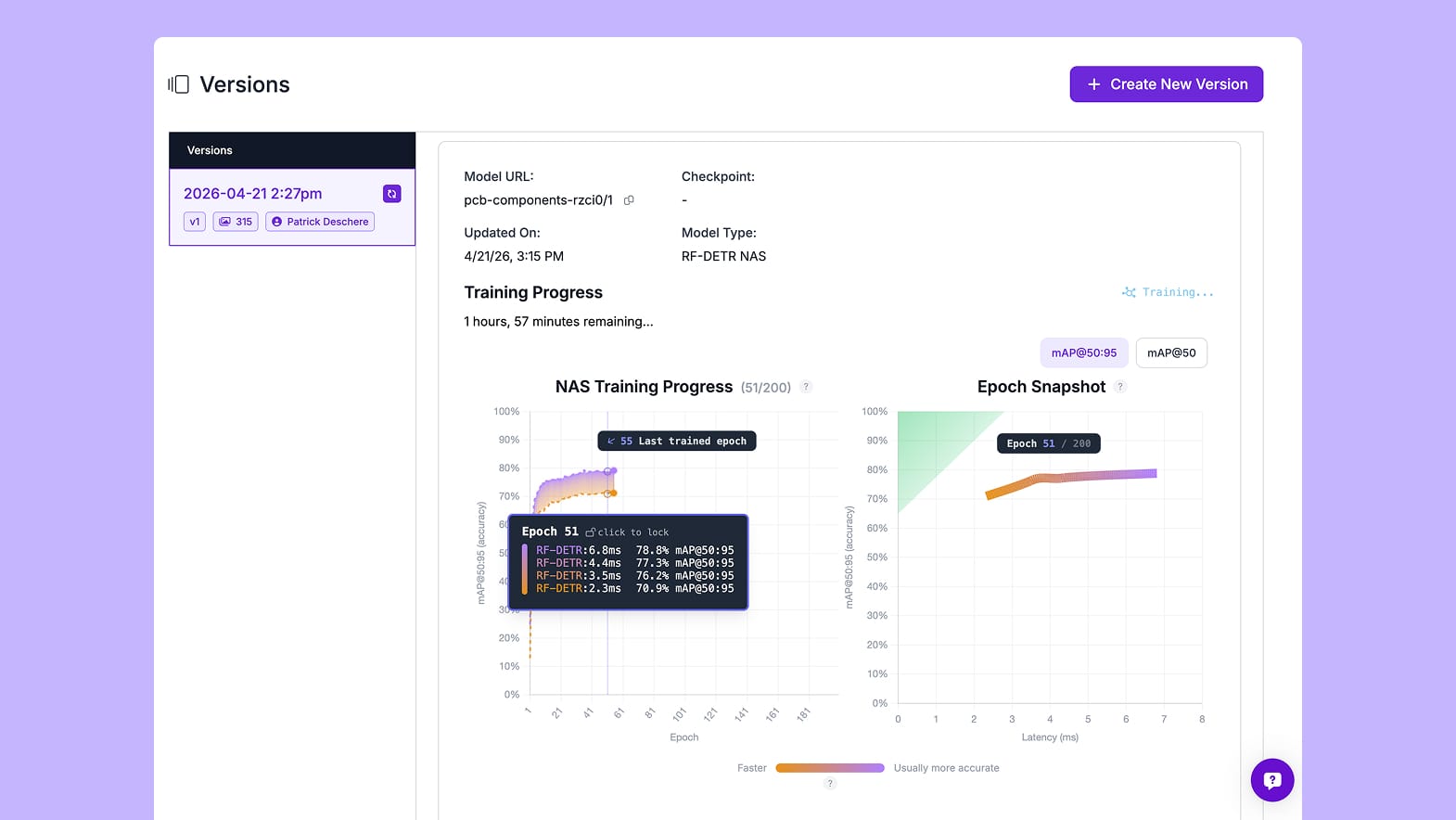
2. Once the training job starts, you can monitor the progress as the engine mines the architecture space.
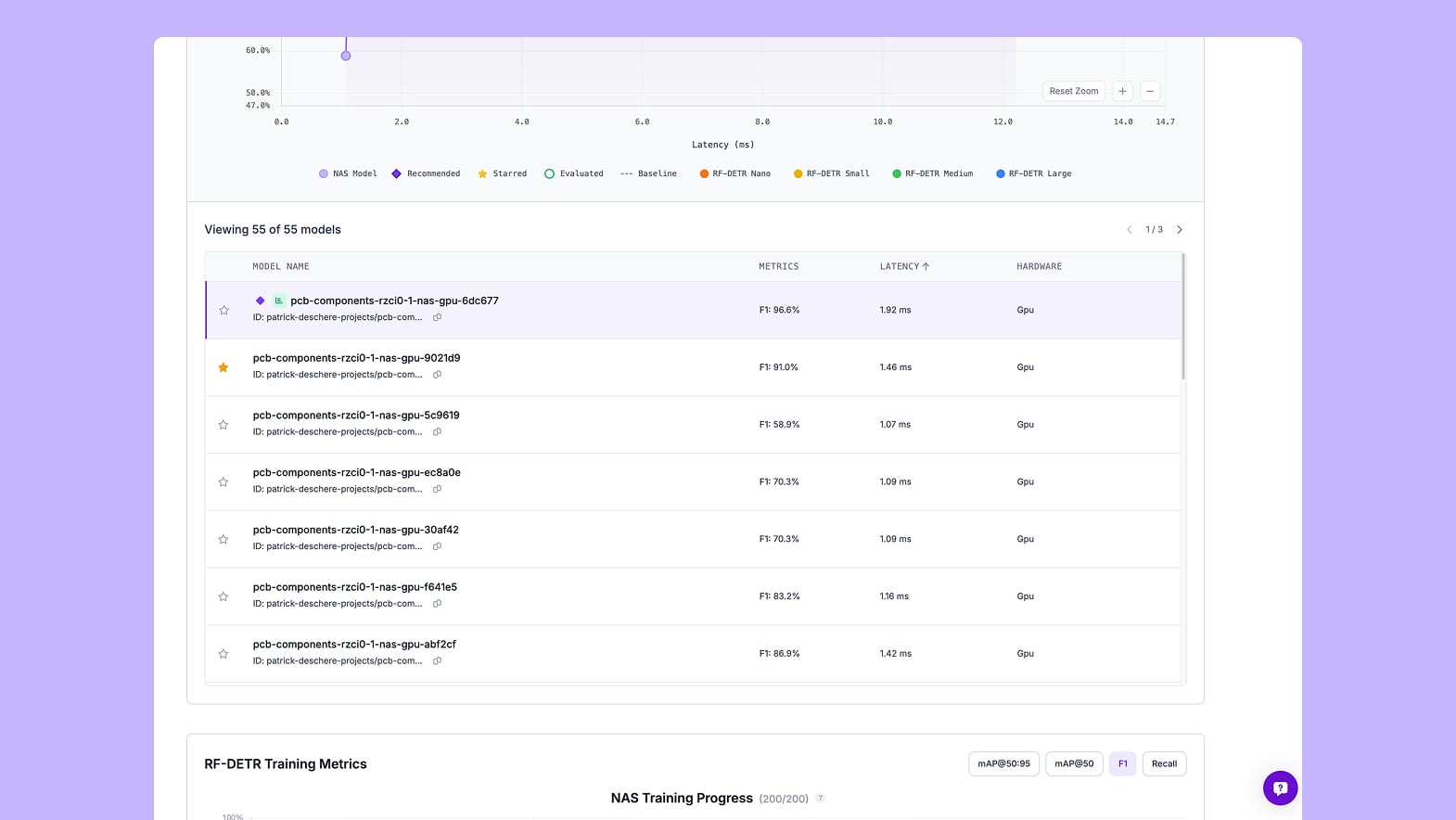
3. After training completes, you can review the results and evaluate performance across different benchmarking standards like mAP@50:95 and F1 scores.
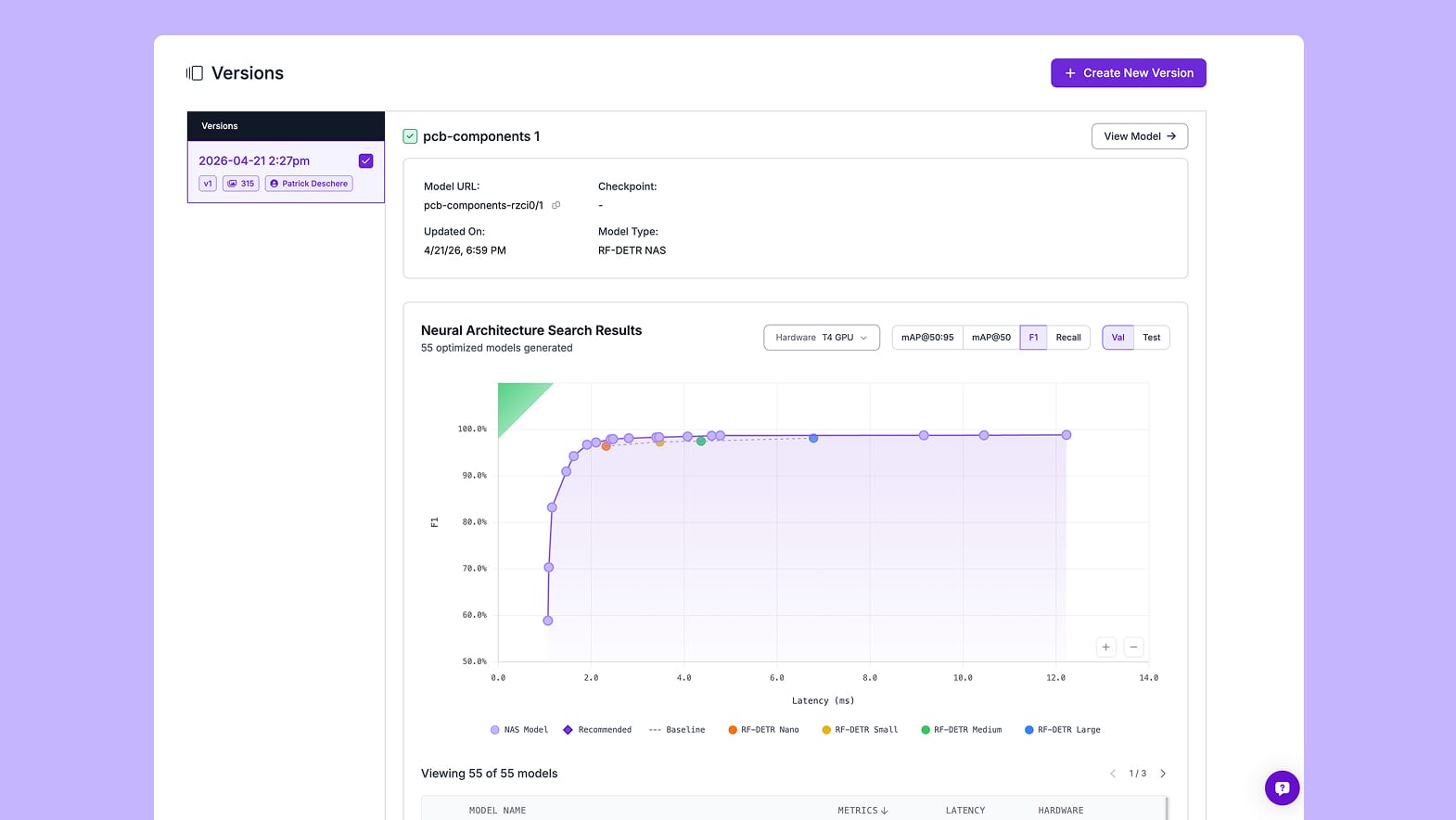
4. Now you are ready to start using the models. If you want to easily find and use one of them later, you can review the full list and star specific models.
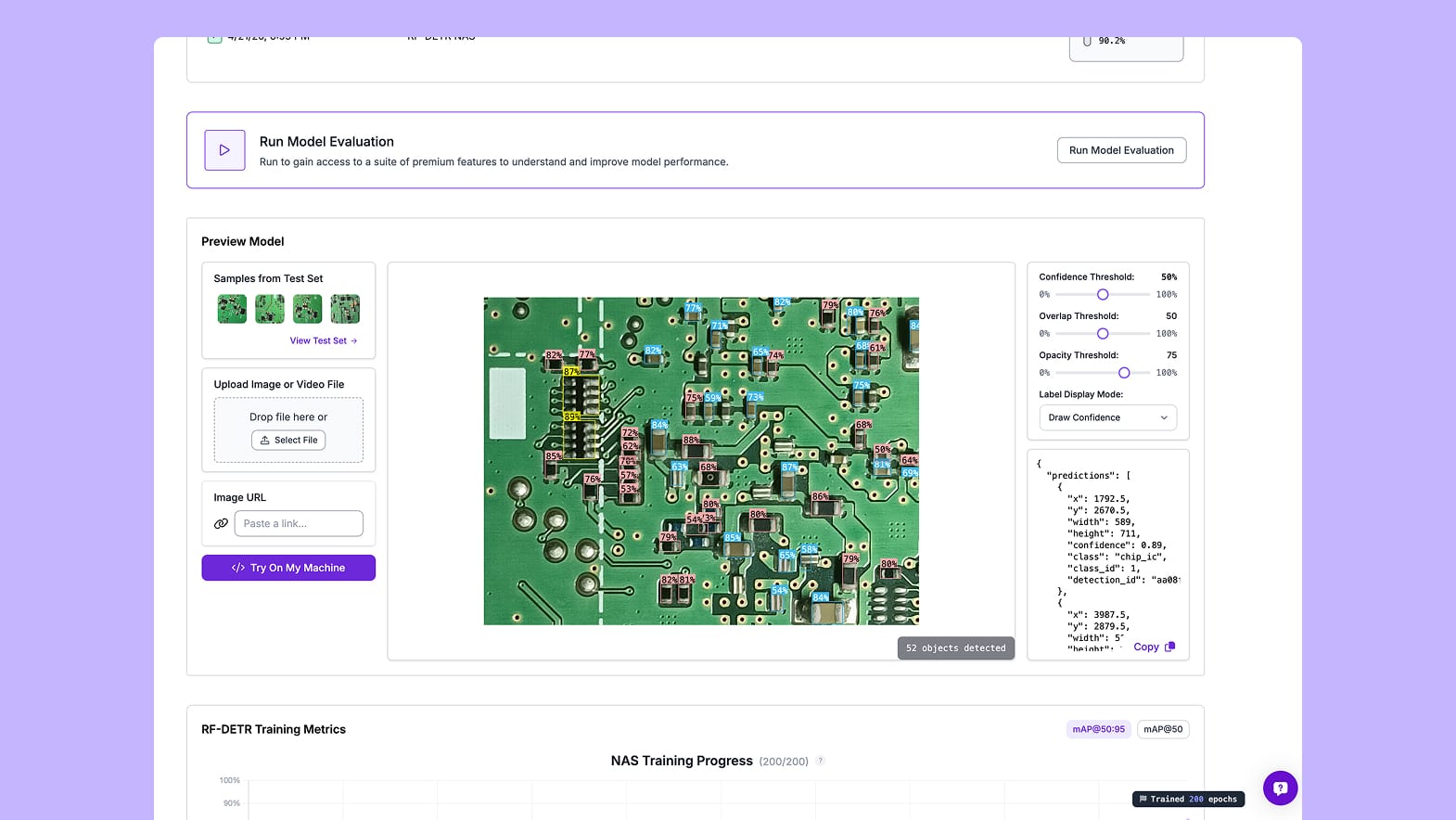
5. Additionally, you can test the different models directly in the browser or use Model Evaluation to understand real-world performance.
Exploring thousands of architectures at a fraction of the cost
How is it possible to evaluate thousands of models without exorbitant compute costs? The answer lies in Roboflow's unique "weight-sharing" NAS strategy. By training one set of model weights that can be applied across thousands of architectures, the system uses a fraction of the computing power you would otherwise need to train and test the same number of models yourself.
Because a NAS run produces dozens of trained models in a single job, the cost per model is significantly lower than training each configuration individually. While the total credit spend for a NAS job can be higher than a single standard fine-tune, it completely eliminates the need to run multiple, separate experiments. For a detailed breakdown of expected credit usage, check out the documentation on NAS cost and credits.
If you want to read more about the research behind our implementation, you can check out the paper: RF-DETR: Neural Architecture Search for Real-Time Detection Transformers.
When to use Neural Architecture Search
NAS is the ideal choice when you are preparing a model for production and need to lock in the absolute best speed-and-accuracy tradeoff. However, if your use case is straightforward or you are just doing early-stage exploration, a standard fine-tune might be all you need. Read our documentation on when to use NAS to see if it fits your current project phase.
Design the best vision model today
Neural Architecture Search is available now for Roboflow users on Core and Enterprise usage-based plans. If you want to stop guessing about hyperparameters and start deploying the best model for your data, log into Roboflow and let NAS find the perfect mix of accuracy and speed.


Cite this Post
Use the following entry to cite this post in your research:
Patrick Deschere. (Apr 27, 2026). Neural Architecture Search: Train the best vision model for your data. Roboflow Blog: https://blog.roboflow.com/train-with-neural-architecture-search/