

A robotics perception stack is the chain of sensors (RGB, depth, LiDAR, IMU), computer vision models (detection, segmentation, pose, depth estimation), tracking, and sensor fusion that turns raw camera and sensor data into a world model a robot can act on. The vision layer is a small Roboflow Workflow, RF-DETR detection plus ByteTrack, and most production failures happen where the parts connect: swapped tracking IDs, mismatched sensor timestamps, and over-trusted confidence scores.
According to the International Federation of Robotics (IFR), the global market value of industrial robots has reached a record $16.7 billion. As robots become more widely used in factories and warehouses, the need for robots to reliably understand their surroundings grows as well.
Learn how robotics perception stacks combine cameras, sensors, computer vision models, tracking, and sensor fusion to help robots understand and interact with their environment.
What Is a Robotics Perception Stack?
A robotics perception stack is the set of sensors, computer vision models, and software that turns what a robot’s cameras and sensors pick up into information it can act on.
- Sensing: collecting the raw data. A camera captures pixels, LiDAR measures distance, and a motion sensor (IMU) records movement.
- Perception: reading that data to work out what’s around the robot.
For example, a warehouse robot takes a picture of an aisle. Its perception system can then:
- Detect workers, pallets, and equipment
- Estimate where obstacles are located
- Track moving objects across frames
- Pass the results to mapping or planning systems
A typical robotics perception stack follows a flow such as:
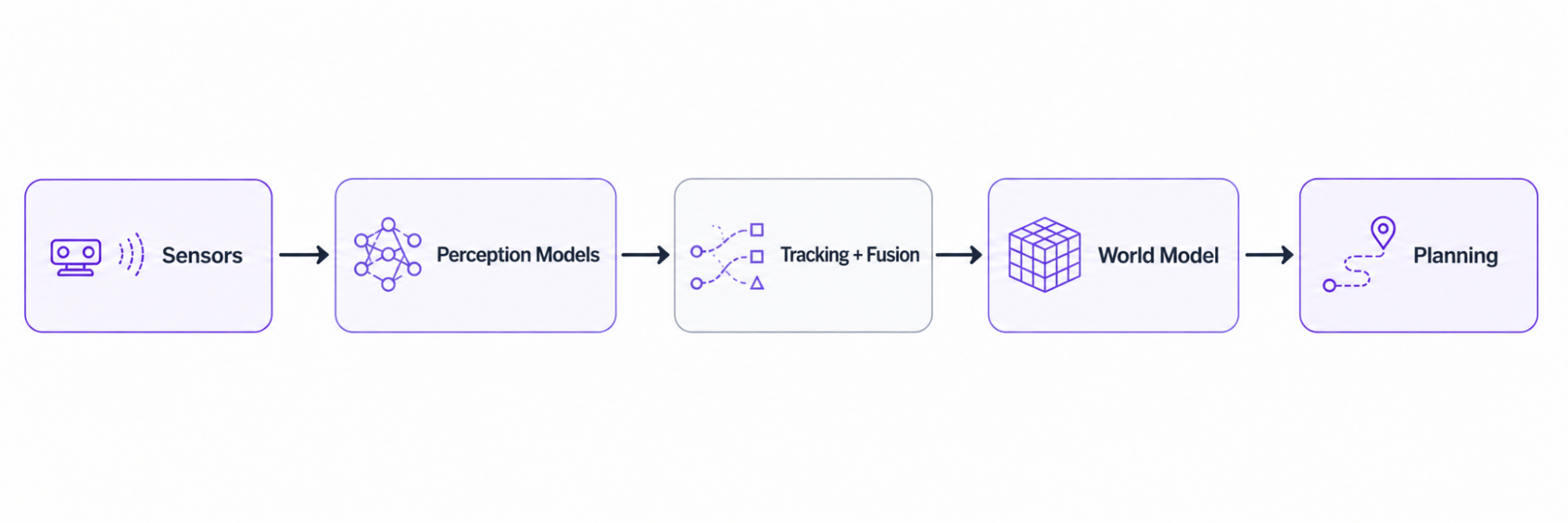
How Robots Perceive Their Environment
Robots perceive their surroundings through sensors that capture different types of information about the environment.
Common Sensors Used in Robotics
- RGB cameras: Capture standard color images and are widely used for object detection, classification, segmentation, tracking, and visual inspection. They provide rich visual detail but don’t directly measure distance.
- Depth and stereo cameras: Estimate how far objects and surfaces are from the robot. Depth information is useful for obstacle avoidance, navigation, object picking, and understanding the 3D structure of a scene.
- LiDAR: Measures distance by sending out laser pulses and recording how long they take to return. LiDAR creates detailed 2D or 3D representations of the environment and is commonly used for mapping, localization, and navigation.
- IMUs, radar, and encoders: An inertial measurement unit, or IMU, measures acceleration and rotation. Radar detects objects and estimates distance or velocity, even in conditions where cameras struggle. Wheel encoders measure wheel rotation and help estimate the distance and direction of a robot’s movement.
Why Robots Combine Multiple Sensors
Sensor fusion combines measurements from different sources to reduce uncertainty. If a camera view is partially blocked, depth and motion data help maintain an estimate of an object’s position. Motion sensors also help separate changes caused by the robot’s own movement from changes in the surrounding environment.
Core Computer Vision Tasks in Robotics
Computer vision models turn camera data into information about objects, surfaces, people, and movement. Most robots use several of these tasks together.
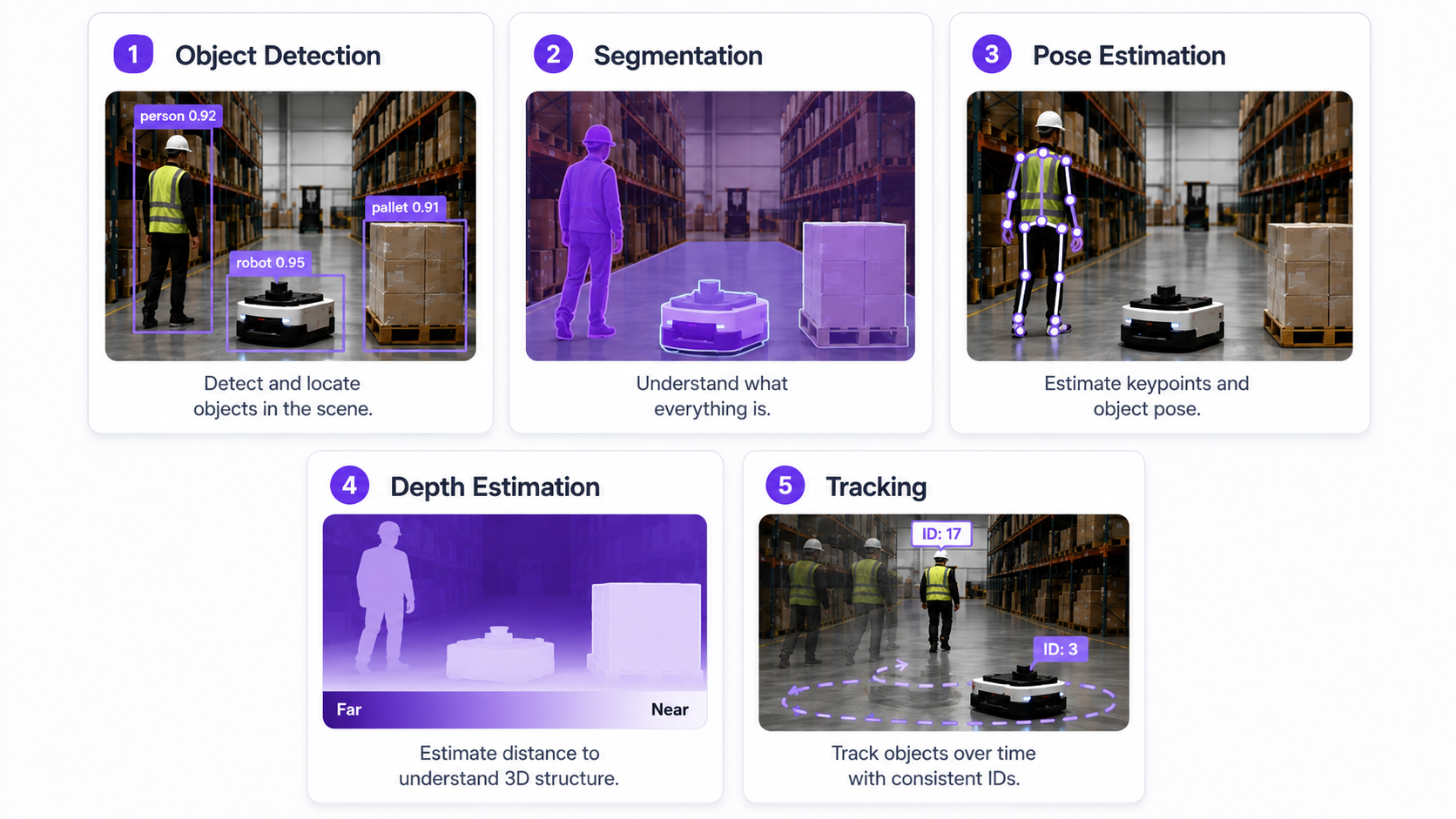
Object Detection
Finds objects in an image and marks their location with bounding boxes. A warehouse robot uses a model such as RF-DETR to spot workers, pallets, forklifts, and boxes, and passes those detections to navigation or safety systems.
Segmentation
Segmentation models classify every pixel, giving exact object outlines. A mobile robot uses this to tell the floor from shelves and walls, and a robotic arm runs the Instance Segmentation Model block to see the exact shape of an object before picking it up.
Pose Estimation
Finds keypoints and orientation. A keypoint model reads a worker’s posture from the position of their arms and torso, or tells a robotic arm how an item is turned before the arm reaches for it.
Depth Estimation
Measures how far away things are. In Workflows, the Depth Estimation block does this from a single camera image and returns a depth map, a distance value for every pixel, so you don’t need a separate depth sensor for rough distance. It tells the robot whether an obstacle is one meter or five meters away, and how far an arm needs to move to reach something.
Tracking
Follows the same object across video frames. A tracker such as ByteTrack keeps one ID on a moving worker instead of treating every frame as a new person, so the robot can follow movement over time. At 30 frames per second, even a 30-second clip gives the tracker 900 chances to lose that ID.
Building the Vision Layer of a Robotics Perception Stack with Roboflow
A robotics perception stack uses a computer vision pipeline to identify and track relevant objects before passing those results to the rest of the robotics system. In Roboflow Workflows, this is a small pipeline that processes frames from warehouse video and returns structured information about objects in the scene.
For example, a Workflow can follow this structure:
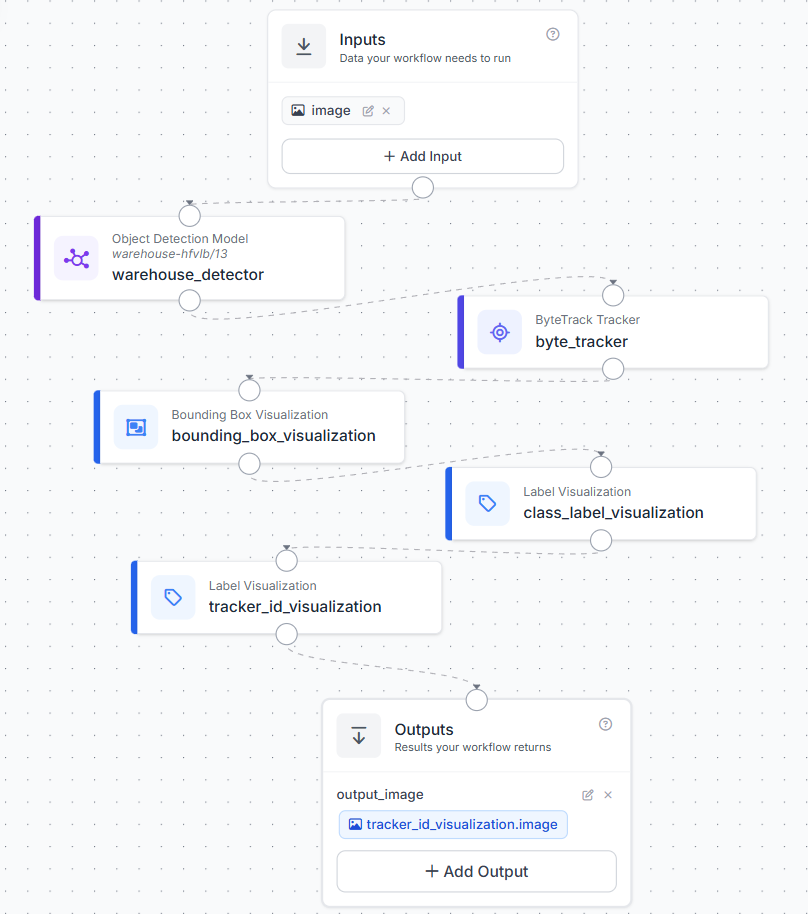
The warehouse_detector, built with RF-DETR, runs object detection on each frame and identifies warehouse objects such as workers, pallets, and forklifts. Its predictions are then passed to Byte Tracker, which assigns each object a persistent tracking ID for downstream systems to use.
Visualization blocks then draw bounding boxes, class labels, and tracking IDs on the image, making it easier to check that the pipeline is finding and tracking the right objects before those predictions are used elsewhere.
The resulting Workflow is only the vision layer of the perception stack. Its outputs, such as object classes, bounding-box locations, and tracking information, feed the other robotics components. Depth or LiDAR measurements add distance and 3D position, while mapping and planning systems use the combined information to update the robot’s understanding of the environment and decide what to do next.
From Sensor Data to Robot Action
The outputs of individual perception models are useful, but a robot often needs a single, continuously updated representation of its surroundings. This is where sensor fusion and world modeling come together.
Data from cameras, depth sensors, LiDAR, and tracking systems gets aligned so that detections are associated with positions, distances, and movement over time. Robots organize this information in different ways depending on the task:
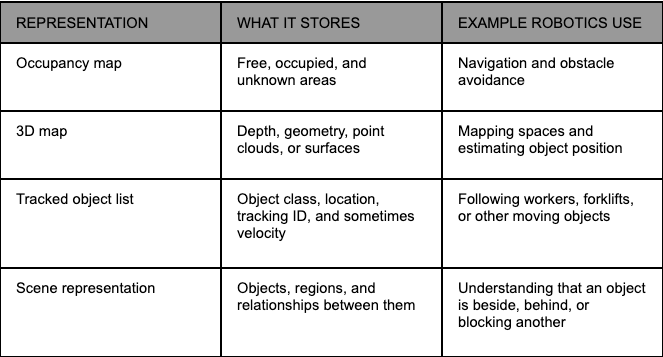
A world model becomes useful when the robot uses it to choose an action. Perception outputs feed navigation, collision avoidance, manipulation, or other planning systems. For a warehouse robot, the flow might look like:
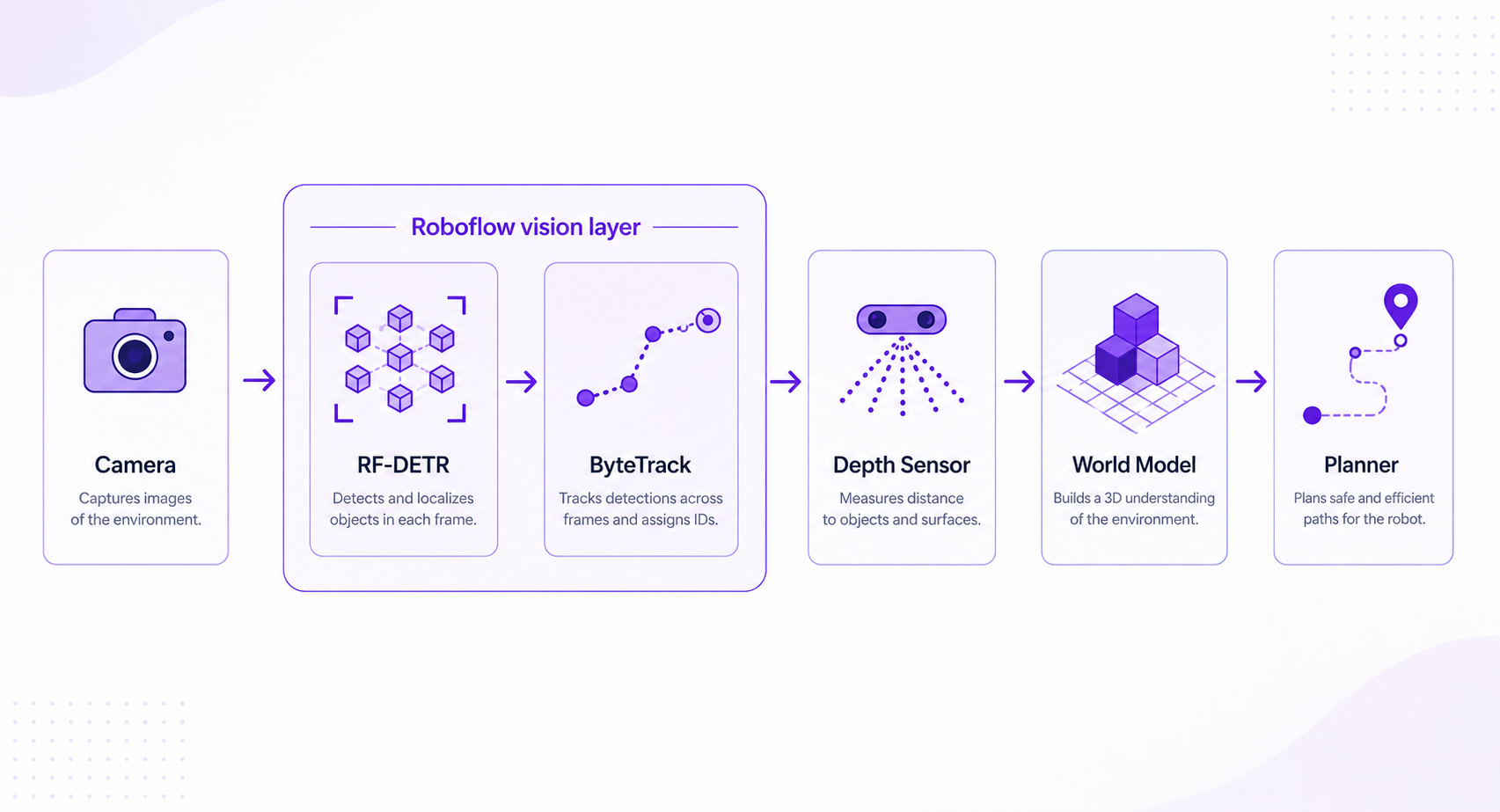
Detection tells the robot that a pallet is present. Tracking maintains the pallet’s identity and position as it moves across frames. Depth adds distance, so the system knows where the pallet is relative to the robot. The planner then uses the updated world model to decide whether to keep moving, slow down, or change direction.
A robotic arm uses the same outputs differently, combining segmentation, depth, and pose information to position its gripper around an object.
Speed also matters. If predictions arrive too late, the robot is reacting to an outdated view of the environment. The acceptable delay depends on how fast the robot and nearby objects are moving.
Perception pipelines should therefore be tested on real video and the hardware they’ll run on. That makes it easier to spot missed detections, unstable tracking, or delays before the pipeline is used for real robot decisions.
Where Perception Stacks Usually Break
Most perception failures in production happen where the parts connect, and less often inside the models.
Tracking IDs swap. When two workers cross paths or one blocks the other, the tracker can hand worker 3’s ID to worker 7, and any logic that trusts IDs over time, like counting or following, will be wrong too. The Byte Tracker block’s tracking thresholds control how eagerly it matches detections to existing IDs, so tune them on crowded video, not on an empty aisle.
Sensors disagree about time. A camera frame and a depth reading taken 100 milliseconds apart don’t show the same scene when a forklift is moving. If the time stamps don’t match, the system places objects where they were a moment ago instead of where they are now. A bumped camera causes the same kind of problem, since a shift of a few degrees puts every depth measurement in the wrong place until someone re-aligns it.
Confidence scores get trusted too much. A detector can be wrong at 0.9 and right at 0.4, especially on objects it rarely saw during training. Use the score to sort detections, and set the cutoff in the Detections Filter block deliberately. It isn’t a guarantee.
Conclusion
A robotics perception stack connects sensing, computer vision, tracking, sensor fusion, world modeling, and planning so a robot can understand what’s around it and respond.
In the Roboflow Workflow shown above, detection and tracking form the vision layer, while depth sensing, mapping, and planning remain part of the wider robotics system. A reasonable first step is to build a small Workflow that pairs an object detection model with the ByteTrack block on one camera feed, then check whether the tracked output is stable before adding depth or a full world model.
Further reading:


Cite this Post
Use the following entry to cite this post in your research:
Mostafa Ibrahim. (Aug 26, 2026). Robotics Perception Stacks: How Robots Understand Their Environment. Roboflow Blog: https://blog.roboflow.com/robotics-perception-stacks/