

Today, Roboflow released the Vision AI Trends: 2026 Report, an analysis of 200,000 projects that reveals how enterprises use computer vision. With over a million engineers and half the Fortune 100 building with Roboflow, the report illustrates the top applications of vision AI across major industries.
By examining this wide range of projects developed by experts and leading enterprises, this report provides ground truth data of how businesses deployed vision AI in the last 12 months.
2025 saw vision AI enter a period of vertical, exponential growth, moving beyond novelty research to become a standard component of the operational stack for enterprises. This is the moment AI moved beyond screens and into physical environments.
2026 Vision AI Trends Report Key Findings
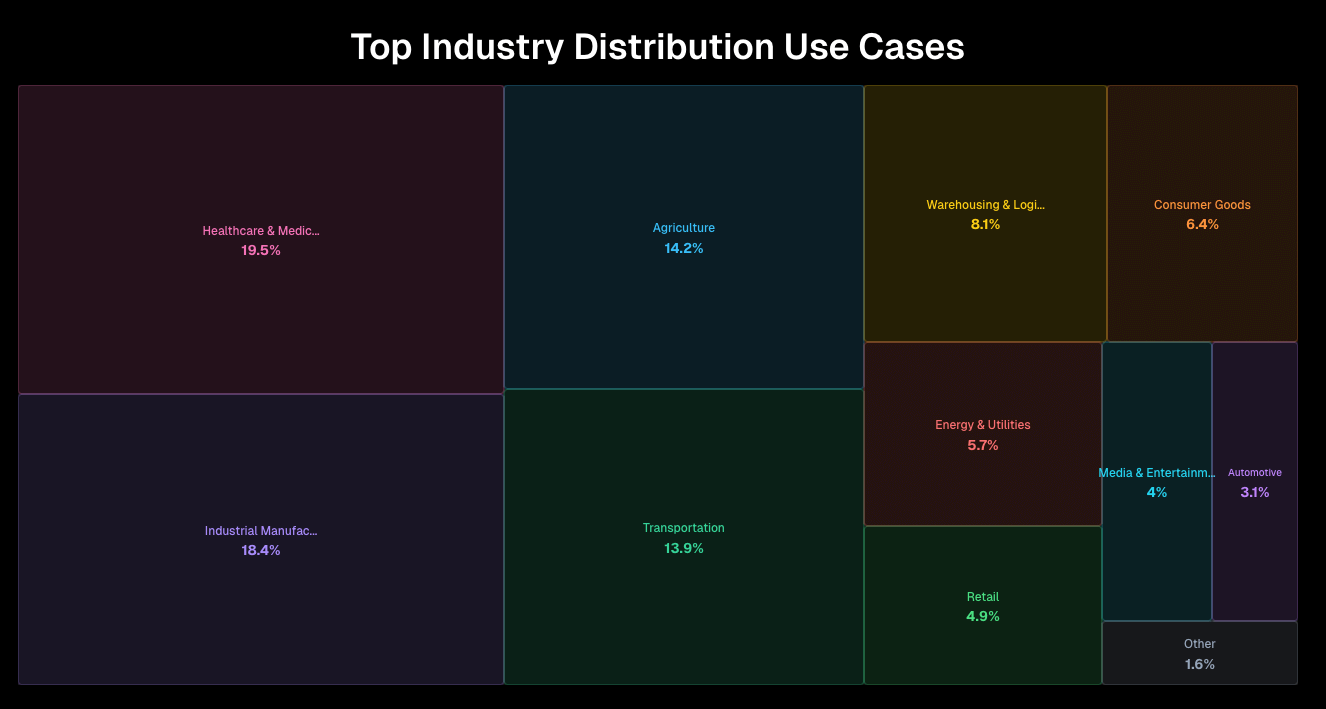
This is the first time a report has analyzed this many computer vision projects and offers a data-driven window into the reality of how businesses are using vision AI in production at scale. We see how organizations are moving beyond pilot projects to operationalize visual AI across 10 global industries: healthcare & medicine, industrial manufacturing, agriculture, transportation, warehousing & logistics, energy & utilities, retail, consumer goods, media & entertainment, and automotive.
The data reveals a clear pattern that vision AI has moved from observation to high-stakes decision-making:
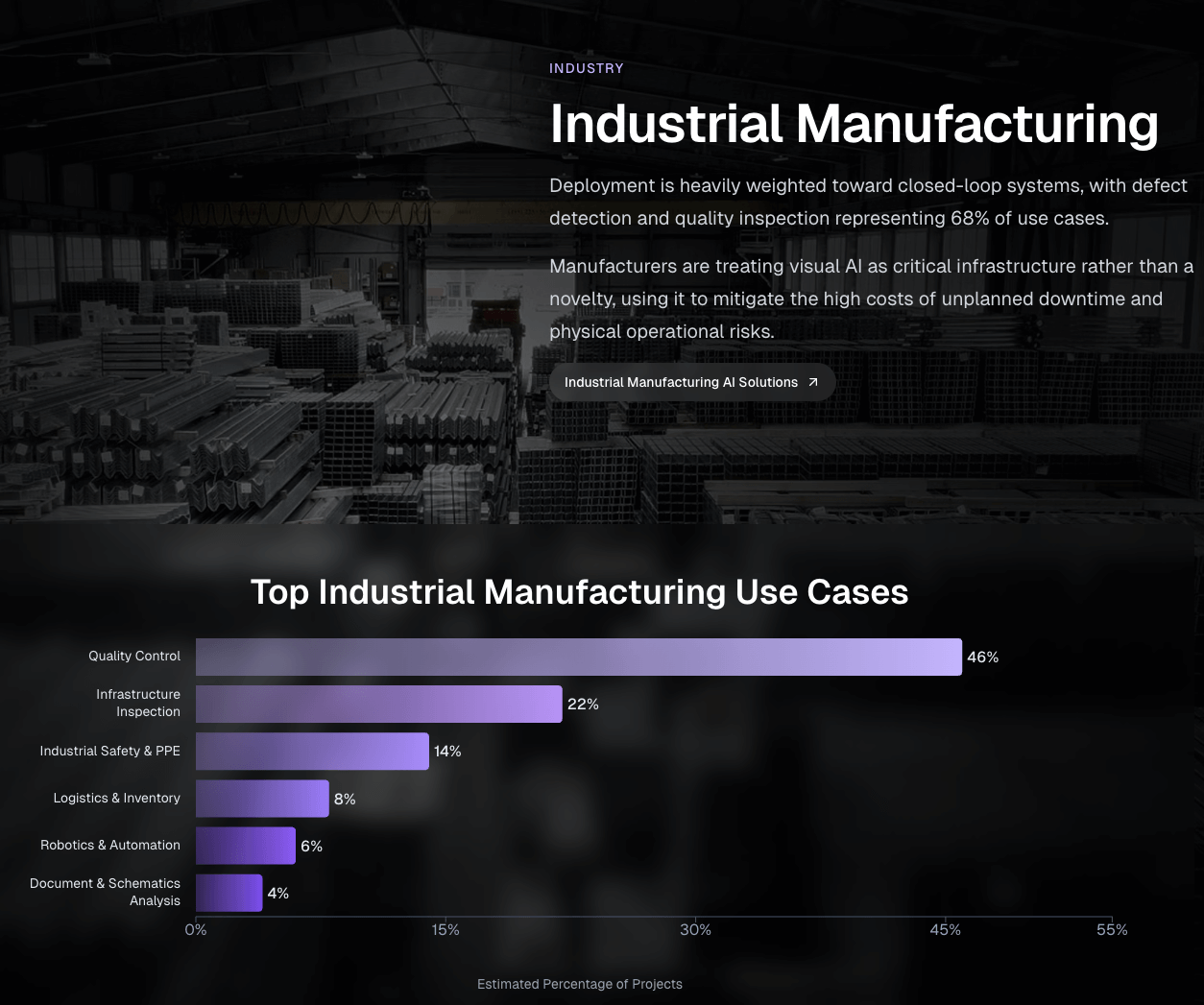
- 68% of manufacturing projects now focused on closed-loop defect reduction.
- 66% of healthcare projects are imaging and diagnostics related for AI-assisted clinical decision support.
- 32% of energy projects are inspecting critical infrastructure for predictive maintenance to prevent outages.
The report highlights the most widely adopted use cases in each industry to provide a roadmap for turning your organization’s unique visual data into a proprietary advantage.
How Enterprises Are Deploying Vision AI
Value Lies in Unique Data, Not Foundation Models
The most successful enterprises are not relying on general AI models. They are leveraging unique, proprietary data that foundation models haven't seen to create agents with precise skills.
By using first-party data to train custom models, enterprises are developing purpose-built models that run on the edge, create agents with the precise skills that general models lack, and move AI systems from observation to high-stakes decision-making.
Deployment Velocity is the New Competitive Advantage
The competitive edge belongs to organizations that deploy visual agents to automate low-complexity, high-value use cases that aren’t suitable for humans due to speed, subjectivity, or feasibility. Whether it is grid and tower inspection in the energy sector or inventory tracking in logistics, the winners are those using vision AI infrastructure to turn visual data into automated business decisions at scale.
The unique insight from production environments is that perfect accuracy is not required for ROI. In industrial settings, a model with only 50% accuracy can still save millions by identifying defects that previously went unnoticed.
Conclusion
Visual data is becoming as programmable as text, and the physical world is becoming readable, queryable, and actionable at scale. Vision AI is now critical infrastructure and the most successful enterprises are deploying visual agents to automate specific workflows
Access the full report to see the top vision AI use cases across 10 global industries.
Cite this Post
Use the following entry to cite this post in your research:
Trevor Lynn. (Feb 12, 2026). Vision AI Trends 2026: Top Use Cases Across 10 Global Industries. Roboflow Blog: https://blog.roboflow.com/vision-ai-trends-2026/