

Electronic batch record (EBR) systems solved the paper problem in manufacturing, but they didn't solve the data problem. Operators still read gauges, scales, and displays by eye and type the numbers into a screen, which means the same transcription errors and data integrity gaps that plagued paper records are still showing up in digital ones. Vision AI closes that gap by reading instruments and labels directly and feeding verified values straight into the EBR.
When manufacturers moved from paper batch records to electronic batch records, the pitch was simple: get rid of the three-ring binders, the handwriting nobody can read, the missing signatures, and the risk of a page going missing between the production floor and the quality department.
Electronic systems delivered on most of that. Records are searchable and signatures are timestamped, and review by QA doesn't require someone flipping through a stack of paper looking for a missed initial.
An EBR is only as accurate as the data going into it, though. In a lot of plants, that data still starts with a person looking at an analog gauge, a digital scale readout, or a printed label, and then typing what they see into a tablet or terminal. The record is electronic, but the data entry is still manual.
This matters because transcription errors are routine in manufacturing. An operator misreads a decimal point on a fill weight. A batch number gets keyed in with a transposed digit. A temperature reading gets copied from the wrong instrument because two gauges sit next to each other on a panel. None of this is negligence. It is what happens when humans read numbers under time pressure, sometimes under poor lighting, shift after shift. The FDA has cited data integrity failures in warning letters for years, and the ones that trace back to manual transcription steps happened inside plants that already had electronic records.
What Is an Electronic Batch Record?
An electronic batch record (EBR) is the digital record of how a batch of product was made: the materials used, the process parameters recorded, the checks performed, and who signed off at each step. It replaces the paper batch record regulated manufacturers have kept for decades, and it serves as the primary evidence that a batch was produced according to its approved process.
EBR and eBMR (electronic batch manufacturing record) refer to the same record, and BMR is the paper-era term both descend from. An MES (manufacturing execution system) is the broader software that runs production; the EBR typically lives inside it or connects to it. In GMP environments, the record also has to meet the FDA's requirements for electronic records and signatures under 21 CFR Part 11, which is where data integrity findings get cited when the numbers in the record can't be trusted.
Where the Errors Actually Happen in EBR for Manufacturing
It helps to think about a batch record less as a document and more as a sequence of checkpoints. At each checkpoint, someone confirms that something is true and logs it. A weight is correct, for instance. Or a temperature is within range. Or the right component is installed. Or the line is clear before the next batch starts.
Most of these checkpoints depend on a visual read of some kind of instrument or physical setup, whether a pressure gauge, a digital scale display, a printed lot number on a label, or a dial that shows fill level. The EBR system captures the result of that visual read, but it has no way to verify that the read itself was accurate. If the operator sees 42.5 and types 45.2, the EBR faithfully records a wrong number with full confidence.
This is exactly the kind of problem that computer vision is good at solving, because it's not really an AI problem. It's a perception problem. A camera pointed at a gauge, trained to recognize the needle position or the digital readout, extracts that value with a level of consistency that a tired operator on the night shift can't match. And it does it every time, without variation.
What Vision AI Actually Does in This Workflow
A vision model doesn't replace the EBR system, of course. Instead, it sits upstream of it, acting as the eyes that feed accurate data into the record instead of relying on someone to key it in. In practice, this tends to show up in a few recurring forms on the plant floor.
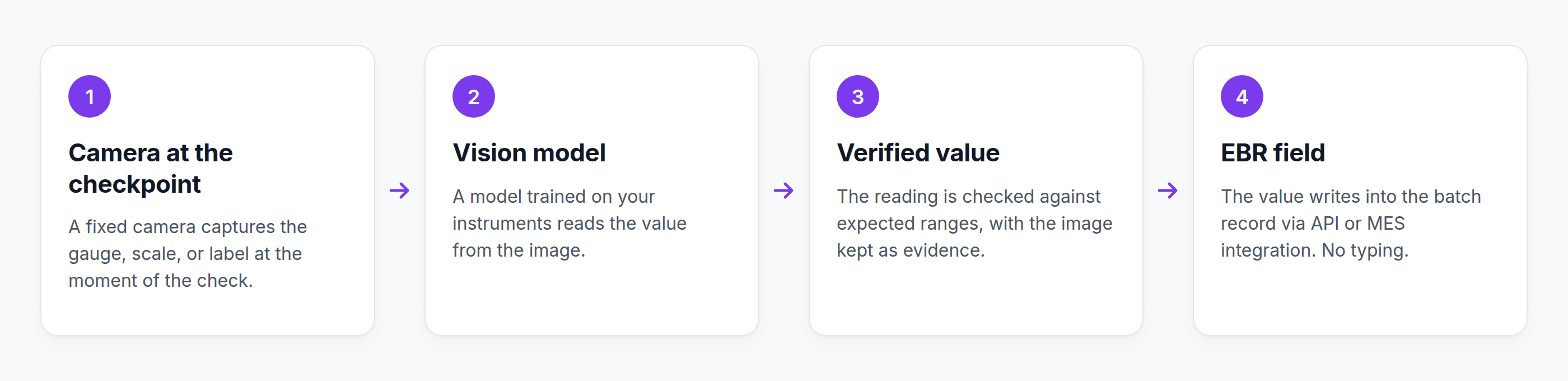
Reading analog and digital instruments is the most direct application. A trained object detection or classification model looks at a gauge face, a digital scale, or a display panel and extracts the value shown, then passes it directly into the EBR through an API call or MES integration (Siemens Opcenter, MasterControl, Tulip, AmpleLogic).
Verifying labels and lot numbers is another common application. Optical character recognition trained specifically for the fonts and formats used on a given production line confirms that a printed label matches the expected lot number or batch code before that container moves to the next step, catching a mislabeled unit before it becomes a bigger problem during a recall investigation.
Confirming physical setup rounds out the main use cases. Before a batch starts, someone typically has to confirm the line is clear and the correct tooling is installed. A camera comparing a live feed against a reference image of the properly configured line performs that check automatically and logs a pass or fail directly into the record, rather than relying on a paper checklist and a signature.
In each case, the underlying idea is the same. The camera does the reading, the model interprets what it sees, and the result goes into the batch record as a verified value instead of a self-reported one.
Why This Matters More Than It Might Seem
Typically, no single misread number is a disaster on its own. Most of the time, an operator catches a mistake, or a supervisor spots it in review, and the batch moves forward with a correction. The real cost shows up somewhere else.
It shows up in the hours that QA spends investigating discrepancies that turn out to be transcription errors rather than actual process deviations. It shows up in audit findings that cite inconsistent data-entry practices, even when the underlying process was fine. And it shows up in the slow erosion of trust in the batch record itself. Once a quality team has been burned a few times by bad manual entries, they start double-checking everything, which defeats a lot of the efficiency that the electronic system was supposed to deliver in the first place.
Vision-verified readings make review by exception trustworthy, because the values were verified at capture. Instead of trying to catch errors after they've already happened, it removes the opportunity for the error to occur. A gauge reading either matches what the camera sees or it doesn't. There's no decimal point to misplace because a person never re-types the number.
How to Implement Vision AI with an Electronic Batch Record for Manufacturing
Getting from concept to a working system on the floor involves a handful of concrete steps, and it doesn't require ripping out existing infrastructure.
- Identify the checkpoints worth automating first. Not every reading in a batch record needs a camera on it. Start with the ones that have the highest error rate or the highest consequence, like critical process parameters or label verification steps tied to product identity.
- Train a model on the actual instruments in use. A gauge-reading model needs to see the gauge faces, lighting conditions, and camera angles it will encounter in production, not generic stock images of dials.
- Decide where the inference runs. Some plants run models on edge devices right at the instrument. Others route camera feeds to a central server. This depends on network infrastructure and how fast the result needs to feed back into the process.
- Integrate the output into the EBR or MES. The model's output needs a clean path into the existing batch record system, usually through an API call that writes the verified value directly into the appropriate field.
- Validate the system before relying on it. Just like any instrument used in a GMP environment, a vision system needs a validation protocol confirming its accuracy against known reference values before it becomes the system of record.
None of this requires an overnight overhaul. Most plants start with one or two checkpoints, prove out the accuracy gains, and expand from there once quality and operations both trust the results.
What kind of camera setup does a manufacturing floor need for this?
Requirements vary by use case, but most implementations use industrial cameras positioned at fixed checkpoints, either connected to an edge device for local processing or routed to a central server, depending on the plant's network setup.
Can this be applied to older equipment that doesn't have digital outputs?
Yes, and this is actually one of the strongest use cases. A vision model can read an analog gauge or dial the same way a person does, which means older instruments don't need to be replaced with digital versions just to get accurate data into an electronic batch record.
Closing the Loop on Batch Record Accuracy
An electronic batch record system was always meant to make manufacturing data more trustworthy, not just more searchable. Getting there means looking at the step most EBR rollouts skipped: how the numbers get into the system in the first place. When a camera reads the gauge instead of a person typing what they think they saw, the record stops being a best guess and starts being a verified fact.
This shift doesn't require tearing out your existing EBR or MES. It means adding a layer of verified perception in front of it, starting with the checkpoints where errors cost the most and expanding from there once the results earn trust on the floor.
If your plant is still relying on manual reads for critical process data, it's worth finding out what a vision-verified checkpoint would look like on your line. Explore Roboflow's quality control solutions to see how manufacturers are already closing this gap and turning their batch records into something they can fully stand behind.


Cite this Post
Use the following entry to cite this post in your research:
Erik Kokalj. (Jun 4, 2026). Electronic Batch Records: Verify Data Entry with Vision A. Roboflow Blog: https://blog.roboflow.com/electronic-batch-record-for-manufacturing/