

A vision AI program scales on three roles: a Builder who takes a use case from zero to a hardened, deployable catalog entry, a Scaler who ports that entry across sites and works themselves out of each deployment, and an Operator who keeps the system trusted in production for years. Staff all three (internally, by a vendor, or hybrid), measure them against speed to implement, first-attempt acceptance, and the share of plants with a certified internal practitioner, and shift the work inward as you mature so cost per deployment falls instead of staying flat.
Most enterprises plan their vision AI program around the technology and discover, a year in, that the missing piece was never the model. It was the team. A pilot ships, a second one ships, and then the program stops compounding because nobody owns the work of turning a one-off win into something the rest of the network can reuse.
Roboflow's Vision AI Center of Excellence Blueprint gives that team a shape. A mature vision AI program runs on three universal roles, the Builder, the Scaler, and the Operator. They are not job titles you hire verbatim; they are the three jobs that have to get done, in order, for a program to move from first pilot to owned capability. They can be staffed internally, by a vendor, or as a hybrid, but all three have to exist.
Here is what each role owns, how they map to real roles, and how to staff them as the program matures.
How to Staf a Vision AI Team
A vision AI solution has a lifecycle: it gets built, it gets scaled across sites, and then it has to keep running and stay trusted for years. Those are three different jobs with three different success metrics, and the skills that make someone great at one are not the skills that make them great at another. The person who loves taking a messy new use case from zero to a working model is rarely the same person who wants to keep forty deployments stable through their third winter.
Collapsing all three into one vision team or one heroic engineer is why programs stall. The build never standardizes, the scale never happens, or the deployed system quietly loses the floor's trust. Naming the three roles separately is what lets each one be measured and staffed for what it actually does.
The Builder
The Builder takes a use case from zero to one. They pair with innovation and engineering leaders and turn a candidate problem into a hardened catalog entry that has cleared rigor testing, not just a model that worked in a notebook.
The Builder's posture is change-forward. They are the ones who see where the platform falls short, signal product gaps and emerging use cases back to the team, and push the edges of what is possible. Their deliverable is a solution that is genuinely deployable: trained on the right data, validated under real conditions, and packaged so someone else can run it.
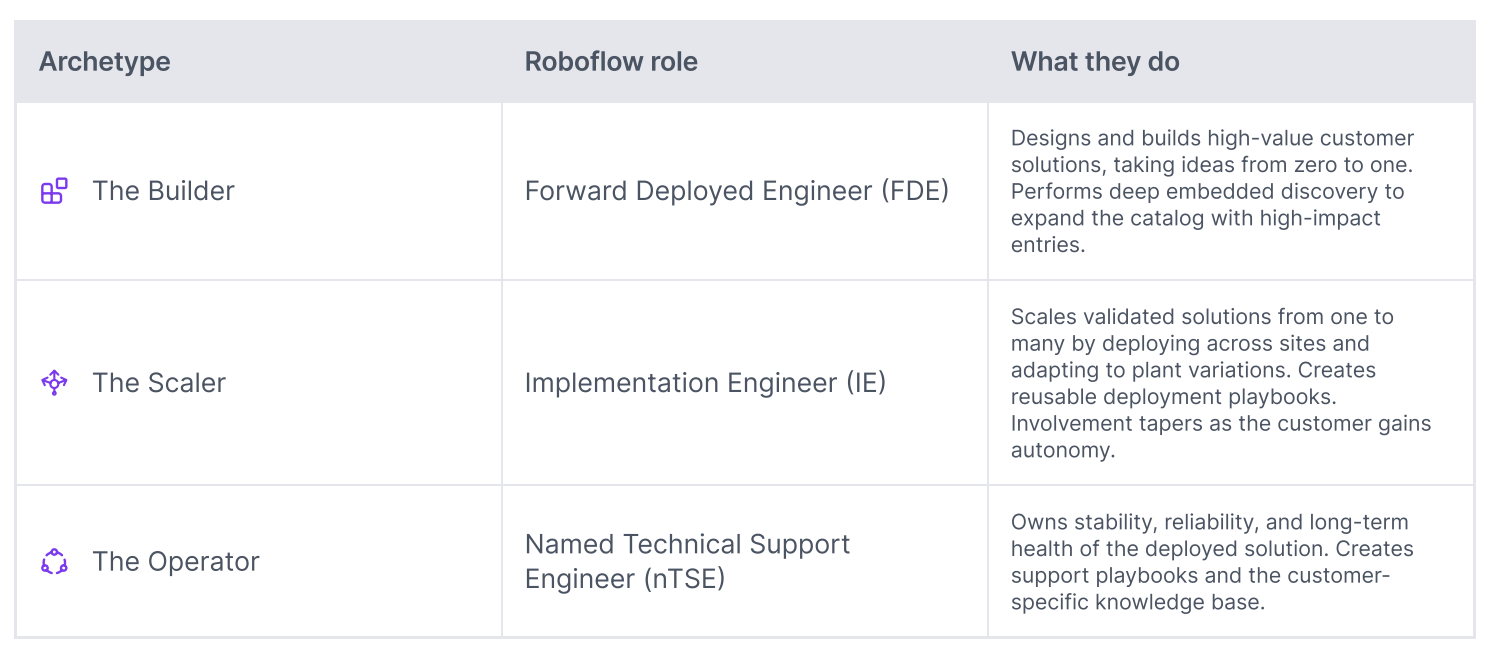
At Roboflow, this role is the Forward Deployed Engineer, who does deep embedded discovery with the customer and designs the first high-value catalog entries.
The Scaler
The Scaler takes a catalog entry from one to many. They pair with site engineers, plant managers, and operations teams, deploy proven entries across plants with site-specific adaptation, and build the deployment playbooks that make the next rollout faster than the last.
The Scaler's success metric is the tell that this role is different from the Builder: it is how quickly they can hand a catalog entry off to the plant's own team. A Scaler who becomes a permanent dependency has failed at the job. A Scaler who works themselves out of each deployment is bending the cost-per-deployment curve downward, which is the entire economic point of the program.
At Roboflow, this role is the Implementation Engineer, who scales validated solutions across sites and whose involvement tapers as the customer gains autonomy.
The Operator
The Operator keeps the deployed system trusted. They pair with site owners, ML engineers, and operations leadership, and they own stability, observability, runbooks, and the long-term health of the catalog in production.
The Operator's posture is stability-first. They are the reason a vision AI program is still trusted by the floor in year three, after the launch excitement has worn off and the system just has to work every shift. This is the least glamorous of the three roles and the one programs most often forget to staff, which is exactly why so many deployments that launched well are quietly distrusted a year later.
At Roboflow, this role is the Named Technical Support Engineer, who owns reliability and builds the customer-specific knowledge base.
How to Measure the Team: the Success Triangle
Three roles need three outcomes to be measured against. The blueprint calls this the Success Triangle, and each point maps to a role.
Speed to implement is the median time from intake to live inference. It should compress from a quarter or longer in early year one to weeks by mid year two. This is largely the Builder and Scaler working well together.
Successful implementation is the percentage of catalog deployments that meet acceptance criteria on the first attempt. This is the metric that tells you whether the catalog is real, and it is the Scaler's signal that entries are genuinely portable.
Workforce upskilling is the percentage of plants with at least one certified internal practitioner. This is the metric that tells you whether the autonomy curve is bending, and it is the clearest sign the program is becoming an owned capability rather than a permanent vendor engagement.
How Staffing Shifts as You Mature
The three roles are constant. Who fills them is not. Most Centers of Excellence in their first year are 70 to 80 percent vendor-staffed, with the vendor's Builders designing the first catalog entries while internal staff observe, learn, and contribute. By year two, that ratio inverts. The catalog grows primarily from internal contributions, the vendor's role shifts from building to consulting, and internal teams take over scaling and operation.
This is the autonomy curve in headcount terms. If your vendor's footprint inside your program grows year over year instead of shrinking, you do not have a Center of Excellence forming, you have a long-term services contract. A healthy program moves ownership inward on purpose.
If you already staff a Builder inside a broader AI team, the question is not whether to add headcount. It is whether your existing Builders have vision-specific muscle: dataset curation, edge inference selection, environmental rigor testing, and HMI design. Two quick tests from the blueprint: ask them to defend a model architecture choice for a Jetson Orin Nano, and to walk through validating a model under three different lighting conditions.
Where to Start
You do not need to hire three people on day one. You need to name the three roles, decide who owns each (internal, vendor, or hybrid), and assign them against your first catalog entry. The Builder hardens it, the Scaler proves it ports to a second site, and the Operator keeps it healthy once it is live. That single end-to-end loop, run by named owners, is what turns a pilot into the start of a real capability.
The full operating model, including the five-level maturity model, the Standard Solution Catalog the roles run, the autonomy curve, and a 10-question diagnostic to find where your program sits today, is in the Roboflow's Vision AI Center of Excellence Blueprint.
Further reading


Cite this Post
Use the following entry to cite this post in your research:
Contributing Writer. (Jun 4, 2026). Who Runs a Vision AI Program: The Builder, Scaler, Operator Model. Roboflow Blog: https://blog.roboflow.com/how-to-staff-a-vision-ai-team/