

The Vision AI Maturity Model is a five-level framework for getting past stuck pilots and turning vision AI into a repeatable capability.
This is Chapter 4 of Roboflow's Vision AI Center of Excellence Blueprint.
Most industrial enterprises spend up to three years stuck in vision AI pilots. According to Roboflow's Vision AI Center of Excellence Blueprint, it’s common for a model that hits 96% accuracy in testing to drop to just 71% in production: a steep decline that causes many teams to abandon their projects entirely.
Yet, walking away leaves massive ROI on the table. Even a 50% accurate defect detector can generate $2.5 million in cost avoidance across 100,000 defects. Ultimately, a model is only as valuable as its ability to survive the factory floor. The true challenge isn't building a perfect algorithm; it's building a robust production framework that successfully translates strong lab results into reliable, real-world performance.
The Vision AI Maturity Model
The Vision AI Maturity Model defines five stages that help enterprises move from isolated pilots to a scalable, production-ready capability. Each stage removes a barrier that prevents projects from scaling. By Level 4, organizations deploy proven solutions from a reusable catalog in weeks rather than months. By Level 5, new sites are operational in days rather than quarters.
This article covers all five levels, examines where most initiatives stall, and shows how the economics change once vision AI becomes a repeatable capability rather than a series of disconnected pilots. For the full report, download your free copy of the Vision AI Center of Excellence Blueprint here.
Why Vision AI Pilots Fail to Scale
Vision AI projects often succeed technically, but fail operationally, never making the transition from pilot to scalable deployment.
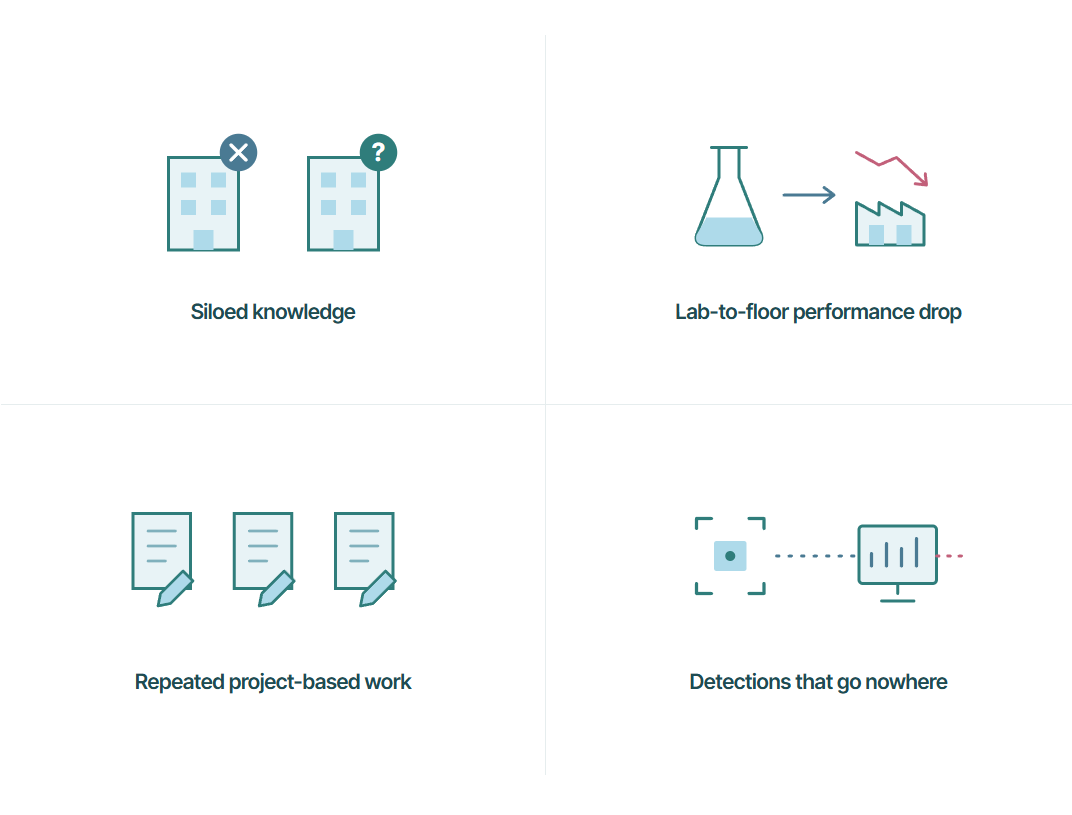
Every Plant Starts From Scratch
When a defect appears at one facility, the team builds a solution around that specific problem. Meanwhile, another facility facing a nearly identical issue often starts over from the beginning, unaware that a solution already exists elsewhere in the organization. Knowledge remains siloed, solutions are not reused, and value does not compound across the network.
Success in the Lab Does Not Guarantee Success on the Floor
Factory environments introduce constant variability through vibration, changing lighting conditions, dust, and network disruptions. These are everyday operating conditions. As a result, models that perform well in testing often behave differently once deployed on the production floor. When this gap is not addressed early, performance declines and confidence in the system drops quickly.
Deployments Remain Project-Based
Many organizations approach every new use case as a separate project. New contracts are signed, new work begins, and the same effort is repeated. As a result, internal expertise never matures, deployment costs remain high, and the organization becomes dependent on external vendors for every expansion. Years later, the program still operates as a collection of isolated projects rather than a scalable capability.
Operators Never See the Business Impact
In many deployments, results only appear on dashboards. The system detects issues, but nothing happens automatically. Alerts are not linked to actions like triggering a workflow, changing a routing decision, or stopping a defective product before it moves forward. Without that link between detection and action, vision AI remains a monitoring tool instead of something that directly affects operations.
What the Maturity Model Is and Why It Exists
The Vision AI Maturity Model exists because the failure patterns discussed earlier are not isolated incidents. They appear repeatedly across industries, plants, and use cases. The model provides a structured framework for addressing them.
It defines five levels that help industrial enterprises move from isolated pilots to a scalable, repeatable capability. The framework is built around three core principles:
- It is use-case agnostic and applies to defect detection, safety monitoring, inventory tracking, and other vision AI applications.
- It focuses on organizational capability, not just model performance.
- It helps enterprises identify barriers to scale and systematically remove them.
The framework works as a guide rather than a fixed roadmap. Enterprises often operate at different maturity levels at the same time. One use case may still be in testing on the production floor, while another is already running across multiple sites. The model helps teams understand where each effort stands and what is needed next.
Across the levels, the technology stays the same. What changes is how well the organization can deploy, support, and scale it. By Level 5, the main advantage comes from the system that allows models to be reused across sites with little effort.
That system is the Vision Center of Excellence.
The 5 Levels of the Vision AI Maturity Model
The Vision AI Maturity Model defines five levels, each one removing a barrier that prevents vision AI from scaling across the enterprise.
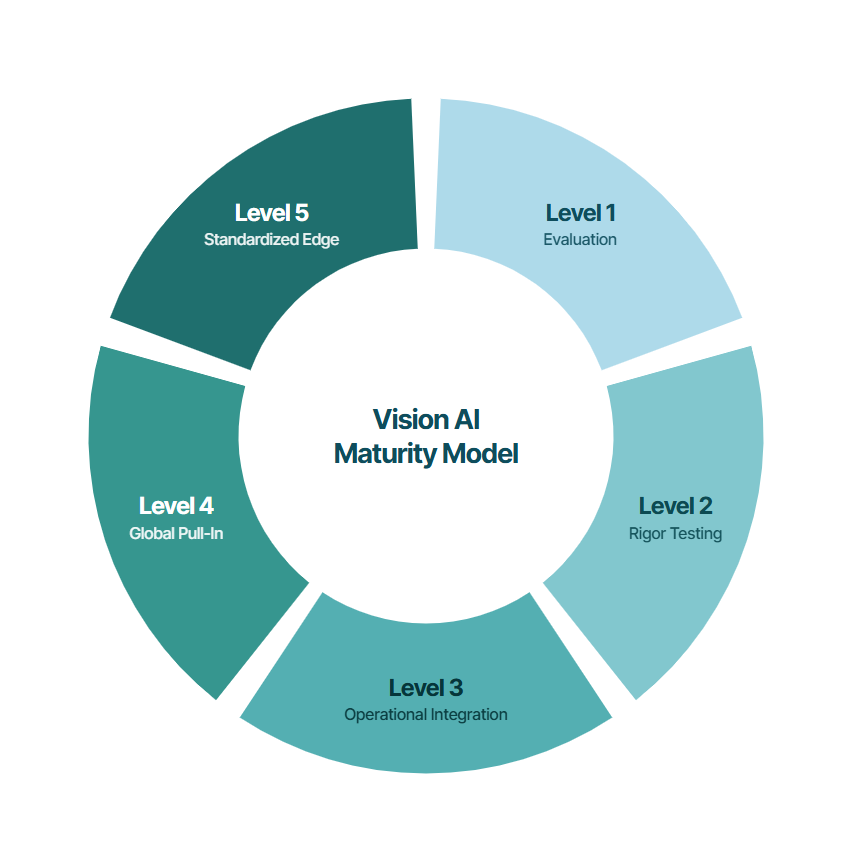
Level 1: Evaluation
The first step is proving that vision AI is a good fit for the problem. Organizations typically do this through three to five proofs-of-concept, each tied to a documented business case. At this stage, the goal is to:
- Validate the business value of the use case.
- Assess the technical feasibility of the solution.
- Identify potential deployment challenges early.
- Build evidence to support further investment.
A successful POC demonstrates that the concept works under controlled conditions. Production deployment requires the system to operate reliably in real-world environments, where conditions, data, and operational requirements are far less predictable.
Level 2: Rigor Testing
This is where most programs succeed or fail. The model moves from the lab into real production conditions, including vibration, lighting changes, dust, network issues, and operator behavior. Research shows that performance in the lab can drop significantly once the system is deployed on the floor.
Skipping this stage often leads to problems later, when the system is already in use and confidence from operations has already dropped. At that point, restoring trust becomes harder than improving the model.
Level 3: Operational Integration
This level is about building the Inspection Blueprint, a repeatable architecture that defines what a deployable catalog entry looks like. Every entry includes a trained model, an inference pipeline, an HMI pattern, an integration template, a deployment runbook, and acceptance criteria that the receiving site can test against.
The trap is that every site is building bespoke integrations because the blueprint was never standardized early enough.
Level 4: Global Pull-In
Plants stop requesting custom builds and start using a standard solution catalog. Time to value drops from months to weeks. USG reached this across 50 manufacturing sites, with edge inference that continues working during internet outages and a single dashboard connecting all sites.
The risk at this stage is catalog drift, where local versions start to multiply without control, and the catalog slowly stops being a single, reliable source.
Level 5: Standardized Edge
Consistent performance across all regions, including sites with limited connectivity. New locations are set up in days. The same operating model works regardless of location, infrastructure, or network conditions.
At this level, the Vision Center of Excellence is fully in place. Internal teams manage the catalog and handle deployments without relying on vendors. Success here is measured not just by deployment speed but by how much internal capability has grown. Engineers who can build, validate, and deploy independently are the clearest sign the program has matured.
Progress does not stop here. The catalog must keep growing as new use cases are tested and added.
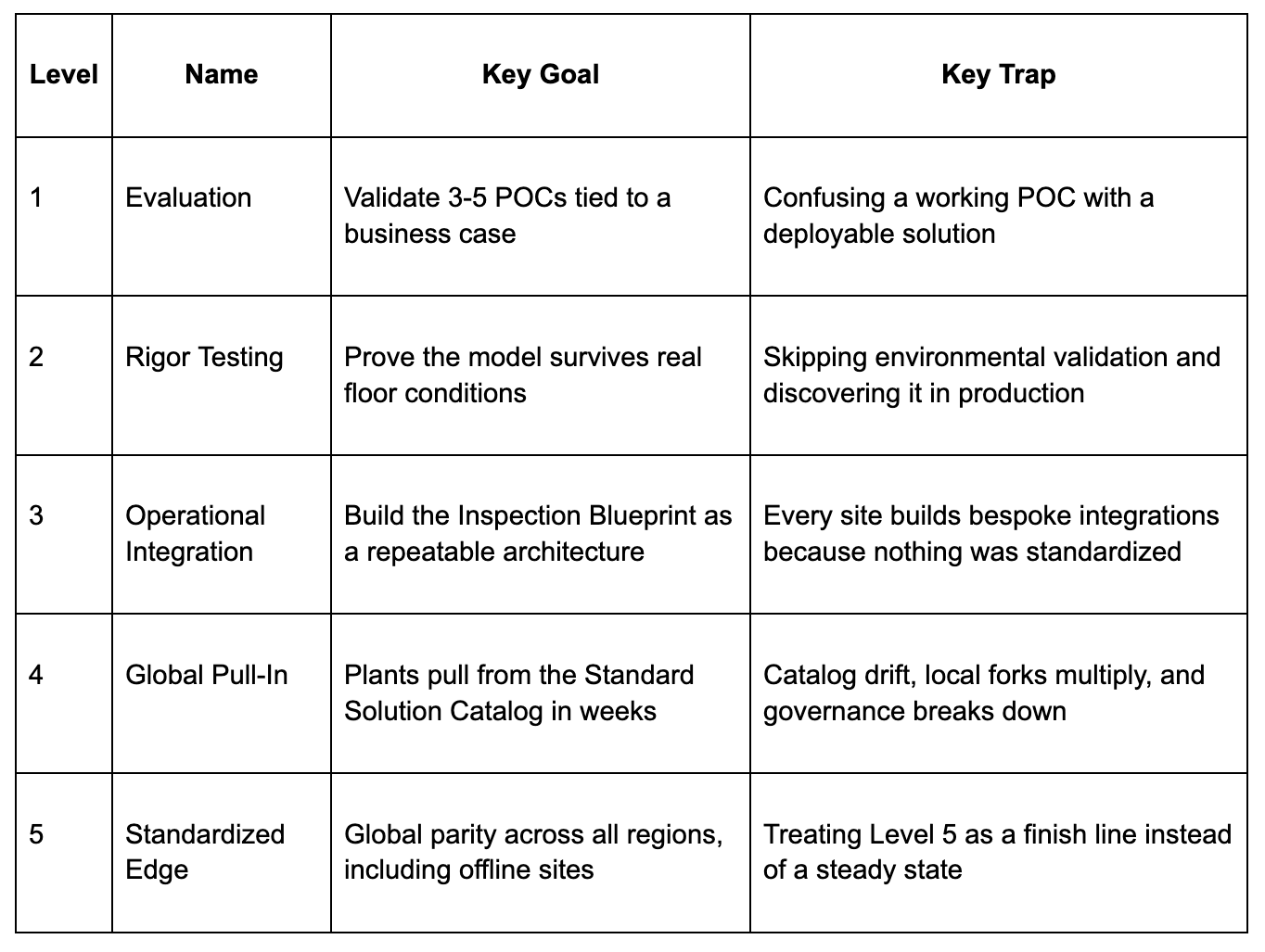
The five levels build on each other. As you progress, each new deployment becomes cheaper and faster to deliver.
The Autonomy Curve
As an enterprise moves through the five levels, two things happen in parallel.
Internal capability builds. Every level adds a new layer of organizational muscle: validated use cases, hardened models, standardized blueprints, a governed catalog, and a team that knows how to operate it. The organization stops depending on external vendors to initiate every deployment and starts owning the system itself.
At the same time, the cost of each deployment falls. When a plant pulls a proven solution from the catalog instead of building from scratch, the effort required drops significantly. The same pattern repeats across every new site, every new use case, and every new region. The system compounds.
This is the autonomy curve. Vendor effort and cost-per-deployment trend downward as internal ownership trends upward. The two curves cross somewhere in year two. That is where the Vision Center of Excellence pays for itself.
Organizations that reach Level 4 and Level 5 build systems that can be reused without starting over each time. New sites can be added without going through long setup cycles. New use cases are added to an existing library instead of requiring a new system design.
The Vision AI Maturity Model Conclusion
Most vision AI programs never scale because the system to support them was never built. Each new deployment starts from scratch. Costs stay high. The organization never develops the capacity to run this independently.
The maturity model changes that. Each level removes one more reason to restart. By Level 5, new sites pull from a catalog and go live in days.
The first step is knowing where your program sits today. Roboflow's Vision AI Center of Excellence Blueprint includes a 10-question diagnostic to help you find out.
Further Reading
- Chapter 2: Why Top-Down Vision AI Rollouts Fail
- Chapter 3: What Goes in a Vision AI Solution Catalog Entry & Renting Vs. Owning
- Chapter 5: How to Staff a Vision AI Team
- Chapter 7: 10 Question Pilot Purgatory Diagnostic


Cite this Post
Use the following entry to cite this post in your research:
Mostafa Ibrahim. (Jun 24, 2026). The Vision AI Maturity Model: A Framework for Taking Pilots to Production Scale. Roboflow Blog: https://blog.roboflow.com/the-vision-ai-maturity-model/