

Artificial intelligence is software that learns from data to perform tasks that normally require human intelligence, from answering questions to spotting defects on a production line. In 2026 it splits into two broad types: systems that generate and reason with information, like language models, and systems that perceive and act on the physical world, like computer vision and robotics.
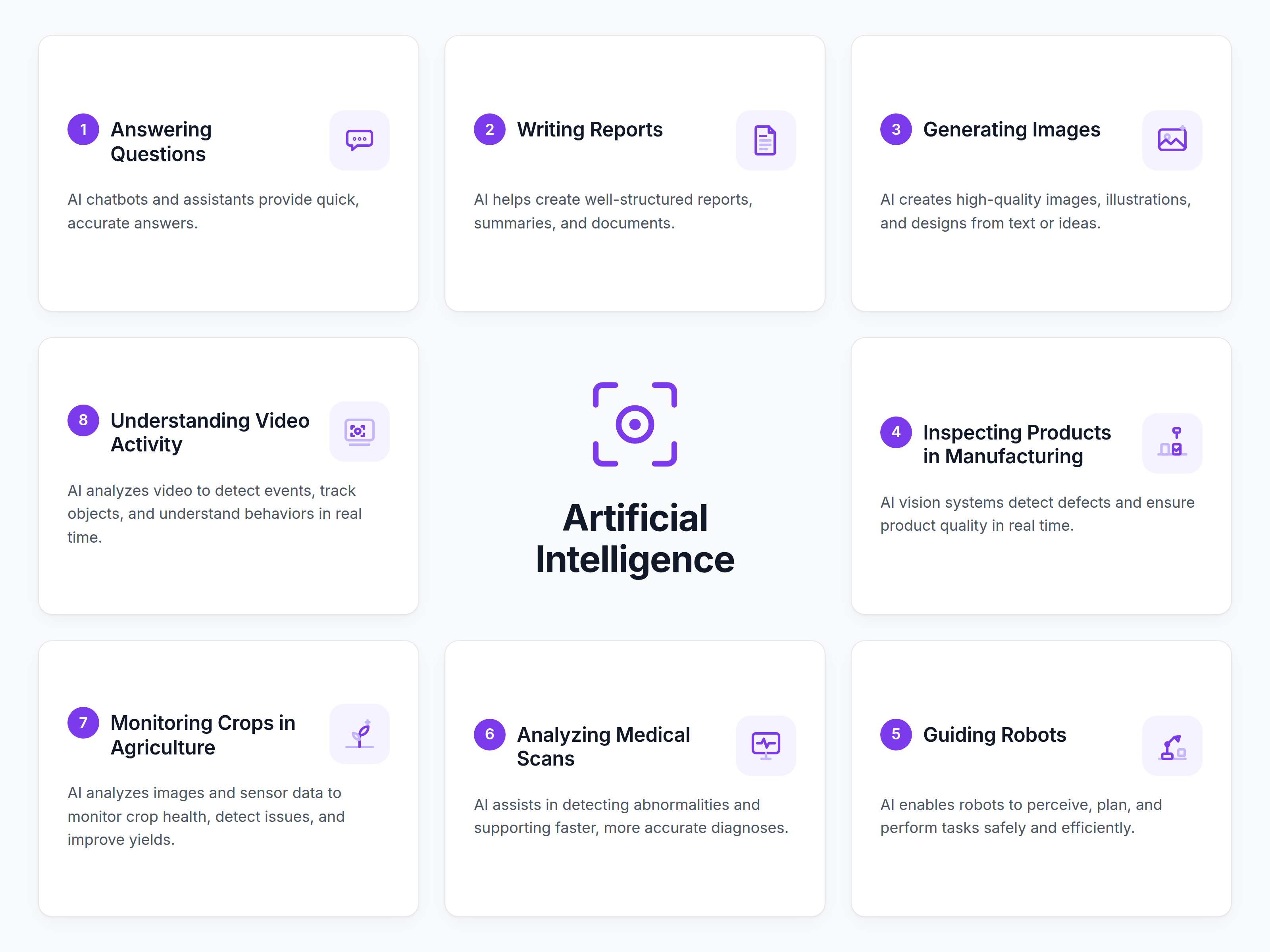
Maybe you've used ChatGPT to research a paper for school, relied on Claude to build a website for your business, or used Apple Intelligence to turn a photo from your brother's baseball game into an emoji. Artificial intelligence now answers questions, generates images, inspects missing parts on tires, calls offsides in football, guides robots through surgery, and that's not even the full list.
A useful way to understand AI in 2026 is to split it into two broad types of systems: systems that generate information and reason with it, such as language models, and systems that understand the physical world, like computer vision and robotics.
The two areas overlap. Many modern models are multimodal and work with both text and images, and many real-world applications combine language models, vision models, business rules, databases, and human review.
What Is Artificial Intelligence?
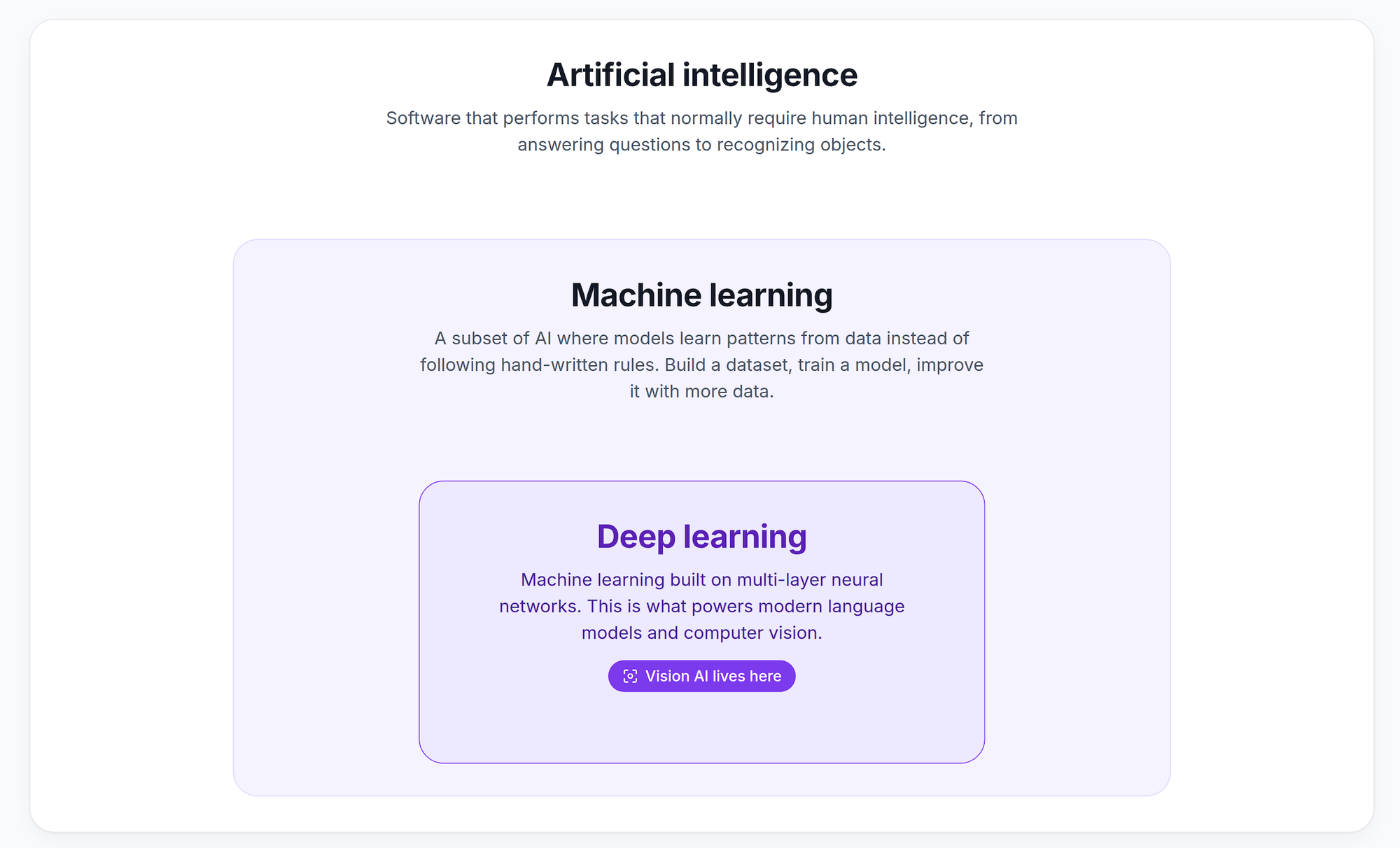
Artificial intelligence is the broad goal of building software that can perform tasks associated with human intelligence. Machine learning is the main way we reach that goal today: instead of writing every rule by hand, we train models on examples.
The difference from traditional software comes down to who writes the rules. A programmer can write, "reject the order if the payment fails" in one line, because every failed payment looks the same. Nobody can write "reject the drywall if it has a defect" that way. Defects chip, crack, stain, and dent in more ways than any rule list can cover, and the same is true of crop diseases, handwritten characters, customer requests, and road conditions. So developers stop writing rules and start collecting examples, and the model learns the patterns: this is what a defect looks like, this is healthy leaf tissue, this is a stop sign in the rain.
Learning patterns is not thinking. Most AI systems are specialized statistical models trained for particular tasks. A model can recognize objects, generate language, or predict equipment failures at a level no human matches, without possessing understanding, judgment, or consciousness.
Narrow AI, general AI, and AGI
Every AI system in production today is narrow AI: it does the specific tasks it was built and trained for. A defect detector cannot write code. A language model cannot count boxes on a conveyor. Even frontier language models, trained on much of the internet, are narrow in this sense: extremely capable within the tasks their training supports, unreliable outside them.
Artificial general intelligence, or AGI, is the hypothetical opposite: a system that matches or exceeds human ability across most cognitive tasks, including ones it was never trained for. AGI does not exist. When it might, and whether current approaches lead there at all, is an open debate among researchers, not a settled roadmap.
For anyone evaluating AI products, narrowness is not a weakness. It is why production systems work. A model that does one inspection task reliably, every shift, on every camera, is worth more on a factory line than a general system that does many things unpredictably.
A Brief History of Artificial Intelligence
The history of AI began long before modern computers. Early inventions such as Blaise Pascal’s mechanical calculator and the programmable-machine ideas of Charles Babbage and Ada Lovelace introduced the idea that machines could perform complex operations.
Modern AI research began in the twentieth century. In 1943, Warren McCulloch and Walter Pitts proposed an early mathematical model of artificial neurons. In 1950, Alan Turing proposed the imitation game, now widely known as the Turing test, as a way to frame the question of whether a machine could display intelligent behavior. The term artificial intelligence appeared in the 1955 Dartmouth proposal, followed by the 1956 Dartmouth Summer Research Project, which helped establish AI as a formal research field.
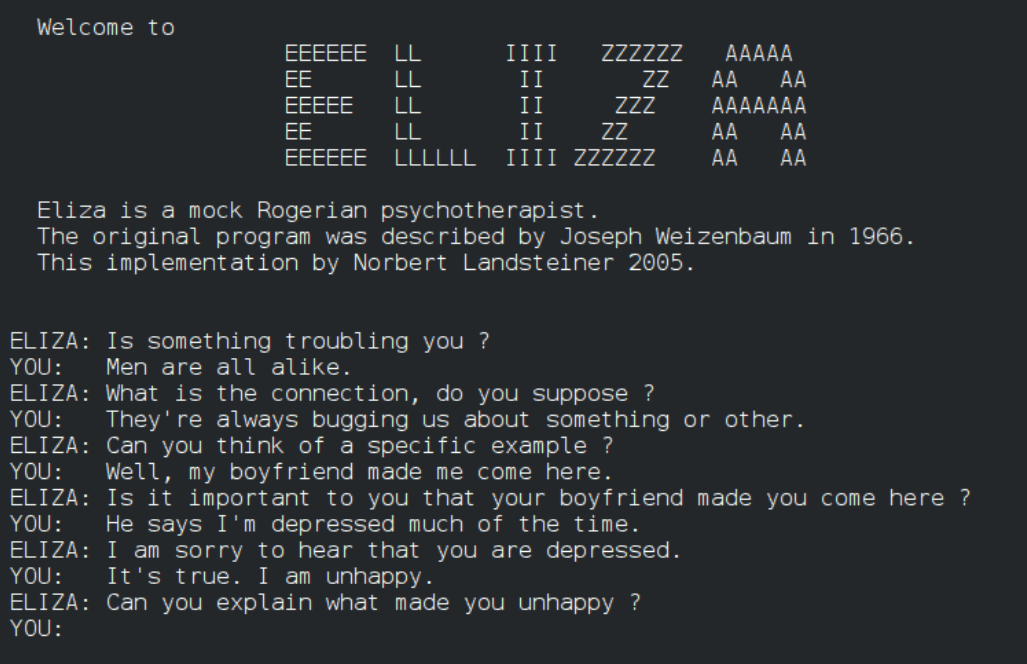
Early AI systems mainly used symbolic reasoning, search algorithms, and manually written rules. ELIZA demonstrated an early form of natural-language conversation in the 1960s, while expert systems became widely used during the 1980s.
Later milestones includ IBM Deep Blue defeating chess champion Garry Kasparov in 1997 and IBM Watson winning Jeopardy! in 2011. Growing volumes of digital data, faster hardware, and renewed work on neural networks contributed to a shift toward machine learning and deep learning. The backpropagation work published in 1986 had made training multilayer networks practical, and AlexNet's result on the 2012 ImageNet challenge is widely credited with accelerating the adoption of deep neural networks in computer vision. GANs were introduced in 2014, AlphaGo defeated Lee Sedol in 2016, and the Transformer architecture was published in 2017. Transformers have since become the basis for many language and multimodal models.
Generative AI reached broad public use following the release of ChatGPT in late 2022. Since then, AI systems have been applied to images, audio, video, robotics, and other multimodal tasks. As of 2026, AI development increasingly focuses on AI agents, smaller and more efficient models, and deployment across cloud, edge, and physical-world systems.
The Main Branches of Artificial Intelligence
Artificial intelligence is an umbrella term. The branches below overlap heavily, and a single production system often uses several of them at once.
Machine learning
Machine learning is the branch of AI where models learn from historical examples: past fraudulent transactions, past equipment failures, past purchases. Given enough of them, a model can classify what it sees, predict a value, flag unusual behavior, or recommend an action. That single capability shows up all over a business as fraud detection, demand forecasting, recommendations, predictive maintenance, and risk analysis. The models themselves range from decision trees and regression, which train in seconds on a laptop, to neural networks with billions of parameters.
Deep learning
Deep learning is machine learning built on neural networks with many layers, each building on the one before it. The first layers respond to edges, colors, and textures. Middle layers combine those into shapes and parts. The final layers recognize whole concepts: a cracked weld, a diseased leaf, a face. Nobody programs that hierarchy; it emerges from training. This is the architecture behind most modern advances in computer vision, speech recognition, language models, and robotics.
Natural language processing
Natural language processing, or NLP, is how computers work with human language: analyzing it, translating it, classifying it, generating it. It powers search, transcription, document extraction, and every virtual assistant you have ever talked to. Large language models are the most advanced form of NLP, though "language" undersells them now, since many also accept images, audio, and structured data.
Computer vision
Computer vision turns images and video into information software can act on. A vision model can answer what is visible, where each object is, which pixels belong to it, how it is moving, and whether anything has changed. Those answers come as concrete tasks, like object detection, classification, segmentation, keypoint detection, OCR, and tracking. In production they become counting products on a line, reading a gauge, catching a defect, or spotting activity a person would miss.
Robotics
Robotics combines perception, planning, and control so machines can act in the physical world, and perception is where computer vision carries the load: a warehouse arm locating the next part to pick, an autonomous vehicle reading its surroundings. Vision-language-action models, which map camera input directly to motor commands, became one of the most active research areas heading into 2026.
Generative AI
Generative AI covers models that produce new content: text, images, audio, video, code. Large language models and diffusion image generators are the best-known examples, but generative models also work behind the scenes in the other branches, generating synthetic training images for vision datasets and labeling data automatically so smaller models train faster.
How Modern AI Actually Works
Although AI systems can appear very different, most machine learning applications follow the same basic process:

Understanding these stages makes it easier to evaluate almost any AI product.
Data: The examples from which a model learns
AI development starts with data, and the data type depends on the task. For example a language models may use text, speech models may use audio, and vision models may use images and video.
In supervised learning, examples include expected outputs, such as a bounding box around a crack. In unsupervised and self-supervised learning, the model learns useful patterns without a human-created label for every example.
A third approach is reinforcement learning, where a model learns by acting and receiving feedback rather than from labeled examples. The system tries an action, receives a reward or penalty, and adjusts to earn more reward over time.
Data quality is often more important than dataset size. Training data should represent real deployment conditions, including different cameras, viewpoints, lighting, backgrounds, object sizes, product variations, seasons, and edge cases. A model trained on clear, stationary products may fail on a moving production line, while a crop model trained on close-up leaf images may not work on drone imagery.
Datasets are usually divided into training, validation, and test sets. The model learns from the training set, the validation set helps improve it, and the test set measures performance on unseen data.
Training: Adjusting the Model
During training, a model processes examples and makes predictions. A loss function measures the difference between the predictions and expected outputs, while an optimization algorithm adjusts the model’s parameters to reduce this error across many data batches.
For a defect detector, training improves both defect classification and bounding-box accuracy. The model does not simply memorize images; it learns patterns that should generalize to new but similar inputs.
However, it can also learn incorrect patterns. For example, if defective products are always photographed on a dark background, the model may learn the background instead of the defect. Dataset review, controlled evaluation, and testing in new environments are therefore essential.
Inference: Using the Trained Model
Inference is the stage where a trained model processes new data and produces an output. A language model generates tokens, an object detection model returns classes, confidence scores, and bounding boxes, a segmentation model produces pixel-level masks.
Although training may take hours or days, inference often needs to run within milliseconds, especially in physical-world applications. Factory inspection systems must analyze products before they reach a rejection point, robots must detect obstacles quickly, and traffic systems may process several video streams at once.
Therefore, production AI depends not only on accuracy but also on latency, throughput, memory usage, hardware cost, network availability, and operational reliability.
Foundation Models vs Custom-Trained Models
A foundation model is pretrained on broad and diverse data so that it can support many tasks. A foundation model may recognize a wide range of general concepts, answer questions about an image, generate a caption, classify an object from a text prompt, or help produce initial annotations.
Foundation models are valuable during exploration because they allow developers to test an idea before building a large task-specific dataset. They can also provide broader contextual understanding than a small specialized model.
A custom-trained model is optimized for a particular task and dataset. It might detect one company’s product types, identify specific manufacturing defects, count a particular agricultural crop, or recognize the pallet styles used in one warehouse network. Custom models generally require task-specific data, but they can offer important production advantages:
- More consistent outputs for a defined task.
- Lower inference latency.
- Lower computing and memory requirements.
- Greater control over classes and output structure.
- Easier evaluation against a fixed test set.
- Better performance on specialized objects or environments.
- More practical deployment on local and edge hardware.
The choice is therefore not simply foundation model or custom model. Each solves a different part of the problem.
Why do production systems often combine both?
Production AI systems often combine custom-trained models with foundation models instead of asking one model to perform every task. A custom model handles a specific task quickly and consistently, while a foundation model provides broader capabilities such as OCR, visual reasoning, or language understanding.
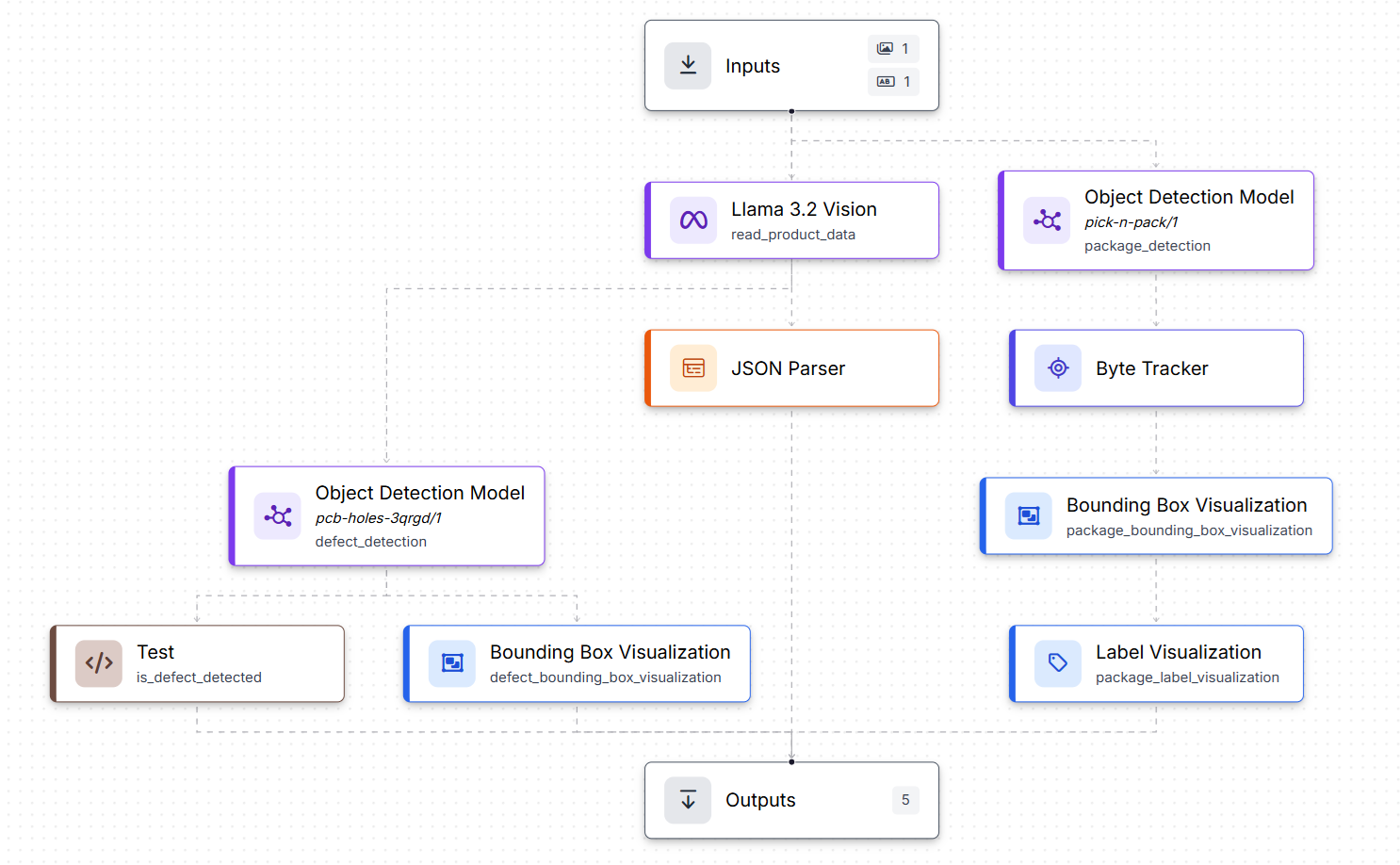
For example, a package inspection and label verification system can combine:
- A custom-trained object detection model to identify product types and visible defects.
- Llama 3.2 Vision, a pretrained multimodal foundation model, to read product names, dates, and batch numbers from labels.
- Logic blocks to check whether defects are present and validate the extracted information.
- Visualization and output blocks to display bounding boxes and return defect status, counts, OCR results, and structured JSON data.
The custom detector is trained for the products and defects found on a specific production line. Llama 3.2 Vision provides general OCR and image-understanding capabilities without requiring a separate model to be trained for every label format.
This modular approach is easier to test, update, and maintain than using a single model for defect detection, label reading, validation, and decision-making. Roboflow Workflows connects the custom detector, foundation model, processing operations, business logic, and outputs in one deployable pipeline.
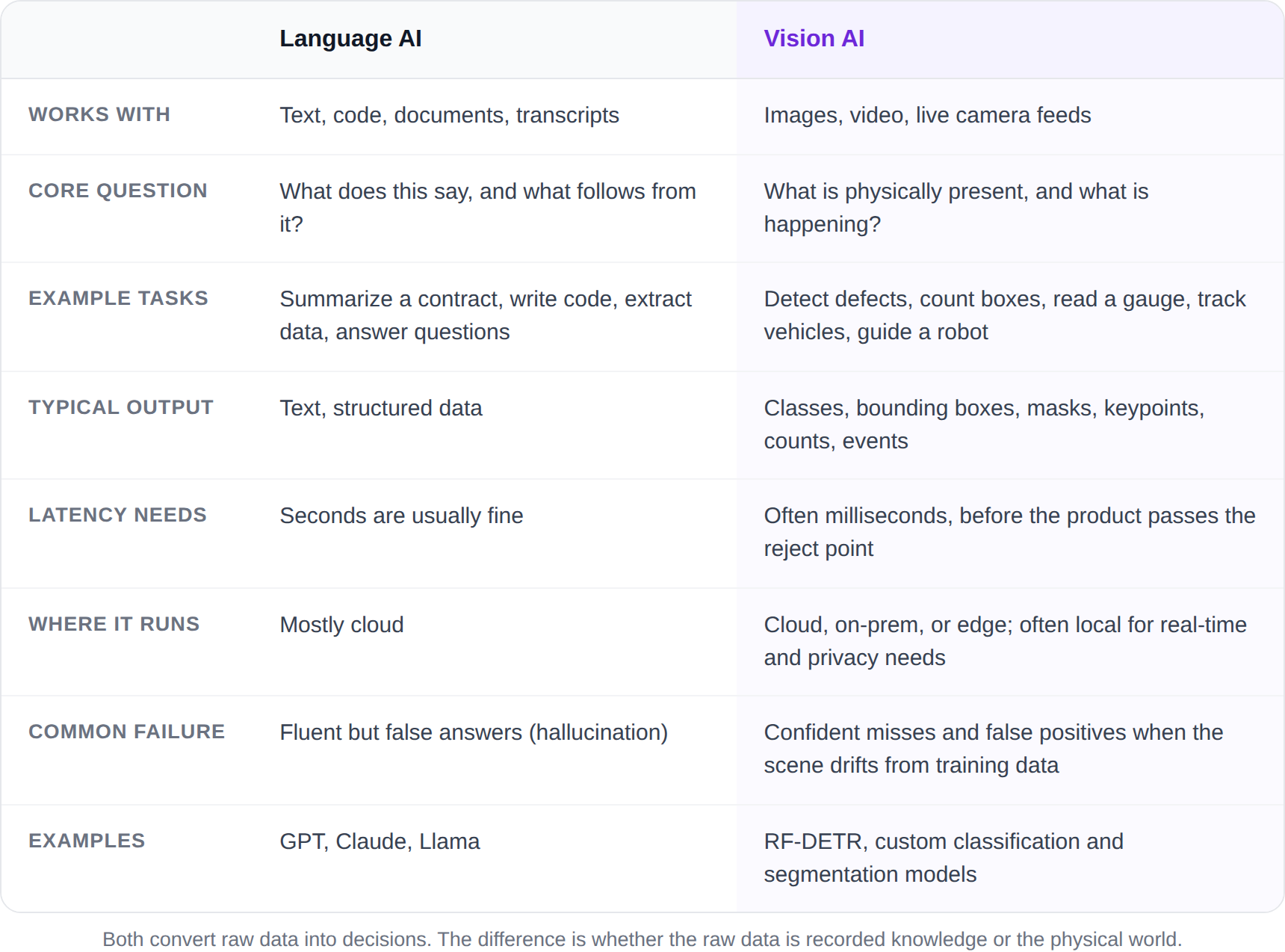
AI You Can See Versus AI You Can Read
Generative AI got a head start for a simple reason: its raw material was already digitized. Decades of text, code, documents, and discussion were sitting on the internet, ready for language models to learn from. Human knowledge was waiting in a format machines could read.
The physical world never got that treatment. Factories are full of machines, products, and defects. Farms are full of crops, weeds, and pests. Hospitals are full of instruments, monitors, and scans. Warehouses are full of pallets, forklifts, and people in motion. Almost none of it exists as data.
Cameras can capture all of it, but a camera image is unstructured data until something interprets it. The image alone does not tell a production system which component is defective, where the defect is, how large it is, or whether to reject the product and alert an operator. Vision AI supplies that interpretation. It converts pixels into objects, locations, counts, events, and decisions.
Language AI works with recorded knowledge
Language models are at their best when the answer already exists in text, code, documents, or past communication:
- What does this contract require?
- What happened in these support conversations?
- How should this code be changed?
- What are the main findings in this report?
They make knowledge someone already wrote down easier to find and use.
Vision AI works with observable reality
Vision AI is at its best when the answer depends on what is physically there right now:
- Is this product damaged?
- How many boxes entered the loading area?
- Is that worker wearing the required protective equipment?
- Which plants show signs of disease?
- Has this vehicle entered a restricted zone?
Nothing here can be looked up. The system observes a situation no one has recorded and turns it into operational data.
Perception must connect to action
A physical-world AI system does not end with a prediction on a screen. A detection triggers an alert, stops a machine, fires a reject mechanism, updates inventory, guides a robot, or sends an event to a programmable logic controller. The hardest examples go back into the training dataset, so the next version of the model catches what this one nearly missed.
That chain is why deploying Vision AI takes more than picking a model. Builders decide how camera data is captured, where inference runs, what confidence threshold is acceptable, what happens when the model is uncertain, and how the system improves after it ships.
Real-World Applications of AI
AI applications become easier to understand when they are described as specific operational tasks rather than broad promises to improve efficiency. The following examples show how AI is being used to convert real-world data into measurable decisions.
Manufacturing: USG Drywall Quality Inspection
Manufacturing companies use Vision AI to inspect products, detect defects, improve quality control, and reduce manual inspection. Computer vision is especially useful when products move quickly through a production line or when defects vary in size, shape, color, and texture.
USG uses a custom Vision AI system to identify visual imperfections in drywall and make quality checks more consistent across its facilities. The model runs on local hardware, allowing it to inspect products in a fast-moving production environment without depending on a constant internet connection. This example shows why custom models and edge deployment are valuable in manufacturing, where low latency, reliable operation, consistent results, and data control are important.
Healthcare: Wellth Care-Plan Verification
Healthcare organizations use Vision AI not only for medical imaging, but also for routine care tasks such as reading devices, checking medications, and verifying patient activities.
Wellth uses computer vision to read blood-pressure meters and count pills from images submitted by users. This reduces manual data entry and makes care-plan activities easier to verify. Wellth reports that these features reduced manual entry time by 90% and scaled to millions of image-processing requests.

The system supports healthcare staff rather than replacing them. It also shows why human review is important when images are blurry, incomplete, or uncertain.
Agriculture: Tomato Leaf Disease Detection
Agriculture uses Vision AI to monitor crops, detect diseases, and reduce the time needed for manual field inspection. A tomato leaf disease detection system, for example, can analyze images captured by a phone, field camera, or drone. The model identifies disease patterns based on changes in leaf color, texture, and shape. It can locate affected areas, classify the likely disease, and send uncertain cases to an agronomist for review.
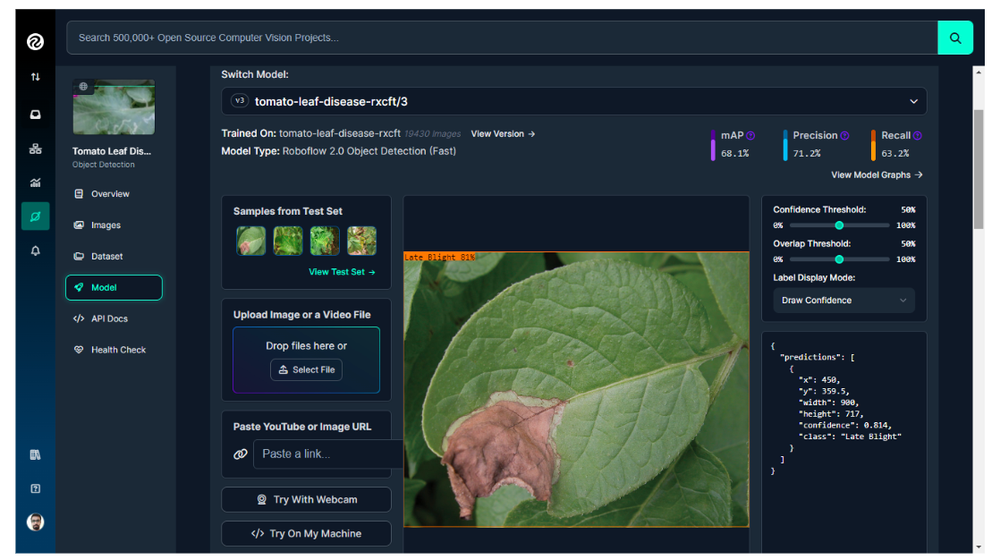
This example shows why local training data is important. Leaf appearance can change with lighting, camera quality, crop variety, growth stage, disease severity, and location. A custom model trained on representative field images is often needed for reliable results.
Logistics: Peer Robotics Pallet Detection
Logistics companies use Vision AI to help robots identify, track, and interact with objects in warehouses and manufacturing facilities. Peer Robotics trains custom computer vision models that allow its autonomous mobile robots to detect pallets and trolleys. The robots use this visual information to approach and dock with these assets accurately. For its first pallet-detection model, the team collected and labeled about 200 to 300 images showing pallets from different angles. This was enough to build and test a working model within one week.
Peer Robotics’ custom models help robots accurately find and dock with pallets and trolleys.
The example shows that a focused AI project does not always need millions of images. Representative data, a pretrained model, and clear evaluation can be enough to validate an application.
Retail: Empty-Shelf Monitoring
Retail companies use Vision AI to monitor shelves, identify low-stock products, and reduce the need for frequent manual checks. For example, an empty-shelf monitoring system analyzes store images or video. An object detection model finds empty shelf areas, while workflow logic classifies shelves as stocked, partially stocked, or empty and creates a restocking alert. A production system can also combine region-of-interest filtering, tracking, timestamps, inventory data, and alerts. Low-confidence images can be saved for review and used to retrain the model for new packaging, shelf layouts, lighting conditions, and seasonal displays.
How to Start Building With AI
The most effective way to begin an AI project is to start with a narrow task and a measurable output. Begin by identifying a repeated decision that depends on data.
1. Define the task
Write down exactly what the system should receive and what it should return. For example:
- Input: An image of a product.
- Output: The defect class and its location.
- Action: Send the product for review when confidence is below the required threshold.
For a vision project, determine which task type best matches the problem:
- Use classification when one label is needed for the complete image.
- Use object detection when objects must be located with bounding boxes.
- Use instance segmentation when the precise shape or area of each object matters.
- Use keypoint detection when important points or joints must be located.
- Use OCR when text must be extracted.
- Use tracking when objects must be followed across video frames.
- Use a vision-language model when the system needs broad visual understanding or a natural-language response.
A narrow first version is easier to evaluate. “Detect whether the safety guard is open” is a better starting task than “understand everything happening in the factory.”
2. Test existing models on your own data
Do not select a model only because it performs well on a public benchmark. Upload images from the actual use case and inspect its outputs. You can use the Roboflow Playground to explore Vision AI models for object detection, classification, segmentation, OCR, captioning, document understanding, and multimodal analysis. Test easy examples and difficult examples. Include:
- Different lighting conditions.
- Small and partially hidden objects.
- Unusual camera angles.
- Busy backgrounds.
- Low-resolution images.
- Normal cases that resemble defects.
- Rare but important failures.
The objective is not only to find the model with the most correct predictions. You should also determine whether its outputs are structured appropriately, whether inference is fast enough, and whether the model can be deployed in the intended environment.
3. Decide whether a foundation model is sufficient
A foundation model may be sufficient for an early prototype, a low-volume application, or a task involving broad semantic understanding. It may also help generate initial labels. For example, a promptable detector can locate candidate objects, after which a person reviews and corrects the annotations. However, a custom model is usually worth considering when:
- The objects are specific to your organization.
- The visual differences are subtle.
- Predictions must follow a fixed class list.
- The system processes large numbers of images.
- Low latency is required.
- Inference must run on an edge device.
- Consistency matters more than open-ended understanding.
- The model must operate without continuous internet access.
Testing a foundation model first and then training a custom model is often more efficient than treating the two approaches as mutually exclusive.
4. Collect and label representative data
Collect images from the same cameras, positions, environments, and processes that will be used after deployment. Avoid building the entire dataset from staged images. Staged data is useful initially, but it may not include motion blur, unusual object positions, reflections, dirt, damaged cameras, environmental variation, or operational mistakes. Create clear annotation guidelines before labeling begins. Decide:
- What should be labeled?
- What should be ignored?
- How should partially visible objects be handled?
- Should small defects be included?
- How tightly should bounding boxes be drawn?
- When should an image be marked as uncertain?
Consistent labels help the model learn a consistent task.
5. Train a custom model
For an object detection project, you can train RF-DETR on your own annotated images. RF-DETR is a transformer-based real-time model family designed for custom object detection and related vision tasks. In Roboflow, the general process is:
- Create a project.
- Upload and annotate images.
- Generate a dataset version.
- Apply preprocessing and augmentation where appropriate.
- Start a custom training job.
- Review metrics and visual predictions.
- Test the model on images and videos that were not used for training.
Roboflow Train lets you train custom models through the web platform, while RF-DETR can also be trained using Python. Do not judge a model only by its evaluation metrics, such as mAP, precision, or recall. Also check false positives, missed objects, incorrect bounding boxes, and performance in real operating conditions. For safety-critical applications, missing a hazard may be more serious than generating an extra alert. In such cases, the model can be configured to prioritize recall and send uncertain results for human review.
6. Build the complete AI application
A model prediction is only one part of an AI application. Processing steps and business logic are needed to turn predictions into useful actions.
Roboflow Workflows can connect models with cropping, filtering, counting, tracking, OCR, multimodal analysis, visualization, custom Python code, web requests, and database outputs. Workflows can also combine custom and foundation models as discussed earlier.
7. Deploy to the cloud or edge
Cloud deployment is useful when images already exist in a web application, workloads change over time, and centralized infrastructure is preferred. A Serverless Hosted API can run models and Workflows on auto-scaling cloud infrastructure, while Dedicated Deployments provide reserved CPU or GPU resources for applications that need more predictable performance. Stored images and videos that do not require immediate results can be processed with Batch Processing, while live webcam, RTSP, and video streams can be handled through the Serverless Video Streaming API.
Edge deployment is better when video must be processed in real time, sending every frame to the cloud would be expensive, network access is limited, sensitive data must remain on-site, or a machine or robot requires an immediate response. With self-hosted deployment, models and Workflows can run through Roboflow Inference on local computers, on-premises servers, GPUs, and supported edge devices. Larger fleets of edge devices can also be configured, deployed, and monitored through Deployment Manager.
8. Monitor and improve the system
Deployment is not the end of an AI project. Products, packaging, cameras, lighting, equipment, and environments can change over time, so a model may start receiving images that were not included in its original training data. Save useful production examples, especially low-confidence predictions, false alerts, missed objects, operator disagreements, images from new locations, and rare safety-critical cases. Active learning can help identify the most valuable production images to review and add back to the dataset. Review and relabel these images, create a new dataset version, retrain the model, and compare it with the current production model. Regular model monitoring can track performance, detect data drift, and show when the model needs improvement. This continuous feedback loop helps turn an early prototype into a reliable production AI system.
What AI Gets Wrong: Limitations and Governance
Every AI system fails somewhere, and knowing the failure modes in advance is what separates a production system from a failed pilot.
Models learn what the data shows, not what you meant. The defect example from the training section is the classic case: if defective products are always photographed on a dark background, the model learns the background, not the defect. It will pass every offline evaluation and fail on the line. Bias in AI is rarely a moral failure of the model; it is a sampling failure of the dataset, which is why dataset review matters as much as model selection.
Models are also confidently wrong. Language models generate fluent, plausible text that can be factually false, which is why the industry calls it hallucination. Vision models have the same failure in a different shape: a confident bounding box on the wrong object, or a missed defect at 98% certainty on everything else. Confidence scores measure the model's internal consistency, not truth. Production systems handle this with thresholds, human review queues for uncertain predictions, and monitoring that catches drift when cameras, products, or environments change after deployment.
Data privacy shapes architecture. Camera feeds from a factory floor, a hospital, or a retail store can contain faces, patient information, and trade secrets. Whether that data can leave the site is often decided by law or contract before it is decided by engineering, which is one reason edge and on-prem deployment matter beyond latency: the frames never leave the building.
Regulation is no longer hypothetical. The EU AI Act entered into force in 2024 and its obligations phase in through 2027, with high-risk systems, a category that includes many industrial safety and biometric applications, carrying requirements for risk management, data governance, logging, and human oversight. In the US, the NIST AI Risk Management Framework plays a similar role as a voluntary standard that enterprise buyers increasingly treat as a checklist. For builders, the practical translation is the same regardless of jurisdiction: document your data, evaluate on a fixed test set, log predictions, keep a human in the loop for consequential decisions, and be able to explain why the system did what it did.
None of this argues against deploying AI. It argues for deploying it the way the case studies earlier in this article do: a narrow task, representative data, measured accuracy, human review where confidence is low, and a retraining loop for when the world changes.
Start Building With AI
Create a free Roboflow account to upload a dataset, test models, train a custom vision model, and begin building an AI application for the physical world.


Cite this Post
Use the following entry to cite this post in your research:
Timothy M. (Jul 2, 2026). Artificial Intelligence: How AI Works. Roboflow Blog: https://blog.roboflow.com/artificial-intelligence/