

Research on the sim-to-real gap shows that a robot policy achieving 95% success in simulation can fall to 30 to 60% when deployed on a physical robot. The challenge begins when the same model has to deal with the real world.
Physical AI refers to systems that perceive, reason, and act in the real world through robots, sensors, and actuators instead of existing only in software. A chatbot only needs to generate a response. A physical AI system first has to understand its surroundings before it can move, grasp an object, or navigate safely.
Recent advances in world foundation models and vision-language-action models have made robots more capable across healthcare, manufacturing, agriculture, logistics, and construction. But none of that reasoning holds up if the system cannot reliably interpret its surroundings first.
This article explains how physical AI works, where it is used today, and why computer vision is the foundation of nearly every production physical AI system.
What Makes Physical AI Different
Physical AI systems operate in a continuous loop: perceive, reason, and act. They take in sensor data, turn it into an understanding of the environment, decide what to do, and carry out that action through motors, actuators, or wheels. Each step depends on the one before it.
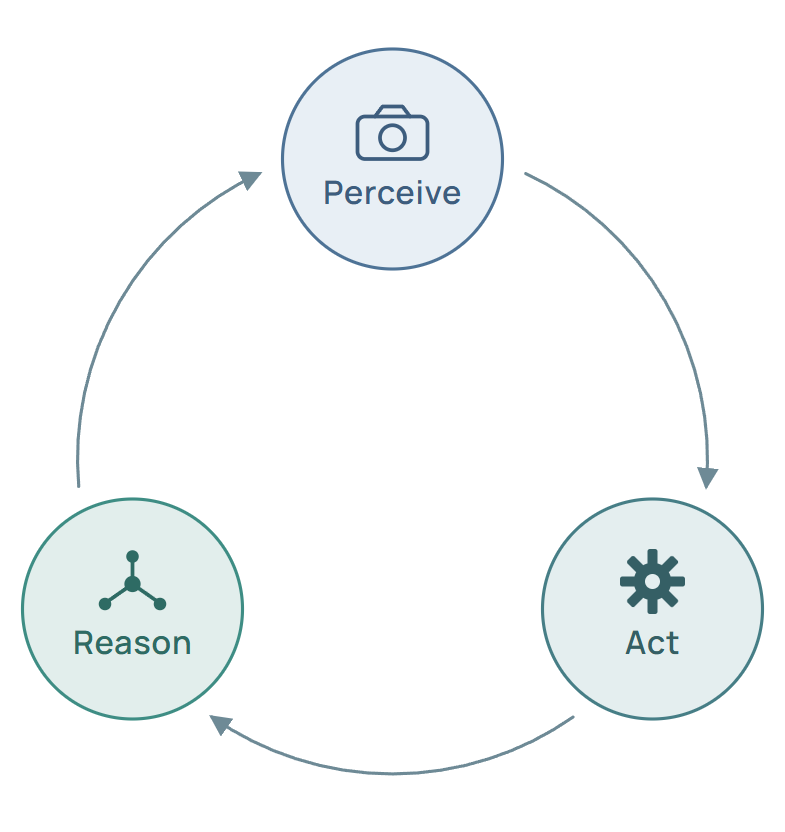
Perception is the step everything else depends on. Vision models transform raw sensor data into structured representations a policy can use: object bounding boxes, 6-DOF poses, semantic segmentation, and point clouds. If perception feeds bad information upstream, every decision built on top of it fails.
There are three dominant approaches to building the reasoning and action layer:
- Imitation learning: collect 100 to 200 tele-operated demonstrations, train a policy, deploy it. Lowest barrier to entry.
- Reinforcement learning: dominates locomotion and manipulation in simulation where physics can be modeled accurately.
- Foundation models: the long-term bet, but require significant compute and data resources.
All three make different tradeoffs on data, compute, and generalization. But they all rely on the same foundation: a perception system that can consistently understand the environment, even when real-world conditions differ from the lab.
Robots Use Physical AI
Robotics is where physical AI is most visible. A robot must understand its surroundings, make decisions, and act in a constantly changing environment.
- Perception: the robot identifies objects, estimates their position and orientation, and builds a working model of the scene using camera feeds, depth sensors, or LiDAR (Light Detection and Ranging).
- Policy: the decision-making layer that maps what the robot sees to what it should do next. Think of it as the rulebook that translates perception output into motor commands.
- Actuation: the motors, grippers, and joints that carry out the decision.
Boston Dynamics' electric Atlas is deployed at Hyundai facilities, navigating unstructured environments and handling parts on the production floor. The perception system underneath it is doing continuous scene understanding in real time, every frame. Robotic perception systems rely on high-quality vision pipelines. Roboflow provides the tools to collect data, annotate images, train custom models, and deploy them to edge devices.
Physical AI for Autonomous Vehicles
Autonomous vehicles are one of the most perception-intensive physical AI systems in existence. A self-driving car has to process multiple sensor streams simultaneously, cameras, LiDAR, radar, and GPS, fuse them into a single coherent picture of the environment, and make decisions in milliseconds.
- Sensor fusion: combines inputs from multiple sensor types to build a complete, redundant model of the scene. A camera sees color and texture. LiDAR measures depth. Radar works in low visibility. No single sensor is enough on its own.
- Perception: detects and tracks objects in real time, pedestrians, vehicles, cyclists, road markings, and traffic signals, and predicts their next move.
- Planning and control: translates the perception output into a trajectory, deciding when to brake, accelerate, or steer based on what the system sees and what it predicts will happen next.
Waymo has driven over 220 million rider-only miles across San Francisco, Phoenix, Los Angeles, Austin, and Atlanta, with 94% fewer serious injury crashes compared to human drivers over the same distance.
The biggest challenge in autonomous driving is handling the long tail of edge cases, the rare situations a perception model has never seen before but still needs to recognize correctly. That is why real-world perception data is one of the most valuable assets in an autonomous vehicle stack.
Physical AI in Smart Manufacturing
Smart manufacturing is where Physical AI has the clearest and most immediate return on investment. The environment is controlled, the tasks are repetitive, and the cost of a missed defect or an unplanned line stoppage is measurable in dollars per minute.
- Inspection: vision models run on camera feeds above production lines, detecting surface defects, dimensional variations, assembly errors, and packaging failures in real time, faster and more consistently than a human inspector.
- Robotics: collaborative robots and automated arms handle picking, sorting, and assembly, guided by perception systems that adapt to variation in part placement, orientation, and lighting.
- Integration: the output of the perception layer feeds directly into production systems, triggering line stops, routing decisions, and quality reports without a human in the loop.
BMW deploys computer vision across 31 plants for paint quality inspection, reducing defect escape rates by 85% compared to human-only inspection.
For manufacturing teams building vision systems, Roboflow's machine vision platform reduces production inspection time by 80% and deploys AI-driven vision solutions 5x faster than legacy systems, without requiring a dedicated ML team.
Physical AI Challenges and Limitations
Physical AI systems are improving fast. But several barriers still prevent most deployments from reaching the reliability needed for fully autonomous operation.
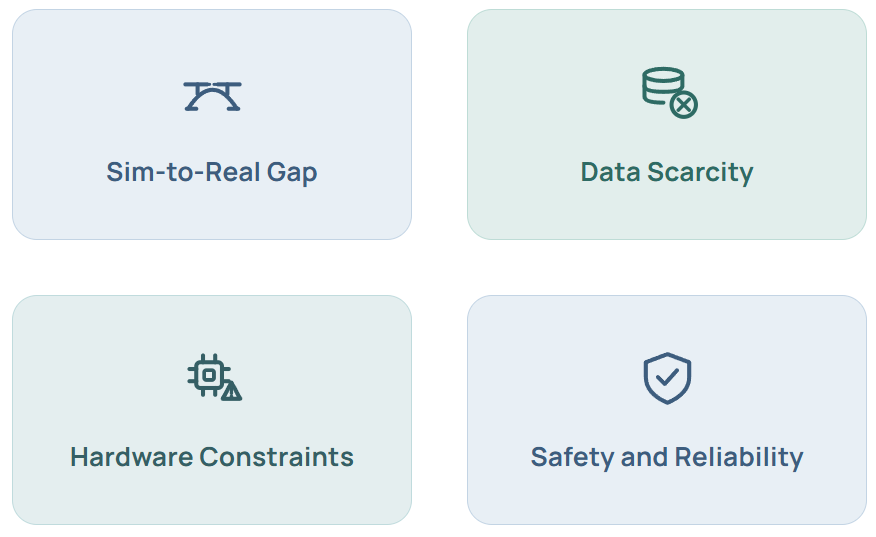
The sim-to-real gap is the most consistent failure point. No simulator perfectly reproduces real-world lighting, textures, contact physics, and sensor noise. Policies that perform well in controlled environments regularly break down on physical hardware, and closing that gap requires real-world data collection and fine-tuning at every deployment.
Data scarcity compounds the problem. Physical AI systems need large volumes of labeled real-world data to train reliable perception models. Rare scenarios, edge cases, unusual lighting conditions, and novel object configurations are exactly the situations where these systems are most likely to fail, and they are also the hardest and most expensive to collect data for.
Hardware constraints limit where these systems can run. Edge devices on robots and vehicles have limited compute, memory, and power budgets. A model that runs well in the cloud may be too slow or too power-hungry to run on the hardware that actually needs it.
Safety and reliability are the hardest problem of all. A language model that gives a wrong answer is an inconvenience. A Physical AI system that makes the wrong decision can cause real harm. Validating that a system behaves correctly across every possible real-world scenario is an unsolved problem, and it is the reason most Physical AI deployments still require a human in the loop.
Where Computer Vision Fits
Computer vision is the perception layer that makes physical AI possible. Before a robot can decide what to grasp, before a vehicle can plan a route, before a manufacturing line can flag a defect, something has to turn raw sensor data into a structured understanding of the scene. That is what computer vision does.
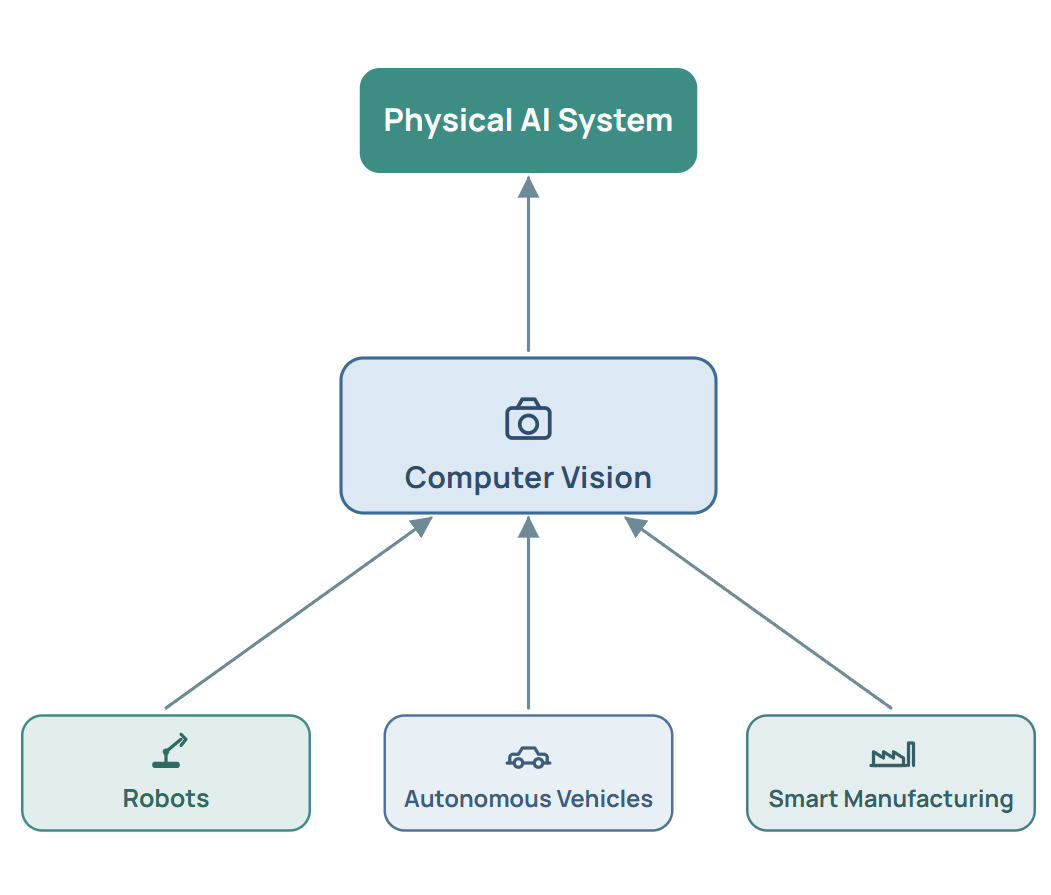
The three domains covered in this article all depend on the same upstream capability:
- Robots need object detection, depth estimation, and semantic segmentation to understand what is around them and where things are.
- Autonomous vehicles need real-time multi-object tracking, lane detection, and scene understanding across multiple sensor streams simultaneously.
- Smart manufacturing needs defect detection, dimensional inspection, and anomaly detection running at production line speed.
The models behind these applications are now widely available, openly licensed, and capable of running on edge hardware. What separates teams that ship from those that stall is infrastructure to collect real-world data, annotate it at scale, train on domain-specific examples, and deploy models reliably to the devices that use them.
That infrastructure is what Roboflow provides. From dataset management and annotation to model training, workflow orchestration, and edge deployment, Roboflow is built specifically for teams taking vision AI from a working prototype to a system that runs in the real world, across robots, vehicles, and factory floors.
Physical AI Conclusion
Physical AI is already here. Robots are running in factories, vehicles are driving through city streets without a driver, and vision systems are catching defects that are often missed.
What separates systems that work from those that stall is perception, not reasoning. Every decision a robot, vehicle, or industrial system makes starts with what it sees, and if that is wrong, nothing else holds up.
The models, tools, and deployment infrastructure for building production-grade perception systems are more accessible than ever. Over the next two to three years, the teams that move fastest will not be the ones with the most compute or the most complex models. They will be the ones that build a tight loop between real-world data collection, training, and deployment.
Further Reading:


Cite this Post
Use the following entry to cite this post in your research:
Mostafa Ibrahim. (Jun 17, 2026). Physical AI: How AI Systems Interact with the Physical World. Roboflow Blog: https://blog.roboflow.com/physical-ai/