

Every computer vision model comes with tradeoffs. Accuracy, inference speed, hardware requirements, licensing, and ease of fine-tuning all shape the right choice, and the highest-ranked model on a benchmark is not always the best fit for a real deployment.
For most GPU-based production deployments, Roboflow's RF-DETR is the strongest starting point. It posts the highest AP of any real-time detector on COCO, holds latency steady in dense scenes because it is NMS-free, converges fast when fine-tuned on custom data, and handles detection, segmentation, and keypoints in a single architecture.
It is also open source and free to use, including in commercial products: the core models, Nano through Large, are released under the permissive Apache 2.0 license, with no paid tier or source-disclosure requirement to ship them. The alternatives, YOLO, D-FINE, RT-DETRv2, and GroundingDINO, offer something different in a specific and narrower situation.
This article maps those situations. We compare all five across the factors that matter in production, so you can see exactly when a specialist beats the default and when it does not. The goal is a practical framework for choosing the right model.
You can try an RF-DETR model below:
What Roboflow's RF-DETR Does Well
RF-DETR handles object detection, instance segmentation, and keypoint detection in a single architecture. It was built to address three specific problems that affect vision models in production: accuracy ceilings, latency inconsistency in dense scenes, and fine-tuning efficiency on custom data.
Accuracy: RF-DETR is the first real-time vision model to exceed 60 AP on COCO, reaching 60.1 AP on the large variant and 60.5 AP on the 2XL at 6.8ms per frame on a T4 GPU. That puts it ahead of every comparable real-time detector on the standard benchmark.
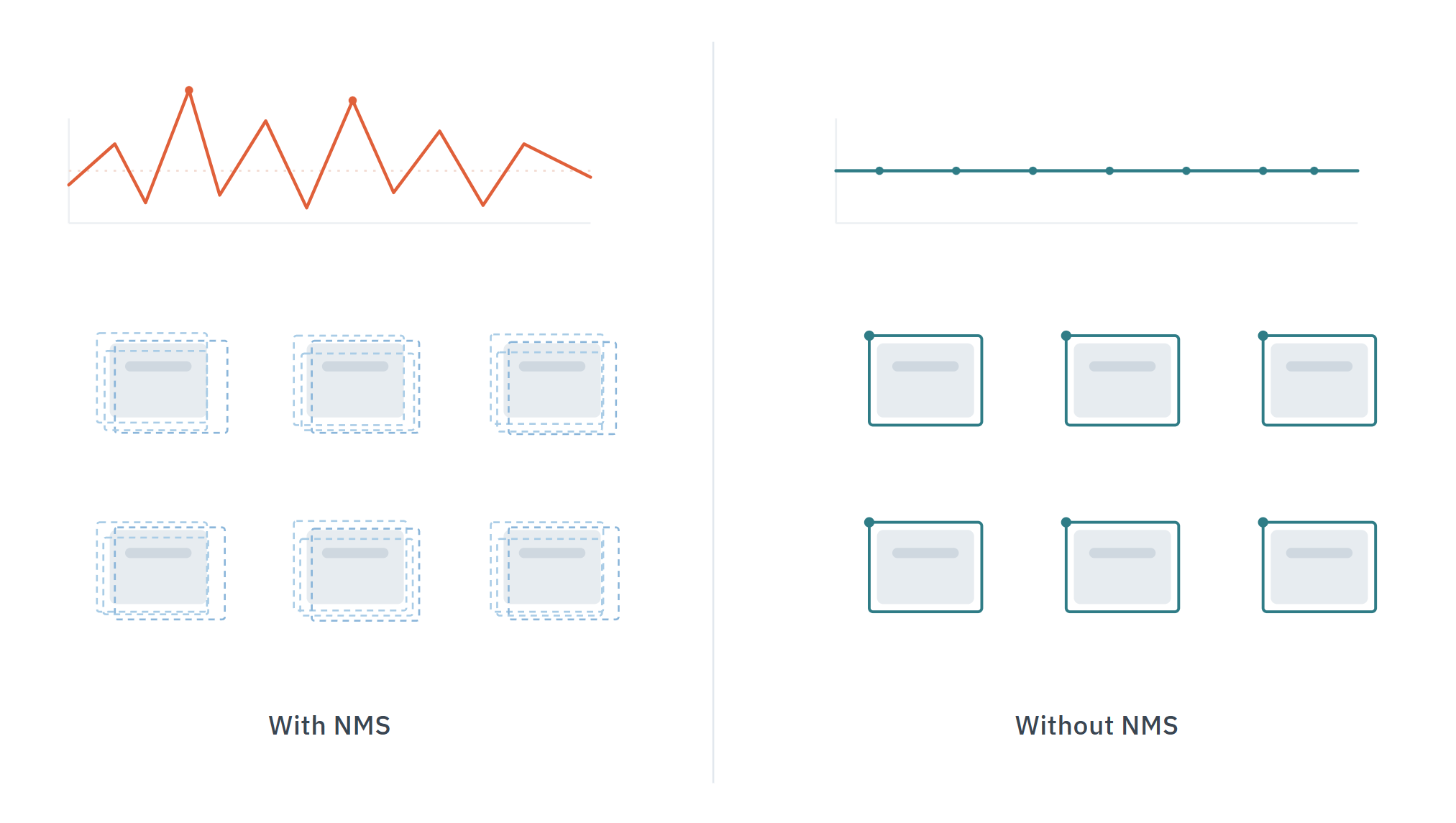
NMS-free architecture: Most detection models use Non-Maximum Suppression to filter duplicate predictions after inference. NMS works well in simple scenes but introduces unpredictable latency spikes when many objects appear in the same frame, such as a warehouse shelf, a traffic intersection, or a crowded production line. RF-DETR is end-to-end and NMS-free, meaning latency stays consistent regardless of scene density.
Training convergence: RF-DETR converges significantly faster than comparable models on custom datasets. A peer-reviewed study on domain-specific vision tasks found RF-DETR plateaued within 10 epochs in single-class scenarios, compared to substantially more for YOLO under the same conditions. Results vary by dataset size and domain complexity, but the study validates RF-DETR's efficiency advantage for fine-tuning on custom data.
Domain adaptation: The DINOv2 backbone gives RF-DETR strong visual priors from self-supervised pre-training on 142 million images. This makes it significantly more effective at adapting to new domains with limited labeled data compared to CNN-based models that rely on supervised pretraining alone.
License: Core models (Nano through Large) are Apache 2.0. XL and 2XL variants use Roboflow's PML license. For most production use cases, the Apache 2.0 models are sufficient.
RF-DETR Is Built for the Edge
Transformer detectors have a reputation for being too heavy to run outside a datacenter. RF-DETR breaks that assumption. The RF-DETR Nano variant was designed specifically for edge and real-time deployment, and its numbers put it ahead of the lightweight CNNs that have owned this space.
On an NVIDIA T4, RF-DETR Nano runs at 2.3 ms per frame while reaching 48.4 mAP (50–95) and 67.6 AP50 on COCO. On an actual edge device, a Jetson Orin Nano, it sustains around 25 FPS, which is real-time for most inspection, monitoring, and tracking workloads. Critically, RF-DETR Nano surpasses YOLOv11-N in both accuracy and speed, so on edge hardware with a GPU or accelerator you no longer trade accuracy for deployability.
Three architectural properties make RF-DETR a strong fit for constrained environments:
Consistent latency in dense scenes. RF-DETR is end-to-end and NMS-free. On the edge, where you cannot over-provision compute, the latency spikes NMS introduces when a frame fills with objects, a loaded shelf, a busy intersection, a crowded line, are exactly what breaks a real-time budget. NMS-free inference keeps frame time predictable no matter how many objects appear, which is what lets you guarantee a frame rate on fixed hardware.
Less labeled data to reach production accuracy. The DINOv2 backbone brings strong visual priors from self-supervised pretraining on 142 million images, so RF-DETR adapts to a new domain with far fewer labeled examples than CNN detectors that rely on supervised pretraining alone. For edge projects, where data collection in the field is often the hardest and most expensive step, that shortens the path from pilot to deployment.
Commercial-friendly licensing for fleets. RF-DETR Nano is Apache 2.0. When you are deploying the same model across dozens or hundreds of edge devices, Apache 2.0 avoids the per-deployment commercial licensing that AGPL-3.0 models like YOLO require, which removes both a legal and a cost obstacle at fleet scale.
RF-DETR also deploys through the same Roboflow pipeline you use to train it. You can push a trained model to an NVIDIA Jetson or an industrial PC and run inference locally with no internet connection, then manage and update the model across your fleet from one place. See How to Deploy RF-DETR to an NVIDIA Jetson for the full walkthrough.
The one place a lightweight CNN like YOLO still has an edge is genuinely compute-starved, CPU-only hardware with no GPU or accelerator, such as a bare Raspberry Pi. If your target has any GPU or edge accelerator, including the Jetson family, RF-DETR Nano is the stronger choice: higher accuracy, comparable or faster inference, and consistent latency under load.
The Alternatives
YOLO Variants
YOLO is fast, lightweight, and built for constrained hardware. The CNN backbone requires significantly less memory than a transformer and delivers real-time inference on CPU without a dedicated GPU. The tradeoff is a lower accuracy ceiling and latency variability in dense scenes due to NMS post-processing.
Pick YOLO when the deployment target is CPU-only or has no GPU or edge accelerator, such as a bare Raspberry Pi or a microcontroller. On edge hardware with a GPU or accelerator, including the Jetson family, RF-DETR Nano now matches or beats lightweight YOLO variants on both accuracy and speed.
- Best for: edge devices, CPU inference, constrained compute budgets
- License: AGPL-3.0, commercial use requires a paid license
D-FINE
D-FINE is a transformer-based detector that refines probability distributions over bounding box boundaries rather than predicting coordinates directly. The result is tighter, more precisely placed boxes. At 78ms per frame on a T4 GPU, it is not suited for latency-sensitive deployments, and fine-tuning tooling is less mature than more established models.
Pick D-FINE when bounding box precision is the priority over speed, such as quality control inspection where a misaligned box means a missed defect.
- Best for: high-precision localization, quality control, medical imaging
- License: Apache 2.0
RT-DETRv2
RT-DETRv2 by Baidu was the first transformer-based model to achieve real-time detection performance. It reaches 53 AP on COCO with broad support across PyTorch, ONNX, and TensorRT and has a larger community and more mature tooling than newer alternatives. The tradeoff is that it sits below the accuracy ceiling of more recent architectures.
Pick RT-DETRv2 when the existing pipeline is built around PyTorch, ONNX, or TensorRT and migrating to a newer architecture introduces risk.
- Best for: framework compatibility, stable production pipelines, PyTorch ecosystem
- License: Apache 2.0
GroundingDINO
GroundingDINO is an open-vocabulary zero-shot detector. It takes a text description and finds matching objects in the image without any labeled training data. It is not suited for real-time inference and is not designed for latency-sensitive deployments.
Pick GroundingDINO when labeled data does not exist and collecting it is not viable.
- Best for: zero-shot detection, automated annotation, novel object discovery
- License: Apache 2.0
Each model covers a specific gap. The right choice comes down to where the system will run, what data is available, and what the deployment actually requires.
Head-to-Head Comparison Table
Here is how all five models compare across the criteria that matter most for a production decision.
| Model | Backbone | NMS Required | COCO AP | Speed | Hardware | License | Best Use Case |
|---|---|---|---|---|---|---|---|
| RF-DETR | DINOv2 | No | 60.1 AP | 6.8ms / T4 | GPU, edge with quantization | Apache 2.0 / PML (XL) | Multi-task: detection, segmentation, keypoints |
| YOLO | CNN | Yes | 51.2 AP (YOLOv8-L) | 3.52ms / T4 | CPU, edge, mobile | AGPL-3.0 | Edge deployment, constrained hardware |
| D-FINE | Transformer | No | 55.8 AP | 78ms / T4 | GPU | Apache 2.0 | High-precision localization, quality control |
| RT-DETRv2 | Transformer | No | 53 AP (R50 backbone) | Real-time | GPU, broad framework support | Apache 2.0 | Stable pipelines, PyTorch ecosystem |
| Grounding DINO | Transformer | No | Zero-shot | Slower, not real-time | GPU | Apache 2.0 | Zero-shot detection, annotation pipelines |
How to Choose
Model selection in computer vision is about matching architecture characteristics to deployment constraints, not chasing the highest benchmark score. Work through these four questions in order.
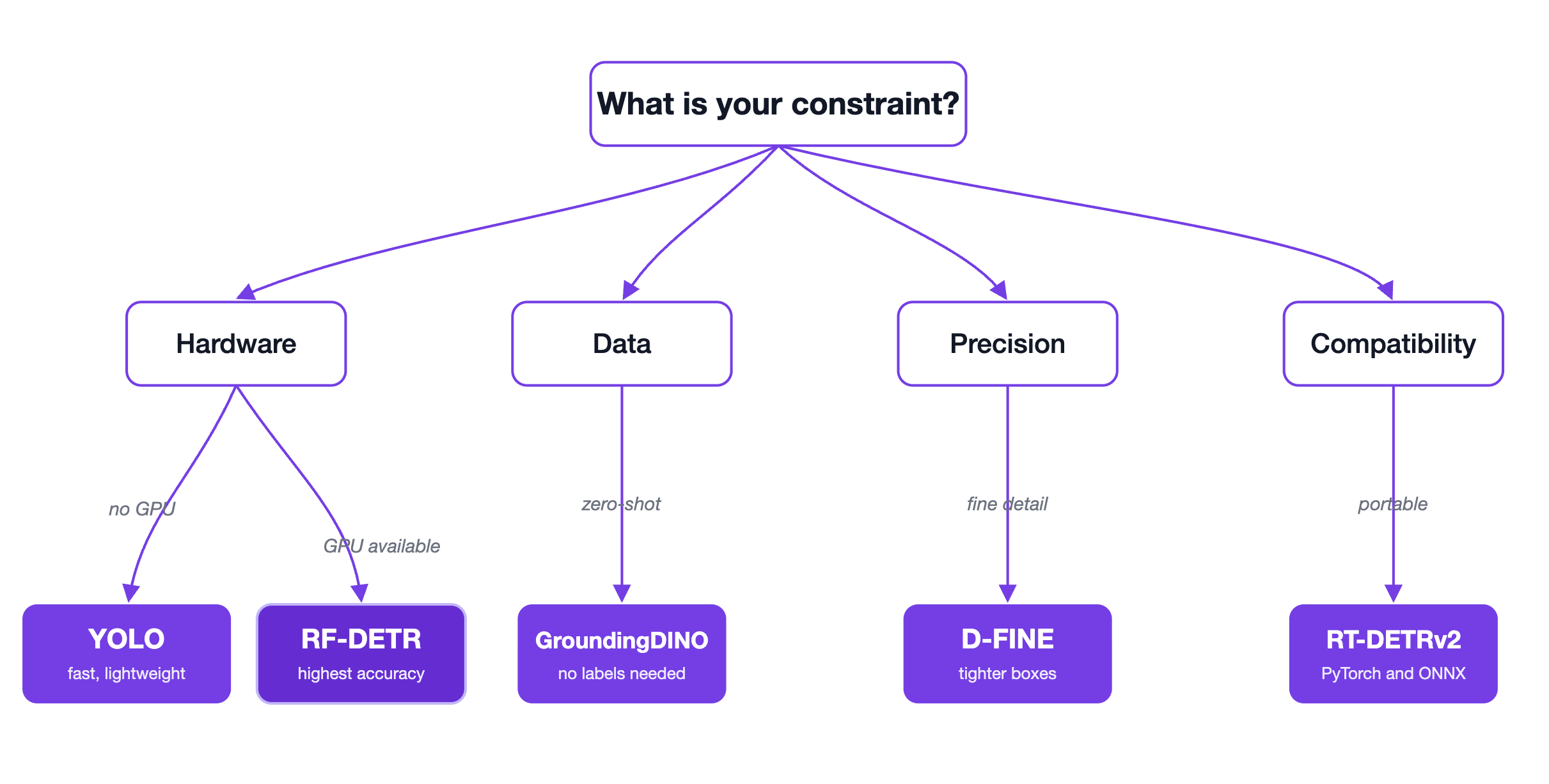
What hardware are you deploying on?
Transformer-based models require a GPU to perform well. On CPU-only or low-power edge hardware such as Jetson Nano or Raspberry Pi, YOLO's CNN backbone typically delivers better throughput and lower memory overhead. If a GPU is available or Roboflow's AI1, RF-DETR is the starting point, and the remaining questions determine whether a different model is a better fit.
Do you have labeled training data?
Without labeled data, GroundingDINO is the only viable option. Its open-vocabulary zero-shot capability detects novel object categories from a text description alone, no training required. If labeled data exists, a fine-tuned detector will consistently outperform zero-shot approaches on domain-specific tasks.
How critical is bounding box precision?
General detection accuracy and localization precision are not the same metric. For applications where box boundary placement is critical, such as dimensional inspection or defect detection, D-FINE's Fine-grained Distribution Refinement produces tighter boundaries. For general-purpose detection where overall AP is the primary metric, RF-DETR is the stronger choice.
What does your existing pipeline look like?
If the inference stack is tightly coupled to PyTorch, ONNX, or TensorRT and architectural migration carries risk, RT-DETRv2 offers broad framework compatibility and a mature community. If those constraints do not apply, RF-DETR is the default for GPU-based deployments: NMS-free for consistent latency in dense scenes, faster convergence on custom data, and the highest AP among real-time detectors on the standard benchmark. It also goes beyond detection, handling segmentation and keypoints in the same pipeline.
RF-DETR vs. Alternatives Conclusion
The best vision model is the one that fits your deployment constraints. For most GPU deployments, that is RF-DETR: the highest AP among real-time detectors, consistent latency in dense scenes, fast convergence on custom data, and detection, segmentation, and keypoints in a single pipeline.
RF-DETR also comes with something the open-source alternatives do not: the full Roboflow pipeline, from dataset management and annotation to training and edge deployment, plus a DINOv2 backbone that reaches production accuracy on fewer labeled images. Top accuracy, lower labeling cost, and one platform end to end are what make RF-DETR the practical default for teams shipping to production, not just the winner on a benchmark.
If you are ready to start building, Roboflow provides the full pipeline from annotation to edge deployment, and the RF-DETR repository and benchmarks are open and available today.
Further Reading


Cite this Post
Use the following entry to cite this post in your research:
Mostafa Ibrahim. (May 6, 2026). RF-DETR vs. Alternatives: Benchmarks and Deployment Compared. Roboflow Blog: https://blog.roboflow.com/rf-detr-vs-alternatives/