

Object tracking in computer vision assigns persistent identities to detected objects across video frames, enabling applications like assembly line monitoring, warehouse inventory tracking, and pedestrian flow analysis. Roboflow Trackers provides modular, Apache 2.0-licensed implementations of these algorithms that pair with any detection model.
Object tracking assigns persistent identities to detected objects across video frames, which is what turns detections into countable, followable things: packages moving through a warehouse, vehicles through an intersection, and products down a line.
Today, I'll share some of the best open-source object tracking tools, covering how each handles association, re-identification, and occlusion, how to choose between them, and how to run tracking without writing a pipeline yourself.
How Object Tracking Software Works
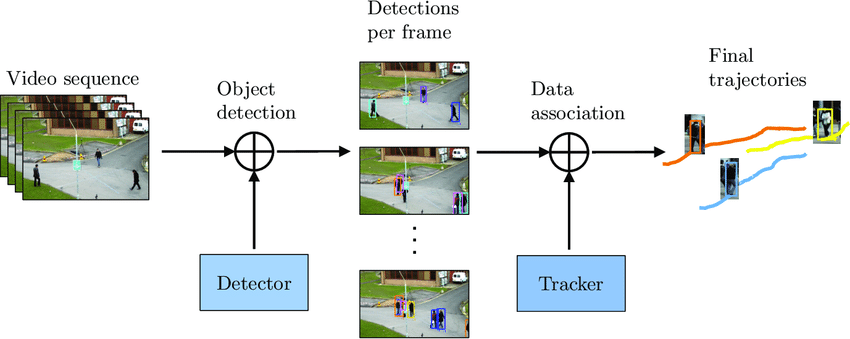
Modern tracking follows the tracking-by-detection paradigm: an object detection model finds objects in each frame, and a tracking algorithm links those detections across frames into identities. Four techniques do the linking:
- Feature extraction: capturing distinguishing characteristics (appearance, position, size) that tell objects apart.
- Motion estimation: predicting where each object will be next, classically with a Kalman filter.
- Data association: matching new detections to existing tracks so IDs stay consistent through clutter and partial occlusion.
- Re-identification: recovering an object's identity when it reappears after being hidden or leaving the frame.
The field evolved from background subtraction in the early 1990s through feature-based methods, estimation techniques like Kalman filtering and optical flow, and finally deep learning, which supplied both the detectors and the appearance embeddings today's trackers rely on.
Because trackers consume detections, tracker quality and detector quality compound: the same algorithm tracks better when fed by a stronger detector like RF-DETR.
Top Free Open-Source Object Tracking Tools
Now, let’s walk through the top open-source object-tracking tools.
1. Roboflow Trackers
Roboflow Trackers is a library of clean, modular re-implementations of leading multi-object tracking algorithms, released under Apache 2.0. Rather than one algorithm, it gives you the family behind most production tracking, with a consistent API that pairs with any detection model you already run.
Because the implementations are unified, swapping trackers to compare behavior on your footage is a one-line change, which is the fastest way to answer the which-tracker question empirically. See the documentation for supported algorithms and usage.
2. ByteTrack
ByteTrack's insight is in what it refuses to throw away. Most trackers keep only high-confidence detections, which fragments trajectories when an object is partially hidden and its detection score dips. However, ByteTrack associates every detection box, high and low score alike: high-confidence boxes match to existing tracklets first, and low-confidence boxes are checked against unmatched tracklets to keep occluded objects alive.
The result is strong identity persistence at very low computational cost, which is why ByteTrack is the default choice for most applications. Easily chain the ByteTrack block in Roboflow Workflows.
3. BoT-SORT
BoT-SORT (Bag of Tricks for SORT), from Tel Aviv University researchers, combines motion and appearance cues and adds camera motion compensation, so tracking stays accurate when the camera itself moves, plus an improved Kalman filter for tighter position prediction.
It posts top marks on standard benchmarks (MOTA, IDF1, HOTA) and is the strong choice for crowded scenes, moving cameras, and warehouse environments where occlusion is constant. Easily chain the ByteTrack block in Roboflow Workflows.
4. DeepSORT
DeepSORT extends the classic SORT algorithm with a deep appearance embedding, letting it re-identify objects that motion alone would confuse. A Kalman filter predicts movement while the appearance features handle interactions and occlusions. It is the historical workhorse of multi-object tracking, well understood and widely ported, though newer trackers generally beat it on benchmarks.
5. StrongSORT
StrongSORT rebuilds DeepSORT with a stronger detector, a better embedding model, and two lightweight additions: AFLink, which links tracklet fragments using only spatiotemporal information, and Gaussian-smoothed interpolation, which fills missed detections using motion.
It achieves top results on MOT17, MOT20, DanceTrack, and KITTI, and suits applications where identity accuracy matters more than raw speed, like monitoring heavy vehicles on a construction site.
6. OC-SORT
OC-SORT (Observation-Centric SORT) fixes the classic SORT failure mode: when detections drop out during occlusion, a Kalman filter keeps predicting blind, and errors accumulate until the track drifts away from the object. OC-SORT re-anchors tracks on actual observations when an object reappears, correcting the accumulated error instead of trusting the stale prediction.
Because it uses motion only, no appearance embeddings, it stays fast while posting strong results on benchmarks with non-linear motion like DanceTrack. It is a strong middle option between ByteTrack's simplicity and BoT-SORT's heavier appearance modeling, and it is available as a tracking block in Roboflow Workflows.
7. Norfair
Norfair, by Tryolabs, is the minimalist of the group: a lightweight Python library where you define the distance function between tracks and detections, from a one-line Euclidean distance to embeddings from a re-ID model. That makes it simple to drop into an existing video pipeline with any detector, at the cost of doing more design work yourself.
Also worth knowing: MMTracking, OpenMMLab's video analysis toolbox, integrates tracking with the MMDetection ecosystem, though its development activity has slowed substantially.
C-BIoU, which buffers the IoU matching space to handle erratic motion, is worth watching but has fewer maintained implementations than the tools I mentioned above.
How to Choose An Object Tracking Tool
Start with ByteTrack: fast, simple, and strong on the common cases. Move to BoT-SORT when your camera moves or scenes are dense. Reach for StrongSORT when identity switches are expensive, and Norfair when you want a thin layer you fully control.
Roboflow Trackers makes the comparison cheap by putting the algorithms behind one API. And remember the detector matters as much as the tracker: upgrading detection quality often fixes more ID switches than changing association logic.
For segmentation-level tracking, a different family applies: SAM 2 and SAM 3 track pixel-precise masks through video, maintaining identity through occlusion and reappearance, with SAM 3 doing it from a plain text prompt.
You can view head-to-head performance of SORT, ByteTrack, OC-SORT, BoT-SORT, and C-BIoU on standard MOT benchmarks here.
Tracking Without Building a Pipeline
If the goal is a working application, Roboflow Workflows provides tracking blocks (including ByteTrack, SORT, BoT-SORT, and OC-SORT) that chain with your detection model, zone logic, counting, and notifications in a visual builder.
A common cost-saving pattern: run detection at a few frames per second and let the tracker maintain identities between detector runs, counting each object exactly once as it crosses a line or enters a zone. The result deploys through the same Roboflow Inference stack, from cloud to edge devices, and handles video, webcam, and RTSP sources.
Challenges and Limitations of Object Tracking
Occlusion remains the central difficulty: objects hiding behind one another force trackers to either hold identities through gaps or re-identify on reappearance. Appearance variability (distance, angle, lighting) degrades the embeddings re-ID depends on. Multi-camera tracking adds a harder re-identification problem across viewpoints. And scale is operational as much as algorithmic: many-camera deployments need infrastructure for stream ingestion, inference scheduling, and result aggregation, which is where a managed pipeline earns its keep.
Get Started
Pick a tracker, feed it good detections, and count something that matters to your operation. Create a free Roboflow account to train a detection model on your objects and chain it with tracking in a Workflow you can deploy the same day.
Learn more:
What is the best open source object tracker?
ByteTrack is the best default: fast, simple, and accurate across common scenarios. BoT-SORT wins when the camera moves or scenes are crowded, and StrongSORT when identity accuracy is paramount. Testing two or three on your own footage through a unified library settles it quickly.
Do object trackers need a detection model?
Yes. Modern trackers follow tracking-by-detection: a detector like RF-DETR finds objects each frame, and the tracker links detections into identities. Tracker output quality is bounded by detector quality.
Can I do object tracking without writing code?
Yes. Roboflow Workflows includes tracking blocks that connect a detection model to counting, zone, and alerting logic in a visual builder, deployable via API or on your own hardware.
How is object tracking different from object detection?
Detection answers what is in this frame and where; tracking adds who over time, assigning each object a persistent ID across frames so you can count, follow, measure speed, and analyze paths.
How do I track objects across multiple cameras?
Cross-camera tracking requires re-identification: matching appearance embeddings between viewpoints rather than relying on motion. It is substantially harder than single-camera tracking and typically involves a dedicated re-ID model.
ByteTrack vs. DeepSORT
How the two most-used multi-object trackers differ
| ByteTrack | DeepSORT | |
|---|---|---|
| Association | Matches every detection box, high and low confidence, using motion (IoU) | Matches high-confidence detections using motion plus a deep appearance embedding |
| Re-identification | None. Motion only, which keeps it simple and fast | Yes. Appearance features recover an object's identity after it is hidden |
| Occlusion handling | Keeps tracks alive by matching the low-score boxes other trackers discard | Re-identifies objects on reappearance using stored appearance embeddings |
| Speed and compute | Fastest. No extra network to run, CPU-friendly at high frame rates | Slower. Runs a re-ID network each frame, benefits from a GPU at scale |
| Best for | The default choice: counting, zones, and most real-time video pipelines | Scenes where objects cross paths and identity switches are costly |
Both trackers pair with any detection model and run as blocks in Roboflow Workflows.
ByteTrack and DeepSORT split on one design choice: ByteTrack tracks with motion alone but matches every detection box, high and low confidence, which keeps occluded objects alive at almost no computational cost, while DeepSORT runs a deep appearance embedding alongside motion so it can re-identify objects after they vanish and reappear.
In practice, ByteTrack is the faster default for counting, zones, and most real-time pipelines, and DeepSORT earns its extra compute in scenes where objects cross paths and an identity switch is expensive.


Cite this Post
Use the following entry to cite this post in your research:
Contributing Writer. (Apr 28, 2026). Top Open-Source Object Tracking Tools. Roboflow Blog: https://blog.roboflow.com/top-object-tracking-software/