

The difference between an IP camera and an AI camera isn't the lens or the network, it's the output: IP cameras record video for later review, while AI cameras analyze the stream in real time and turn activity into structured events teams can act on. When video needs to drive an operational decision, an integrated system like Roboflow's AI1 (camera, compute, lighting, models, and Workflows in one on-device unit that emits Vision Events and improves over the air as it runs) gives you a production-ready path without sourcing and maintaining every piece separately.
For decades, video cameras have served a straightforward purpose: capture footage and store it for later review. Whether deployed for security, traffic monitoring, or facility operations, most camera systems have been designed to record events rather than understand them.
Computer vision has started to change that model. Modern camera systems can analyze video streams as they are captured, counting objects, catching defects, and other events in real time. Instead of acting solely as recording devices, cameras can now generate alerts, trigger automated workflows, and provide operational insights without requiring continuous human attention.
This shift has led to the growing adoption of AI cameras. While traditional IP cameras focus on capturing, transmitting, and storing video, AI cameras add a layer of intelligence that allows them to interpret what is happening within a scene.
The trend is accelerating across industrial environments. Analysts project the machine vision market to reach $22.59 billion by 2032.
Understanding IP Cameras and AI Cameras
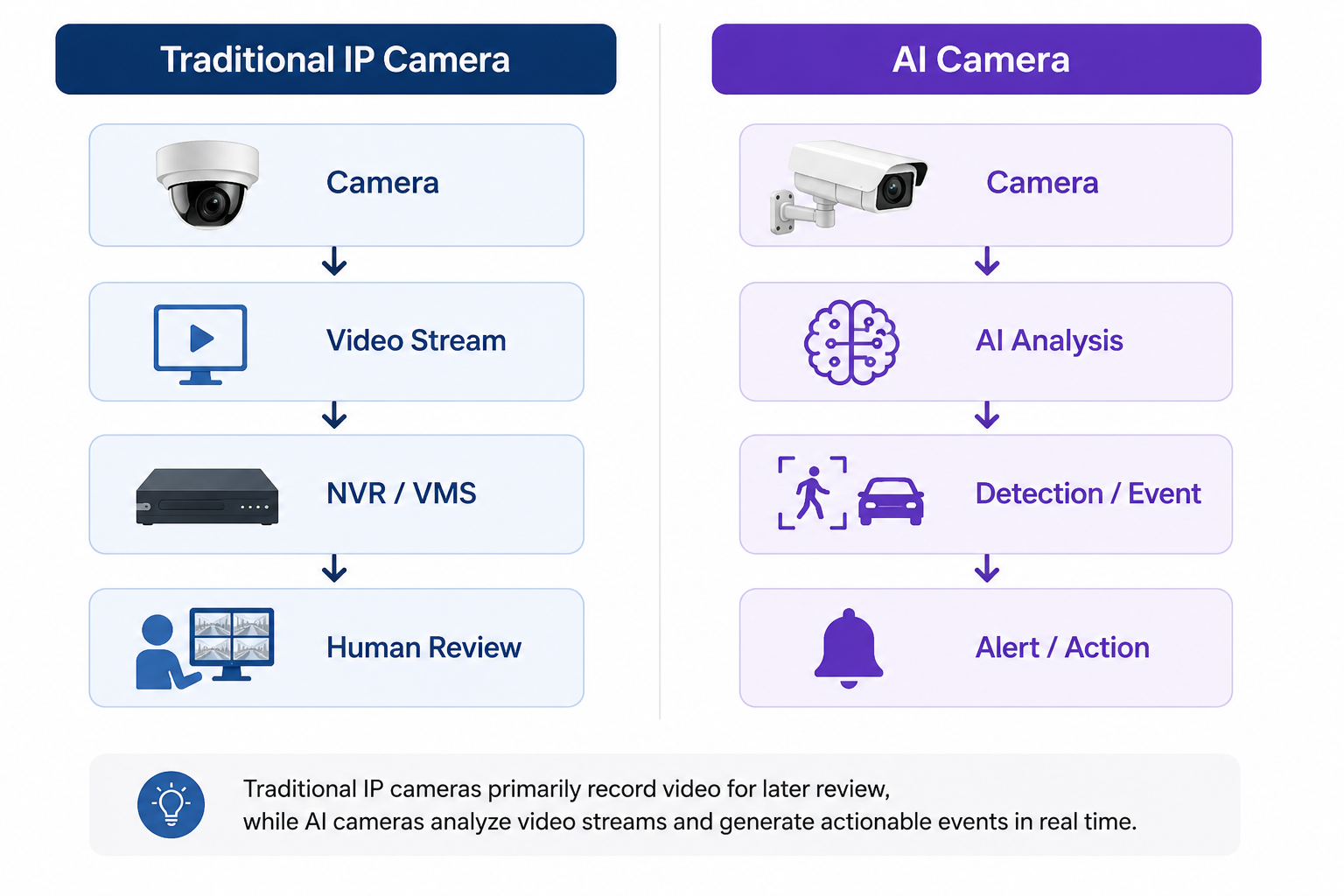
At first glance, IP cameras and AI cameras look very similar. Both capture video and connect to a network. The difference lies in what happens after the video is captured.
IP cameras are primarily designed to stream and store footage. AI cameras take the same video stream and analyze it automatically, identifying objects, activities, and events as they occur. This allows organizations to move beyond simply recording incidents and toward detecting and responding to them in real time.
The diagram below illustrates where AI-powered analysis is introduced into the camera workflow.
AI Cameras vs IP Cameras: Key Differences
The main difference between IP cameras and AI cameras is not the camera lens or the network connection. It is the type of output the system produces. IP cameras mainly produce video footage. AI cameras produce video plus structured information about what appears in that footage.
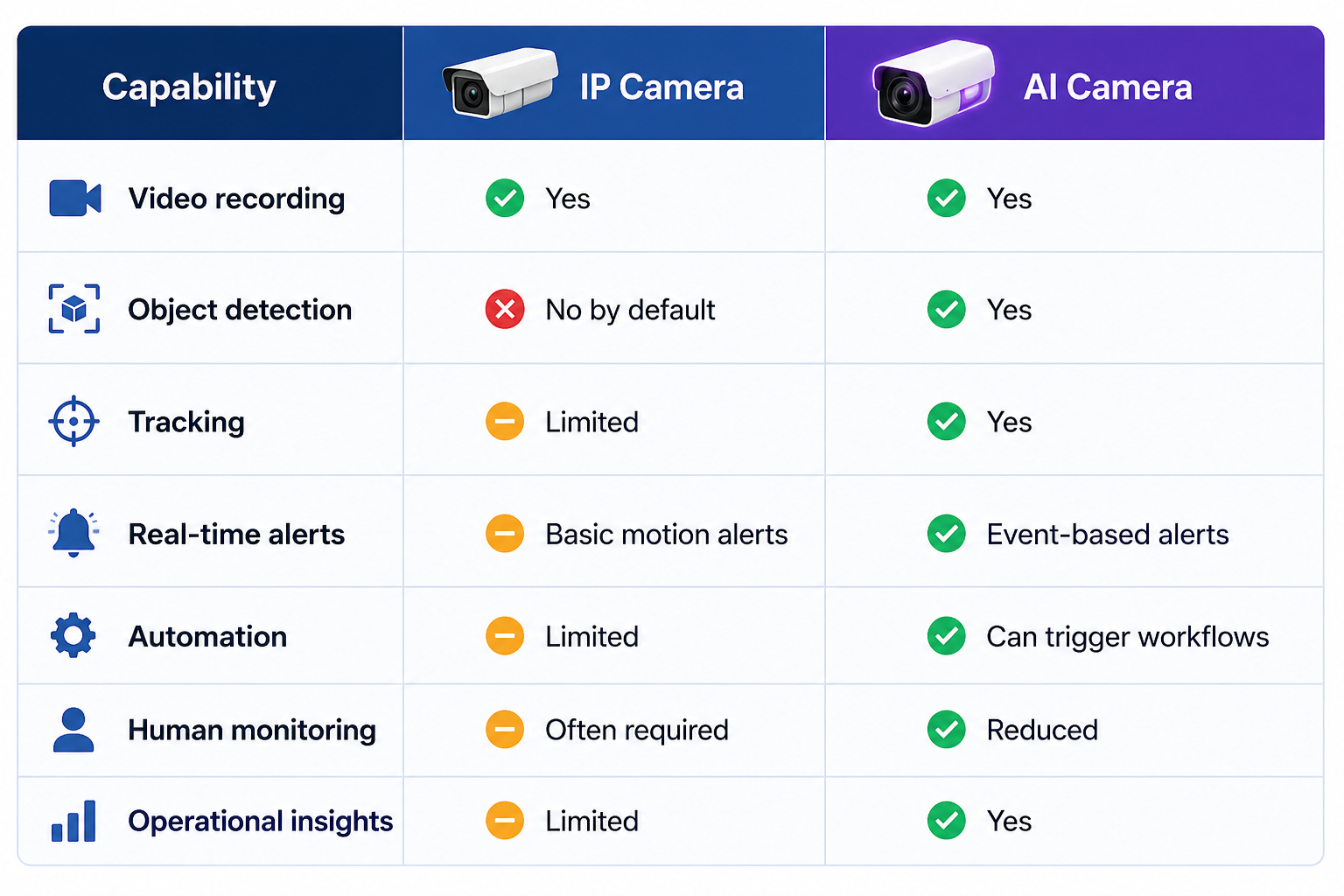
This difference matters most when camera volume increases. A small site with two or three cameras may be manageable with manual review. A warehouse, parking facility, factory, or transit hub with dozens of cameras creates a different problem. More video does not automatically create better visibility if teams still need to watch or search through footage manually.
AI cameras help by filtering video into useful events. For example, instead of storing every second of a loading dock feed and asking someone to review it later, the system can detect when a vehicle arrives, when a person enters a restricted area, or when required safety equipment is missing.
Where AI Cameras Create Business Value
AI cameras are most useful when video needs to support an operational decision, not just provide a record. The value comes from turning visual activity into events that teams can act on quickly.
In practice, this usually means using video to answer questions like:
- Is someone entering an area they should not access?
- Are workers following required safety procedures?
- How many vehicles or assets are moving through a space?
- Is a production line, loading dock, or inspection area operating as expected?
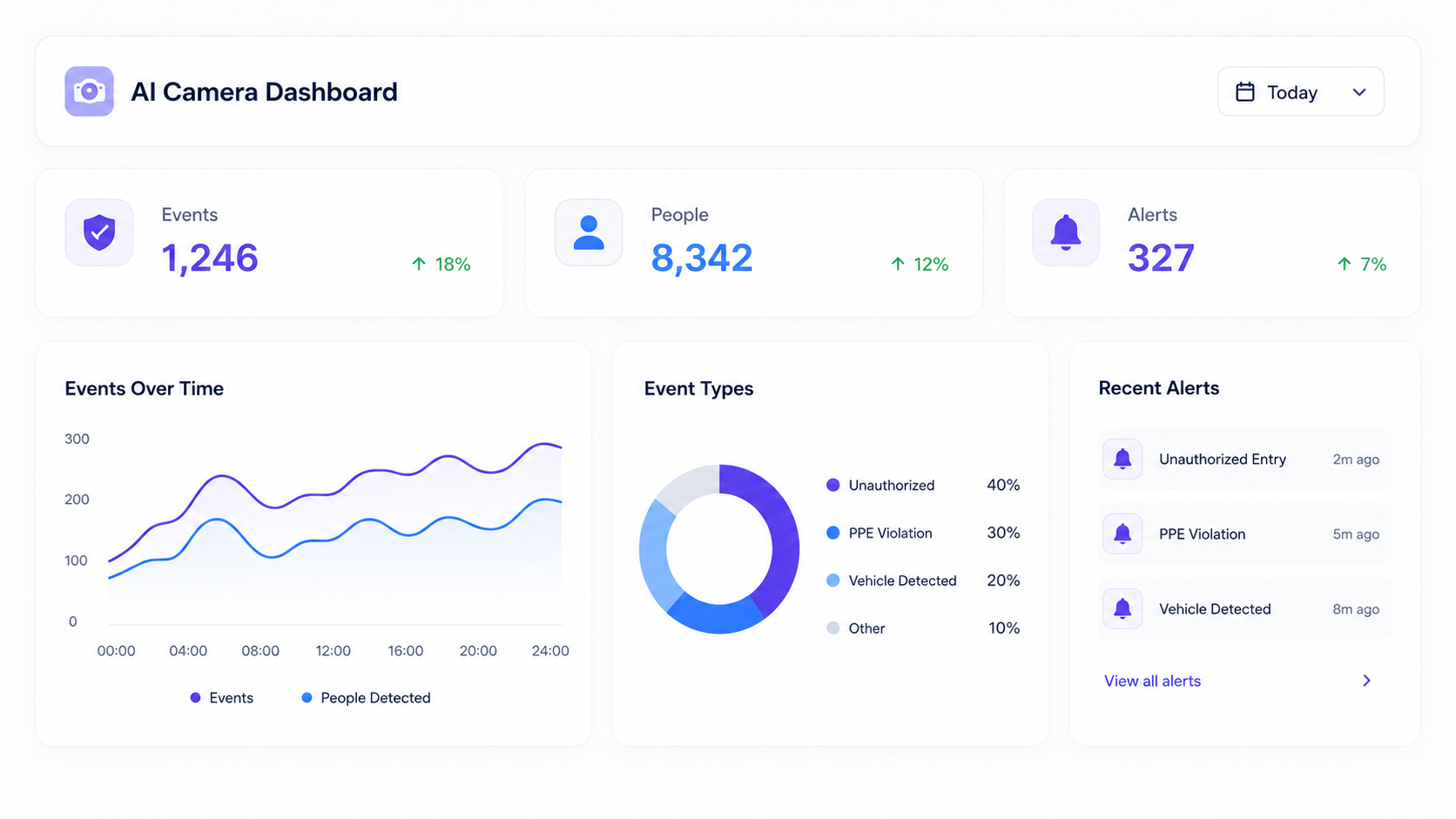
In security and access control, an AI camera can detect when a person enters a restricted area after hours or when a vehicle stops in a blocked zone. Instead of waiting for someone to review footage later, the system can send an alert while the event is still active.
In manufacturing and logistics, the value shows up differently. Teams can catch defects at the press, weld, or assembly station before they reach QA or end up with a customer. Logistics teams can track pallets, assets, and vehicle arrivals without relying on barcodes or manual counts. Safety teams can monitor PPE compliance, forklift zones, and restricted areas consistently across every shift, not just when someone happens to be watching.
The business impact can be significant. A survey of 600 manufacturers found 61% experienced unplanned downtime in the past year, costing $852 million per week, creating strong incentives to identify defects, equipment issues, and process bottlenecks earlier in the production cycle.
How Integrated Vision Systems Simplify AI Camera Deployment
Building an AI camera deployment usually involves several separate pieces: camera hardware, lighting, edge compute, model deployment, monitoring, and integrations with business systems. Each piece has to be selected, configured, and maintained.
That can slow down deployment, especially in industrial environments where cameras need consistent image quality, low-latency decisions, and reliable communication with factory systems.
Roboflow's AI1 simplifies that process by packaging the key parts of a production vision system into one device. AI1 combines an industrial camera, onboard compute, integrated lighting, and Roboflow software in a single system. Instead of treating the camera as a passive video source, AI1 is designed to capture visual data, run models on-device, and convert detections into structured events that operations teams can use.
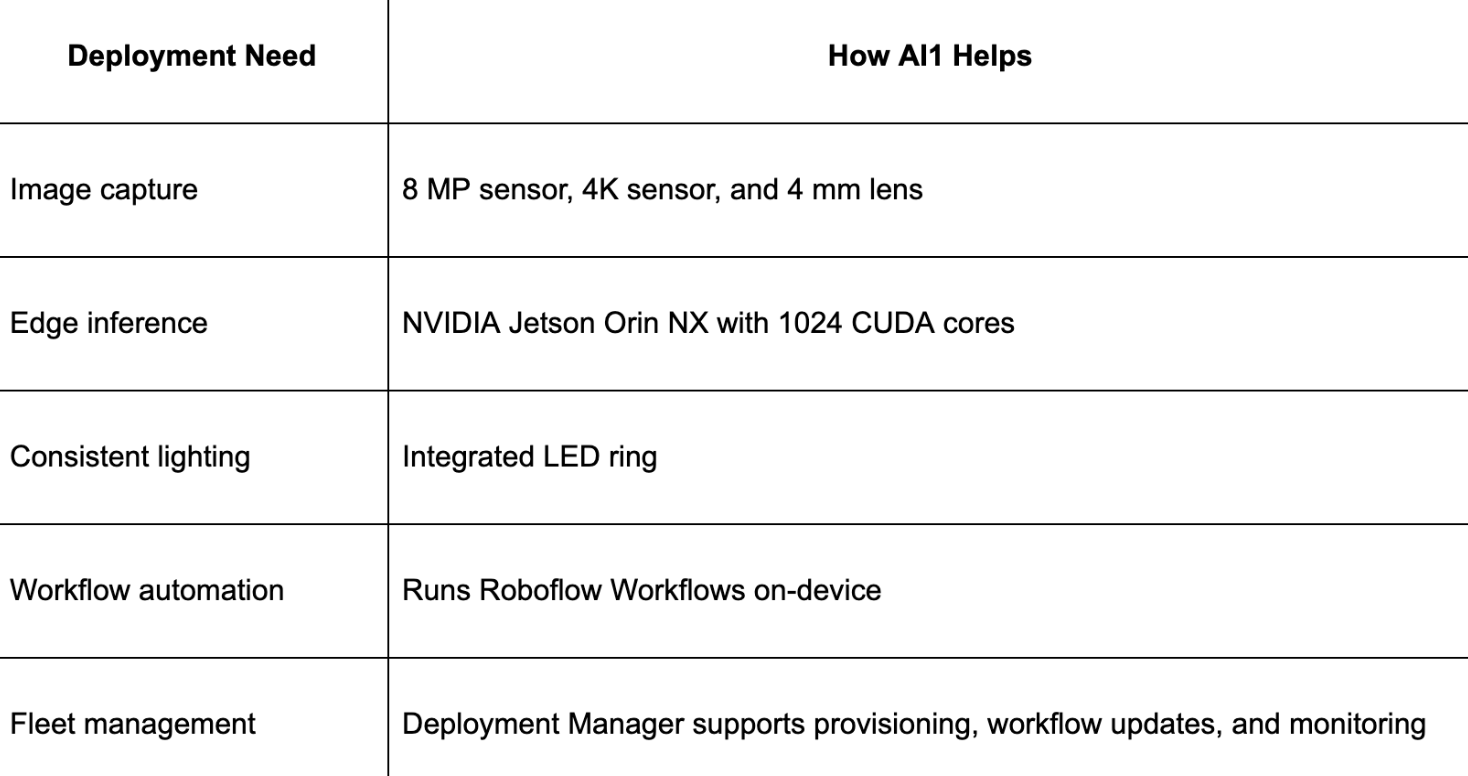
One of AI1's strongest advantages is that it keeps the vision workflow close to the production line.
AI1 runs Workflows on-device, syncing with Deployment Manager, and emitting Vision Events that teams can query, export, or send into business intelligence tools. This matters because the output is not just video. It is structured information such as defect type, timestamp, line, position, confidence score, and frame ID.
That makes AI1 especially useful for production environments where teams need fast, repeatable decisions. A camera can check whether a seal is complete, a label is aligned, a worker is wearing required PPE, or a part is assembled correctly. The result can then be sent to a dashboard, PLC, MES, ERP, or alerting system.
AI1 is also designed to improve over time, rather than stay fixed after deployment. As the camera runs on the line, it automatically surfaces edge cases and footage it is uncertain about, feeding that data back into Roboflow for labeling and correction.
Once reviewed, the updated model deploys back to the device over the air with no downtime. The result is a vision system that gets more accurate the longer it runs, without requiring engineers to start from scratch or manually hunt for what needs fixing.
For teams comparing traditional IP cameras with AI camera systems, AI1 represents the integrated path: camera, compute, lighting, models, workflows, deployment, and operational events in one production-ready vision device.
Manufacturing Facility Cameras' Cost and Deployment Considerations
The right choice is not always the camera with the lowest upfront cost. A traditional IP camera setup may be cheaper to purchase when the goal is basic recording, but the total cost includes more than hardware.
Teams should consider:
- Storage: Continuous recording increases retention and infrastructure requirements.
- Monitoring: More cameras often mean more footage to review manually.
- Deployment complexity: AI systems require models, compute, and integrations.
- Scalability: Adding cameras is easy, but scaling useful decisions from video is harder.
- Operational value: Faster detection can reduce delays, missed events, and manual investigation.
For simple surveillance, an IP camera may be sufficient. A small office or compliance-focused deployment may only need reliable recording and retention.
AI camera systems become more valuable when video supports an operational process. In factories, warehouses, and transportation sites, the goal is often to detect issues quickly and reduce manual review.
Integrated systems such as AI1 simplify deployment by combining camera hardware, lighting, compute, and AI software into a single platform. A traditional IP camera might look cheaper at first glance, but building an AI vision system around it means sourcing compute hardware separately, setting up lighting, writing custom integrations, and maintaining all of those pieces over time.
For teams deploying across multiple lines or sites, that complexity adds up fast. AI1 brings those components together in one device running on one platform, which tends to reduce both the time it takes to get a deployment running and the ongoing effort to keep it working.
Which Camera Is Right for Your Manufacturing Facility?
The best choice depends on what role the camera plays within your organization.
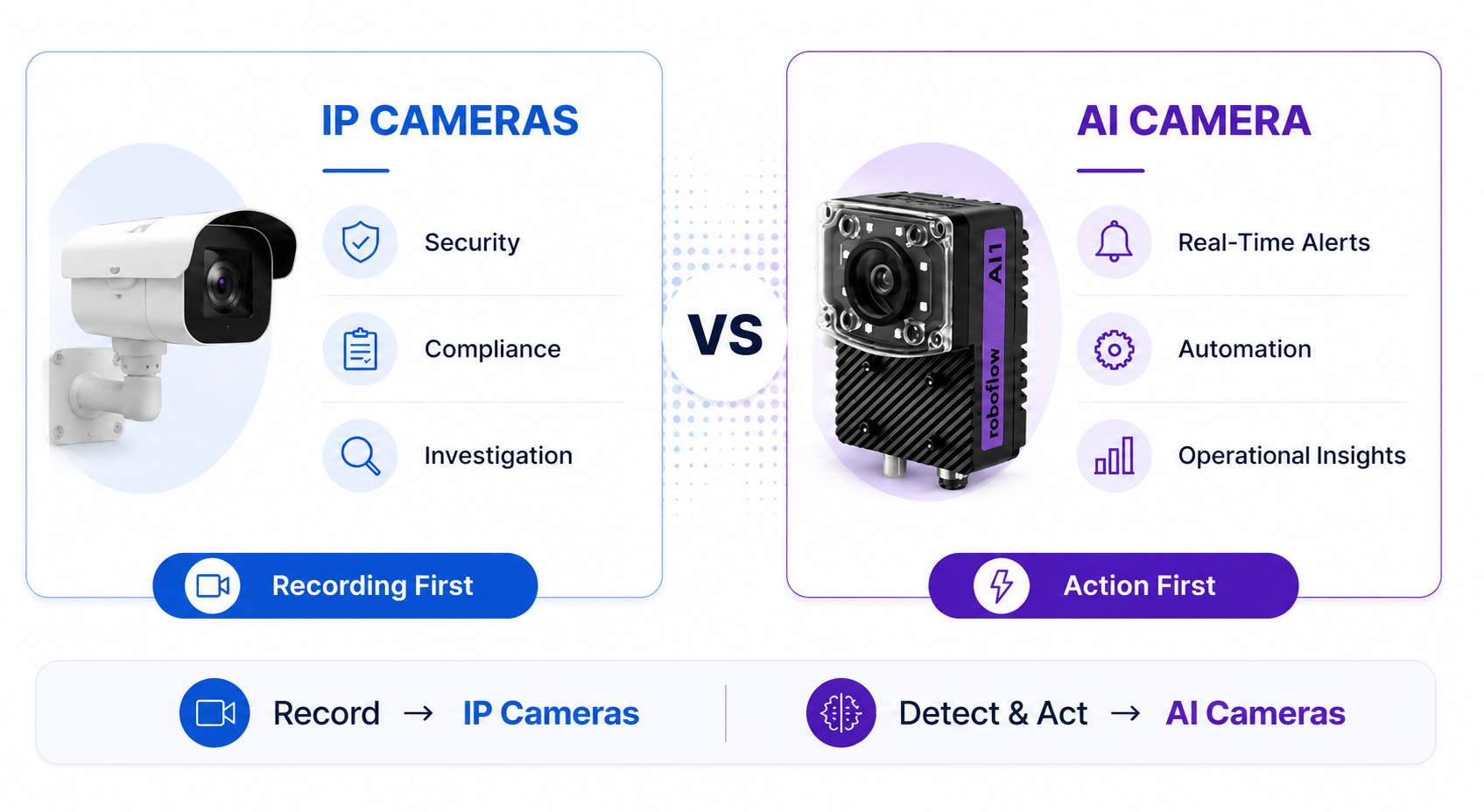
If the primary goal is recording footage for security, compliance, or incident investigation, traditional IP cameras remain a practical and cost-effective option. They are well-suited to smaller deployments where footage is reviewed only when needed and advanced analytics are not a priority.
AI cameras are designed for a different objective. Rather than simply storing video, they analyze activity in real time, generate alerts, and provide operational insights that can support safety, quality, and process improvement initiatives. This makes them particularly valuable in manufacturing, logistics, transportation, and other environments where responding quickly to events matters.
For organizations looking to move beyond video recording, integrated vision systems provide a more streamlined path to deploying vision AI.
AI Cameras vs. IP Cameras Conclusion
The growing adoption of computer vision is changing how organizations think about cameras. The question is no longer only how much video can be captured and stored, but also how quickly that video can be turned into useful decisions.


Cite this Post
Use the following entry to cite this post in your research:
Mostafa Ibrahim. (Jun 1, 2026). AI Cameras vs. IP Cameras: What's the Difference?. Roboflow Blog: https://blog.roboflow.com/ai-cameras-vs-ip-cameras/