

Vision AI in manufacturing automation means using cameras and trained models to automate work that once required a person watching the line: quality inspection, jam detection, safety monitoring, and inventory counts. Manufacturers running these systems are seeing concrete returns. One agricultural equipment maker saved at least $8 million per facility, another cut customer returns in half through automated quality inspection, and a third reduced inventory update time by 90%.
This guide covers what vision AI can automate in a factory, the use cases where manufacturers see returns first, how it differs from traditional machine vision, and a step-by-step path to deploying it on your own line.
What vision AI automates in manufacturing
Vision AI (also called computer vision) is software that interprets what a camera sees. In manufacturing automation, it takes over the visual tasks in a process: is this part the right size; is this weld sound; is this label readable; is a person standing where a forklift is about to be?
The mechanics are consistent across use cases. Cameras on the line feed images to a trained model. The model detects, classifies, or measures what it sees. Logic downstream of the model turns that output into an automated action: reject the part, stop the conveyor, alert a supervisor, log the event to a database.
Most manufacturing automation handles movement and repetition; vision AI adds judgment. Manufacturers apply it to four broad jobs:
- quality inspection (finding defects a human inspector would catch on a good day, on every part, every shift)
- process monitoring (spotting jams, verifying assembly steps, tracking throughput)
- safety (detecting PPE violations and near-collisions) and
- tracking (counting inventory, reading labels and serial numbers as goods move).
Where manufacturers see returns from automation first
Experimenting with vision AI is simple; the hard part is getting into production and scaling results. Based on successful deployments among manufacturers using Roboflow, here are the highest value places to automate first:
- Detecting jams, pileups, or bunching along assembly lines
- Identifying quality issues and defects in products, packaging, and labels
- Alerting facility staff to safety and health hazards
Each of the following stories comes from a manufacturer running these systems in production today.
Need help automating with vision AI at your business? Talk to us.
Solution 1: Avoiding jams and pileups
Our first story comes from a company that produces building and construction materials. In the past, as products moved along their production line, if one item was angled or sized incorrectly, it would get snagged and jam machinery. This resulted in unplanned downtime, damaged products, and time lost clearing the line.
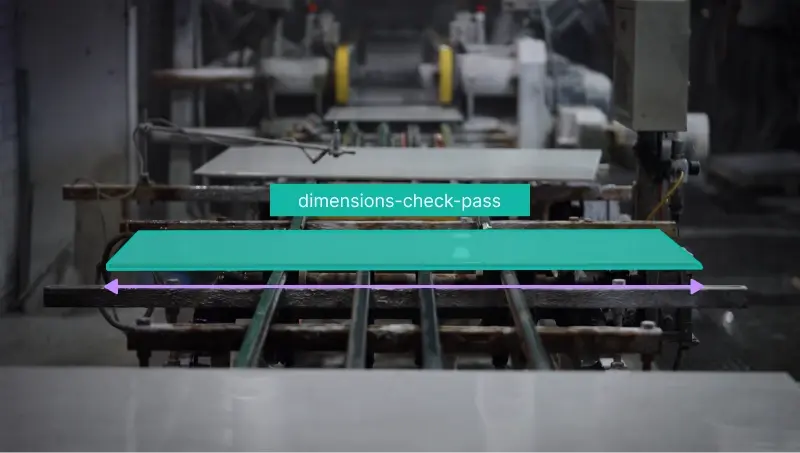
To avoid these costly pileups, the company rolled out an automated monitoring system that continuously tracks goods moving along the production line. It identifies when a component is the wrong size or angled incorrectly. When a problem is detected, it triggers an alarm for production crews to resolve the issue proactively.
During the implementation process, the system identified an average of nine daily issues, each of which could have caused an hour of downtime. That translates to around 3,000 hours of unplanned downtime prevented annually.
Solution 2: Identifying defects in products, packaging, and labels
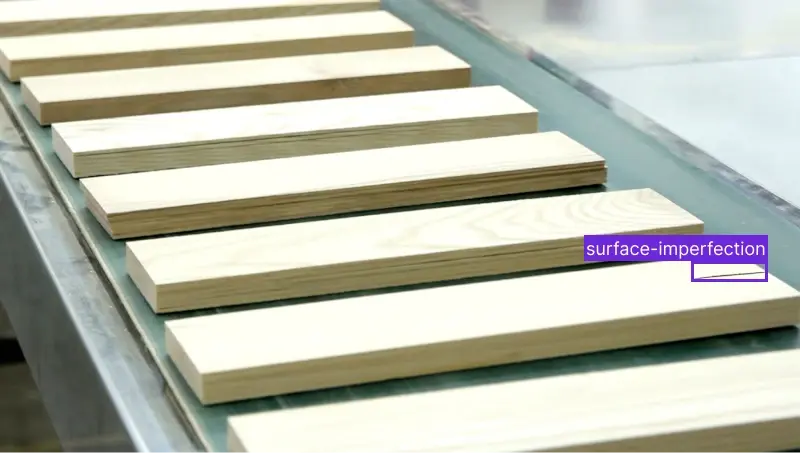
Our next story comes from a manufacturer of wood, fiberglass, and vinyl building products. They wanted to improve quality control and reduce downstream issues like reworking products and processing return requests.
To accomplish that, the company deployed a vision AI system that automates quality inspections. Compared to traditional machine vision solutions, their modern AI system can identify nuanced variations in product specifications like color, texture, inaccurate labels, and other slight imperfections.
By automatically detecting these quality issues earlier in the production process, this manufacturer minimized the number of defects going out the factory door. As a result, they project at least 60% fewer return and exchange requests annually.
For a practitioner's account of making automated inspection stick on the floor, Florida Crystals' (parent company of Domino Sugar) quality leader shares what actually worked, mostly change management and operator feedback loops, in making visual AI standard practice in complex manufacturing.
Solution 3: Alerting staff to safety and health hazards
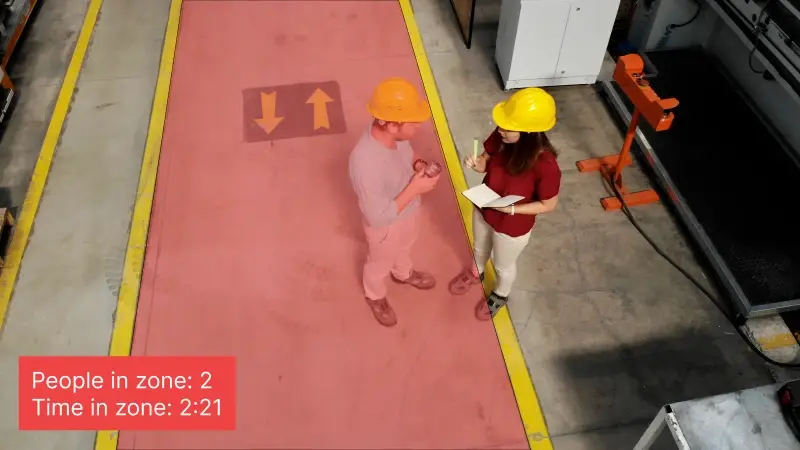
When monitoring the safety of employees, it's crucial to detect hazards and dangerous behavior before an incident occurs. One story that exemplifies this comes from a global manufacturer of industrial equipment.
The company is introducing an automated monitoring system that detects near-collisions between vehicles and humans. In addition to triggering a real-time warning, the system identifies the exact vehicle and records incidents of near-collisions to a database.
With this safety monitoring system in place, staff can review trends and take proactive steps, like scheduling additional training sessions or altering facility layout, to reduce the possibility of collisions in the future.
More manufacturing automation use cases for vision AI
The three patterns above are where we see the fastest returns, but they are not the whole map. Here is where else manufacturers are automating with vision AI, with guides for building each one:
- Defect detection: catch scratches, dents, cracks, and contamination on parts as they pass a camera. Start with our guide to building a defect detection system.
- Surface inspection: find surface defects on materials like metal, wood, and glass where texture variation defeats rules-based systems.
- Electronics inspection: verify solder joints and component placement with PCB defect detection.
- Weld inspection: grade weld quality in real time, including on robotic welding cells.
- Dimensional checks: measure parts against spec with automated dimensional inspection.
- Assembly verification: confirm every step happened, in order, before a unit leaves the station.
- Safety and PPE monitoring: detect missing hard hats, vests, and gloves, and flag people in restricted zones.
- Label and text reading: read serial numbers, lot codes, and labels, including with vision language models that can answer open-ended questions about what the camera sees.
- Inventory tracking: count pallets, bins, and finished goods automatically instead of by clipboard.
Case Studies of Computer Vision in Manufacturing
Next, let's walk through a few real-life case studies of large-scale and international manufacturing companies using computer vision systems to improve product quality, increase efficiency, etc.
Assessing Car Damage with Computer Vision
Using computer vision techniques like instance segmentation, damaged parts of a car can be detected. Volvo, a luxury vehicle manufacturer in Sweden, is using AI-powered automated systems to offer better car services to its customers. The automated systems, equipped with advanced machine learning and computer vision techniques, inspect the damaged vehicle, provide real-time feedback, and estimate the repair cost.
By assessing car damages with computer vision, car manufacturers and insurance companies can also process inspection operations faster and smoother. Customers can also benefit from faster repairs and quick claims.
Electronics Manufacturing
An electronic board can contain around 5,000 to 8,000 solder joints, making it nearly impossible for humans to inspect each one accurately with the naked eye. Manufacturers are using PCB inspection cameras with computer vision to improve flaw detection in circuit boards. Bosch uses AI-driven systems to check whether all the elements in a circuit board are soldered with perfection.
How does this work? PCB inspection cameras capture high-quality images of the circuit board. Computer vision algorithms then extract specific information, such as joints, corners, and textures. The extracted information is processed and analyzed to detect defects or misplaced joints. A visual inspector reviews the defects spotted by AI and makes any necessary adjustments.
Food and Beverage Industry
Computer vision systems are also becoming common in the food and beverage industry. For instance, a German bottle cap manufacturer has introduced a machine vision inspection system to improve quality control for ceramic beer bottle caps. Previously inspected by humans, the caps are now checked automatically using computer vision.
The system analyzes each cap for flaws in shape, material, and print quality, comparing them to a perfect model to catch issues like color variations, missing edges, or other defects. If a defect is found, the cap is redirected for further inspection. It inspects up to 120 caps per minute, increasing accuracy and efficiency while reducing the need for manual labor.
Vision AI vs. traditional machine vision
Most plants already automate some inspection with machine vision: fixed cameras with rules-based software checking parts against a template. Vision AI is a different approach, and the difference matters most where traditional systems fail.
| Traditional machine vision | Vision AI | |
|---|---|---|
| How it decides | Hand-written rules and thresholds | A model trained on example images |
| Handles variation (lighting, texture, color) | Poorly; rules break | Well; models learn the variation |
| Product changeover | Re-engineer the rules | Retrain on new examples |
| Hardware | Often specialized cameras and controllers | Works with commodity and existing cameras |
| New defect types | Requires new rules | Add labeled examples and retrain |
Traditional systems sometimes still win on simple, high-precision, fixed tasks like gauging a machined dimension under controlled lighting. Vision AI wins when the thing you're inspecting varies: natural materials, cosmetic defects, multiple SKUs on one line, outdoor or changing light. The manufacturer in Solution 2 above moved to vision AI for exactly this reason; their defects were subtle variations in color and texture that rules could not describe.
The ROI and benefits of automating with vision AI
Systems running in production see real returns today:
- $8 million saved per facility by an agricultural equipment maker
- Customer returns cut in half after automated quality inspection
- 90% less time spent updating inventory
- Roughly 3,000 hours of unplanned downtime prevented annually at one building materials plant
The pattern behind these numbers is consistent. Vision AI does inspection and monitoring work that was previously sampled (a human checks one part in fifty) at full coverage (every part, every shift). The savings come from catching problems earlier: before the jam stops the line, before the defective unit ships, before the near-miss becomes an incident.
Additional benefits include:
- Cost Reduction: In manufacturing, the longer a defect goes undetected, the more costly it becomes to repair. Detecting defects early in the production line reduces operational costs and minimizes raw material waste. Once trained to meet industry standards, the AI system can detect even the smallest defects consistently.
- Improved Product Quality: Computer vision systems reduce human errors, so only products meeting 100% quality standards reach the end of the production line.
- Scalability and Flexibility: Computer vision systems offer flexibility to adapt to various standards. They can be adjusted up or down based on industry requirements. By tweaking algorithms and using different vision models, industries can tailor computer vision systems to their needs. If demand increases, these systems can be scaled up with minimal effort.
This is also no longer early-adopter territory. Over half the Fortune 100 build with Roboflow, and models built on the platform have run more than 55 billion inferences in production across industries like rail, agriculture, and building products.
For what separates the deployments that produce this kind of value from pilots that stall, Roboflow CEO Joseph Nelson's framework for turning computer vision into real-world value names three requirements: data visibility, a proprietary model, and integration with business systems.
How to automate your line with vision AI
The manufacturers above did not start with a plant-wide rollout. They started with one line and one problem, as documented in the Center of Excellence Report. Here is the path we see work:
- Pick one measurable problem. Choose a line where you can name the cost today: hours of downtime, return rate, rework hours. This becomes your ROI baseline.
- Capture images from cameras you already have. You rarely need new hardware to start. Pull frames from existing IP cameras covering the line.
- Label examples and train a model. Annotate the defects, jams, or events you care about and train a model like RF-DETR on them. A few hundred labeled images is a common starting point.
- Fill data gaps with synthetic data. Rare defects are rare by definition; you may only have a handful of real examples. Synthetic data generation lets you train on defects you have barely seen in production.
- Connect the model to action. A model alone is a prediction; an automated system is a prediction plus logic. Use Workflows to chain the model with business rules: trigger the alarm, log the event, stop the line. Learn more about turning vision events into downstream actions through PLC and MES integrations.
- Deploy at the edge and measure. Run inference on-prem or on edge devices so the system works without cloud connectivity and meets plant IT requirements. Compare results against the baseline from step 1, then expand to the next line.
Teams following this path go from quality issue to successful production model.
Common challenges, and how plants handle them
Every one of the deployments above hit obstacles. Four come up repeatedly:
- Too few defect examples. Good production runs mean few defect images. Plants handle this with synthetic data, and by putting an early model into production in shadow mode so it collects and flags real examples that improve the next training run.
- Lighting and environment variation. Shifts change, seasons change, bulbs dim. This is the argument for learned models over rules, but it still requires capturing training images across the conditions the camera will actually see.
- Plant IT constraints. Many facilities restrict cloud connectivity or run air-gapped networks. Edge and on-prem deployment keeps inference inside the building.
- Scaling past the pilot. As one customer put it: "Achieving positive results using AI in a lab environment is easy, but the real challenge comes when scaling the solution across a network like ours without disrupting day-to-day operations." Standardizing on one platform for labeling, training, and deployment is what lets a model proven on one line roll out to twenty without a rebuild per site.
Roughly 77% of manufacturing vision AI initiatives never make it past the pilot stage, usually because of integration rather than model accuracy, and our guide to scaling a computer vision pilot to production covers how plants get through that gap.
Technologies behind computer vision in manufacturing
The applications above are built on a small set of technologies. Here is what each one does, and when you'd reach for it.
Machine learning and deep learning
Every vision AI application runs on a model: software trained to recognize objects, patterns, and irregularities in images and video. Object detection models, for example, find and locate specific things in a scene, whether that's a person near a forklift or a part on a conveyor.
What makes these models useful is that you train them on your products, your defects, and your lighting. The model keeps improving after deployment, too: parts it misclassifies become training examples for the next version.
3D imaging
2D cameras judge appearance. 3D imaging measures shape. Structured-light and laser scanners capture the surface of a part as a digital model, which you can compare against a defect-free reference or the CAD file to catch dents, warping, and dimensional drift that a flat image would miss.
The same scans work before production starts. Teams can build 3D models of prototypes and check fit and tolerances digitally before cutting material, so fewer iterations end up as scrap.
Edge computing and IoT
Where the model runs matters as much as how accurate it is. Sending every frame to a cloud server adds round-trip latency, and a line moving hundreds of parts a minute can't wait for it. Edge deployment runs the model on hardware next to the line, an industrial PC or a GPU device like an NVIDIA Jetson, so a camera can spot a defect and trigger a reject in the gap between one part and the next.
Local processing also keeps working when connectivity doesn't. Many plants restrict cloud access or run air-gapped networks, and an edge system inspects parts either way.
Robotics and vision systems
A robot without vision repeats the same motion whether or not the part is where it should be. Add a camera and a model, and the robot can find the part, adjust, and verify its own work. Assembling a single car body requires around 5,000 to 7,000 welding spots, each of which has to land precisely, on every unit, on every shift. The camera locates the seam, the model confirms position, the arm welds, and a second inspection pass grades the result.
Do we need new cameras to start?
Usually not. Most deployments start with frames pulled from existing IP cameras. Specialized hardware only enters the picture for tasks like high-speed lines or thermal imaging. Read our guide on how to use you current cameras for vision AI, and learn more about Roboflow's AI1, which packages camera, compute, lighting, and Roboflow in one device.
Learn more about computer vision in manufacturing automation
See how Roboflow supports manufacturing use cases.
Ready to automate your line with vision AI? Talk to our team.
Keep Reading
- A blog post on computer vision solutions for steel manufacturing.
- An article on how to build a computer vision model to count rebar.
- Read more on how to track and count objects using RF-DETR.


Cite this Post
Use the following entry to cite this post in your research:
Patrick Deschere. (May 1, 2026). Computer Vision in Manufacturing Automation: Use Cases, ROI, and How to Deploy. Roboflow Blog: https://blog.roboflow.com/computer-vision-in-manufacturing/