

OPC UA (Open Platform Communications Unified Architecture) is the vendor-neutral communication standard that lets machines, controllers, and software systems on the factory floor exchange data in a structured, secure way. For manufacturers deploying vision AI, OPC UA solves a persistent problem: inspection results trapped in a silo. By publishing model outputs such as pass/fail decisions, defect classes, and confidence scores as OPC UA nodes, Roboflow's vision system can talk directly to PLCs, MES, SCADA, and historians. The result is a factory where cameras do not just see problems, they trigger the response.
The Interoperability Problem OPC UA Was Built to Solve
Walk through any established manufacturing plant and you’ll find equipment from a dozen vendors installed across three decades. A Rockwell PLC runs one line, a Siemens controller runs another, the MES came from a third supplier, and the historian from a fourth. Each of these systems speaks its own dialect, and for years, connecting them meant writing and maintaining brittle custom drivers.
OPC UA changed that. Released in 2008 by the OPC Foundation as the successor to the original OPC standard, OPC UA provides a platform-independent, service-oriented architecture for industrial communication. Unlike its predecessor, it does not depend on Microsoft's COM/DCOM technology, so it runs on Windows, Linux, embedded controllers, and edge devices alike.
Three characteristics explain why OPC UA has become the backbone of modern factory automation:
- A rich information model. OPC UA moves raw values, but it also carries structure and context. A temperature reading, for example, arrives with its units, its source, its timestamp, and its relationship to the machine that produced it. In this way, data becomes self-describing.
- Built-in security. Certificate-based authentication, message signing, and encryption are part of the specification, not an afterthought. In an era of increasing OT cybersecurity threats, this matters.
- Platform and vendor independence. Any OPC UA client can read from any OPC UA server, regardless of who manufactured the underlying equipment.
In practice, OPC UA works on a client-server model, with a publish-subscribe option for high-volume scenarios. A machine or software application runs an OPC UA server that exposes its data as an address space of nodes. Clients browse that address space, read values, write setpoints, and subscribe to changes. The MES, the SCADA system, and the quality database all consume the same structured data from the same source.
What Is OPC UA?
OPC UA (Open Platform Communications Unified Architecture) is a vendor-neutral, platform-independent standard for industrial machine-to-machine communication, published as IEC 62541 and maintained by the OPC Foundation. It lets PLCs, sensors, software systems, and edge devices exchange structured, secure, self-describing data, regardless of who manufactured the underlying equipment.
OPC UA vs OPC Classic
The original OPC standard (now called OPC Classic, including OPC DA for data access) was built on Microsoft's COM/DCOM technology, which tied it to Windows and made it notoriously difficult to run across firewalls. OPC UA replaced that foundation entirely: it is platform-independent, runs on Linux and embedded hardware, adds security to the specification itself, and folds data access, alarms, and historical data into one framework. New deployments should start with OPC UA; OPC Classic survives mainly in legacy installations behind gateways.
The New Data Source on the Factory Floor
While OPC UA was maturing, another technology was transforming what factories can measure. Computer vision models now inspect products at line speed, detecting surface defects, verifying assemblies, reading labels, and monitoring processes that previously required human eyes. Modern platforms have made it practical to train and deploy custom defect inspection models without a team of machine learning specialists.
The challenge, of course, is that a vision system that identifies a defective part has produced valuable information only if something acts on it. Too many vision deployments end at a dashboard. The camera sees the flaw, the model flags it, and the result lands in a standalone application that nobody connects to the rest of the plant. The defective part continues down the line. The machine that caused the defect keeps running with the same parameters. The MES records the lot as clean.
This is the vision silo, and it’s the most common reason that vision projects stall after the pilot phase. The model works as intended, but the integration doesn’t.
OPC UA as the Bridge Between Vision Systems and Everything Else
OPC UA gives inspection results a first-class seat in the plant's data architecture. Instead of living in a proprietary application, vision outputs become structured nodes that any authorized system can consume.
Consider what a Vision AI inspection result actually contains: a pass/fail decision, a defect classification, a confidence score, coordinates of the flaw, a part identifier, and a timestamp. That is structured data, and it maps naturally onto OPC UA's information model. Once the vision system exposes those results through an OPC UA server (or publishes them to an existing one), the downstream possibilities open up:
- The PLC subscribes to the pass/fail node and actuates a diverter to reject the defective part, all within the cycle time of the line.
- The MES logs the defect class and image reference against the work order, building a complete quality genealogy for the lot.
- The SCADA system displays live inspection status alongside machine states, so operators see quality and equipment health on one screen.
- The historian archives every result, creating the dataset that quality engineers mine for trends and root causes.
As you can see, the vision model supplies the perception. Then the OPC UA supplies the plumbing. Neither is useful at scale without the other.
The OPC Foundation has recognized this convergence formally. The OPC UA for Machine Vision companion specification (OPC 40100), developed with the VDMA, standardizes how vision systems expose their state, results, and recipe management over OPC UA. A plant running vision systems from multiple vendors can integrate them all through one consistent interface.
How This Works on the Factory Floor
Picture a bottling line running at 600 units per minute. A camera positioned after the capper feeds frames to a defect detection model running on an edge device. The model checks every cap for proper sealing and seal integrity.
When the model detects a faulty cap, the sequence unfolds in milliseconds. The inference result publishes to an OPC UA node. The line PLC, subscribed to that node, fires the reject mechanism at exactly the right moment. The MES increments the defect count for the batch and stores the inspection image. If the reject rate crosses a threshold, the SCADA system raises an alarm suggesting the capper needs adjustment, and a maintenance work order generates automatically.
This same pattern extends across use cases:
- Weld inspection results feed back to welding parameters.
- Label verification results gate the palletizer.
- Assembly verification results release or hold the part at each station.
In every case, the machine vision system participates in the control loop rather than observing from the sidelines. Because inspection results flow into the same infrastructure as availability and performance data, they also feed quality metrics directly, closing the loop on OEE measurement.
OPC UA and MQTT and Modebus: Complementary, Not Competing
Not sure which protocol to standardize on? Most plants rely on more than one, because the three solve different problems at different layers.
| OPC UA | MQTT | Modbus | |
|---|---|---|---|
| Model | Client-server, plus pub/sub | Pub/sub via broker | Client-server (request/response) |
| Data | Self-describing information model: values carry units, timestamps, and context | Raw payloads; meaning defined by convention | Registers and coils; no context |
| Security | Certificates, signing, and encryption in the spec | TLS and auth as add-ons | None |
| Overhead | Higher; built for rich plant-floor data | Very low; built for constrained links | Minimal |
| Best at | Interoperating with PLCs, MES, and SCADA | High-volume telemetry to brokers and cloud | Simple device-level I/O and legacy retrofits |
| Default port | 4840 | 1883 / 8883 (TLS) | 502 |
A reasonable rule of thumb: use OPC UA where structured, contextualized data must interoperate with control systems and MES; use MQTT where you need lightweight, high-volume messaging to brokers and cloud analytics; and expect to meet Modbus wherever legacy devices need to be read.
It is straightforward to broadcast computer vision predictions over MQTT, and Vision AI results often travel both paths simultaneously, driving real-time control through OPC UA while streaming telemetry northbound over MQTT.
Connect Your Vision System to the Rest of Your Factory
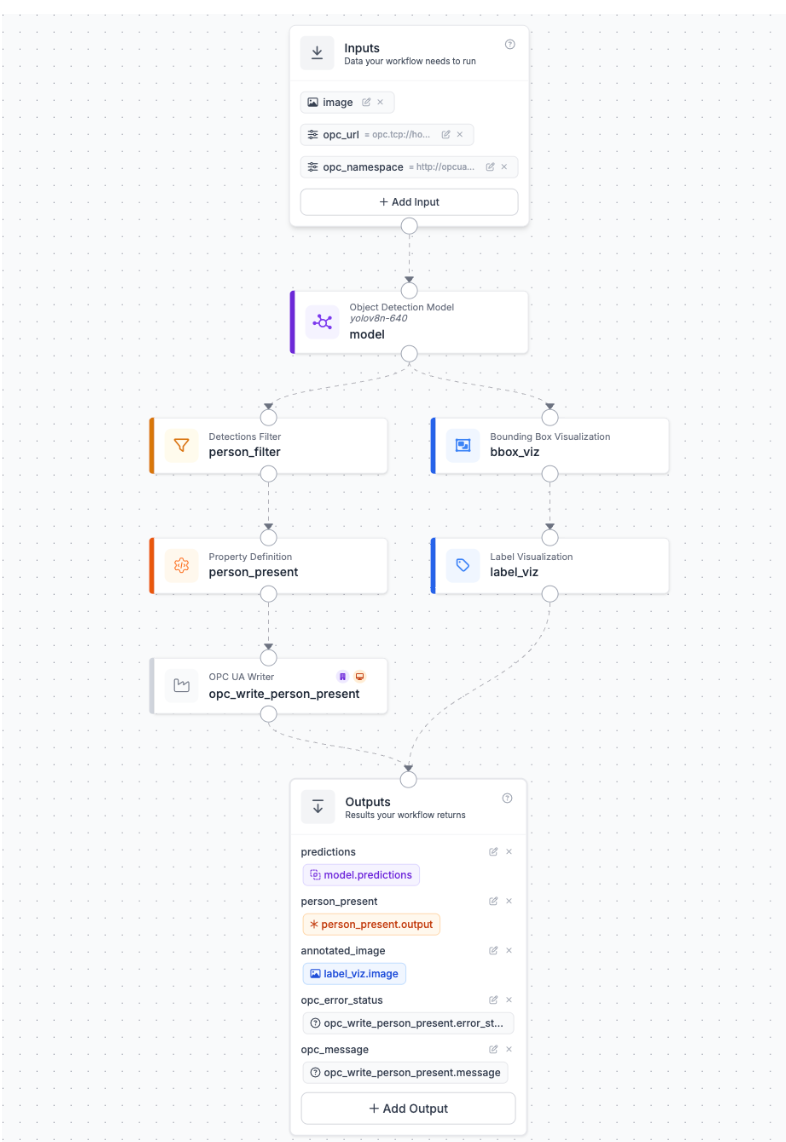
Connecting Vision AI to your factory through OPC UA is more approachable than it was. Roboflow Workflows includes native blocks for OPC UA, MQTT, and PLC triggers, so a vision pipeline built in the browser can publish inspection results directly to your industrial systems without custom middleware. The practical path looks like this: train a model on your parts, deploy it to an edge device at the line, configure the workflow to publish results to your OPC UA infrastructure, and let your existing PLC and MES logic take it from there.
Further reading:
Is OPC UA secure enough for plant networks?
Yes. Security is built into the specification, including certificate-based authentication, message signing, and encryption. Proper deployment still requires certificate management and network segmentation, but the foundation is far stronger than legacy industrial protocols.
Can a Vision AI system connect directly to a PLC through OPC UA?
Yes. Most modern PLCs either run an embedded OPC UA server or connect through a gateway. A vision system can publish inspection results to OPC UA nodes that the PLC reads, enabling real-time actions like part rejection within the line's cycle time.
Do I need OPC UA if I already use MQTT?
Not necessarily, but the two serve different purposes. MQTT moves lightweight messages efficiently, while OPC UA adds semantic structure, security, and native integration with control systems. Many plants run both, and vision platforms such as Roboflow support both protocols.
What is the OPC UA for Machine Vision companion specification?
OPC 40100 is a companion specification developed by the OPC Foundation and VDMA that standardizes how machine vision systems expose their state, results, and recipes over OPC UA, so vision systems from different vendors integrate through one consistent interface.


Cite this Post
Use the following entry to cite this post in your research:
Erik Kokalj. (Jun 2, 2026). What Is OPC UA? How Factories Connect Vision AI to PLCs. Roboflow Blog: https://blog.roboflow.com/what-is-opc-ua-how-factories-connect-vision-ai-to-plcs/