

The best open-source OCR models today are small dedicated document models, not large VLMs: PaddleOCR-VL-1.6 (96.34%), MinerU2.5-Pro (95.75%), and GLM-OCR (95.22%) take the top three spots on OmniDocBench v1.6 at 0.9 to 1.2B parameters, beating Qwen3-VL-235B (89.78%) at a fraction of the compute. Reach for a general-purpose VLM like Qwen3.5 when you need reasoning over the document as well as reading it, and run either kind as a block in Roboflow Workflows without deploying the model yourself.
Various industries use Optical Character Recognition (OCR) to read and extract text from images, scanned documents, and printed or handwritten materials. OCR converts them into searchable, copyable, and machine-readable text, enabling organizations to automate data entry, streamline document processing, bring real-world information into digital workflows, and reduce manual effort.
Depending on their infrastructure, privacy requirements, and customization needs, organizations may deploy open-source OCR models on their own infrastructure rather than relying on commercial OCR APIs.
In this guide, we evaluate the leading open-source OCR models in 2026, compare their performance across OCR-specific benchmarks, and examine how they stack up against general-purpose open-source vision-language models. We also explore their key capabilities and learn how to integrate them into Roboflow Workflows.
Dedicated Open-Source OCR Models vs. General-Purpose Open-Source VLMs
Dedicated open-source OCR models such as PaddleOCR-VL, MinerU2.5, and GLM-OCR are specifically optimized for document understanding tasks, including text recognition, document parsing, table extraction, formula recognition, layout analysis, and reading-order detection.
General-purpose vision-language models (VLMs), such as Qwen3-VL, Llama 3.2 Vision, and Ovis2.6-30B-A3B, are designed for a much broader range of visual tasks, including image understanding, visual question answering, chart interpretation, and general visual reasoning. This difference in specialization can be significant on OCR-specific benchmarks.
On OmniDocBench v1.6 (a benchmark for evaluating document parsing and understanding), dedicated OCR models occupy many of the top positions, with PaddleOCR-VL 0.9B scoring 96.34% to rank first, followed by MinerU2.5-Pro 1.2B at 95.75% and GLM-OCR 0.9B at 95.22%.
By comparison, the general-purpose VLM Ovis2.6-30B-A3B scores 93.70% and ranks eighth, despite having roughly 10 to 30 times more parameters than these specialized models.
The advantage becomes even more apparent when considering accuracy relative to model size. GLM-OCR reaches 95.22% with only 0.9B parameters, while Ovis2.6-30B-A3B reaches 93.70% with 30B parameters. Likewise, Qwen3-VL-235B scores 89.78% despite having 235B parameters.
This efficiency is important for self-hosted document-processing systems and large-scale workloads. A 0.9B model such as PaddleOCR-VL or GLM-OCR requires substantially less GPU memory and compute than a 30B, 72B, or 235B general-purpose VLM. This can translate into higher throughput, more concurrent requests per GPU, lower inference costs, and easier deployment on consumer GPUs or smaller datacenter infrastructure. For workloads involving thousands or millions of pages, these differences can have a major impact on overall operating costs.
However, general-purpose VLMs are not simply inferior OCR models. Their primary advantage is versatility. A model such as Qwen3-VL-235B can read a document, reason about its contents, answer questions, interpret charts, identify objects, analyze photographs, and perform broader visual reasoning within a single model. This makes them more attractive when document understanding is only one component of a larger multimodal application.
For example, extracting tables and structured information from 100,000 invoices is a strong use case for a dedicated OCR model. In contrast, analyzing an invoice, explaining an unusual total, comparing it with a previous invoice, and interpreting an accompanying product photograph is better suited to a general-purpose VLM.
Best Dedicated Open-Source OCR Models
These models are purpose-built for OCR, with different strengths in text recognition, detection, accuracy, efficiency, and document parsing.
Among them, PP-OCR, GLM-OCR, and EasyOCR are readily available as workflow blocks in Roboflow Workflows, allowing you to integrate OCR directly into your vision pipelines without writing complex code or managing the underlying infrastructure.
1. PaddleOCR
PaddleOCR-VL-1.6 is a vision-language model (VLM) specifically optimized for document parsing and recognition. Unlike general-purpose VLMs, it is designed around document-centric tasks such as recognizing text, tables, formulas, charts, and other structured elements while preserving document layout and reading order. The model uses a compact 0.9B-parameter architecture, allowing it to deliver strong document understanding with relatively low computational requirements.
PaddleOCR-VL-1.6 achieves 96.34% on OmniDocBench v1.6, setting a state-of-the-art result on the benchmark. It delivers leading performance in overall document parsing, text, formula, and table recognition, while also demonstrating strong reading-order performance. It also achieves state-of-the-art results under challenging image conditions, including skew, scanning artifacts, warping, screen photography, and uneven illumination.
PaddleOCR-VL-1.6 operates within a broader two-stage document parsing pipeline that combines layout analysis with VLM-based recognition. PP-DocLayoutV3 performs layout analysis, while PaddleOCR-VL-1.6-0.9B handles element-level recognition and parsing.

This architecture allows PaddleOCR-VL-1.6 to produce high-quality document parsing with a compact 0.9B model, making it particularly attractive for production document processing and large-scale OCR workloads.
Given below are examples of OCR performed using the PaddleOCR-VL-1.6 model within the two-stage pipeline on various input images and scanned PDFs to generate Markdown.

PaddleOCR-VL-1.6 Supports 109 languages, covering major global languages, including but not limited to Chinese, English, Japanese, Latin, and Korean, as well as languages with different scripts and structures, such as Russian (Cyrillic script), Arabic, Hindi (Devanagari script), and Thai.
PaddleOCR-VL-1.6 is licensed under the Apache License 2.0 (Apache-2.0), which permits commercial use, modification, distribution, and private use, provided that the license and copyright notices are retained and its terms are followed.
2. PP-OCR
PP-OCR also belongs to the PaddleOCR ecosystem alongside PaddleOCR-VL. However, unlike PaddleOCR-VL, which uses a vision-language model for broader document parsing and understanding, PP-OCR is a dedicated OCR system that uses specialized detection and recognition models primarily for scene text recognition.
PP-OCR is designed to answer “Where is the text, and what does it say?”, while PaddleOCR-VL is designed to understand “What are the different elements in the document, and how are they structured and related?” This makes PP-OCR particularly well suited for extracting text from real-world images such as signs, labels, receipts, product packaging, and industrial displays, while PaddleOCR-VL is better suited for more complex document understanding tasks.
Because PP-OCR uses specialized detection and recognition models, it is more lightweight, faster, and computationally efficient than PaddleOCR-VL, making it well suited for high-throughput OCR applications and resource-constrained deployments.
The latest-generation PP-OCRv6 is available in Tiny, Small, and Medium configurations, ranging from 1.5M to 34.5M parameters, compared to the 0.9B-parameter PaddleOCR-VL-1.6 VLM. This difference in model size allows PP-OCRv6 to deliver OCR capabilities with substantially lower computational and memory requirements than PaddleOCR-VL-1.6.
PP-OCRv6-Tiny is particularly well suited for edge devices, lightweight local OCR applications, latency-sensitive deployments, and environments with limited computational resources.
The example below compares text detection and recognition across several models, including PP-OCRv6, PP-OCRv5, GPT-5.5, and Gemini 3.1 Pro. Highlighted text indicates content that was successfully detected and recognized. Across these images, the PP-OCR models outperform the general-purpose VLMs, even when text is affected by distortion, surface curvature, complex backgrounds, glare, small text sizes, or varied orientations.
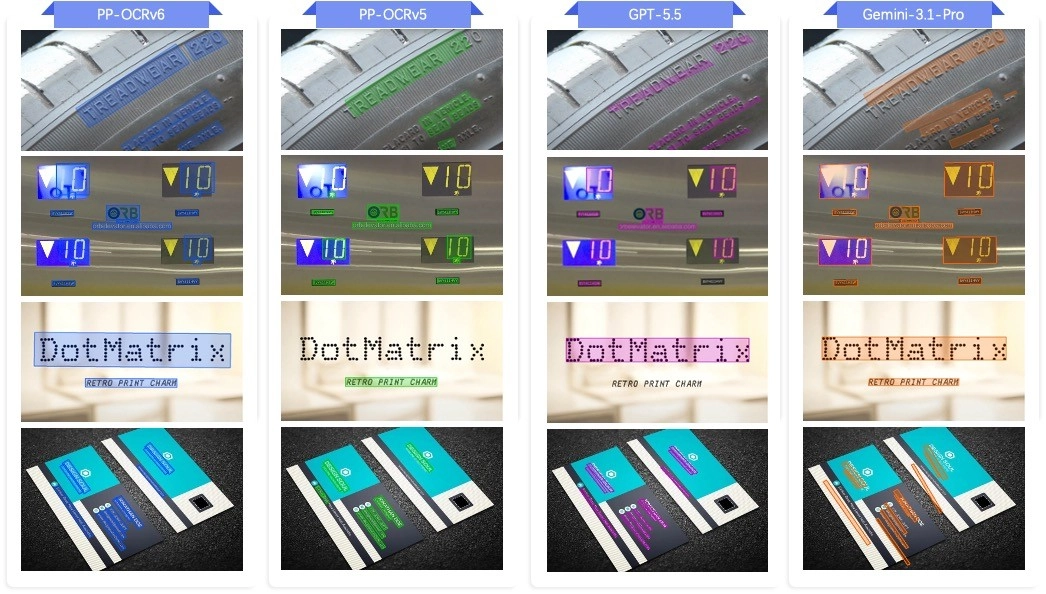
PP-OCRv6’s unified model supports 50 languages, including Chinese, English, Japanese, and 46 Latin-script languages. It is licensed under the Apache License 2.0.
3. GLM-OCR
GLM-OCR is a vision-language model (VLM) specialized for OCR and complex document understanding. Built on the GLM-V encoder-decoder architecture, it is designed to recognize and interpret not only ordinary text but also challenging document elements such as tables, formulas, code, stamps, and mixed text-image content. Its compact 0.9B-parameter architecture allows it to provide strong document recognition while keeping inference and deployment costs relatively low.
Similar to PaddleOCR-VL-1.6, GLM-OCR can be used within a two-stage document processing pipeline that combines layout analysis with parallel recognition. PP-DocLayoutV3 first analyzes the document and identifies its individual elements. GLM-OCR then processes the detected regions in parallel, generating recognition and parsing results that are assembled according to the document structure.
At launch, GLM-OCR achieved a score of 94.62% on OmniDocBench v1.5, ranking first on the leaderboard at the time. On the newer OmniDocBench v1.6, GLM-OCR achieves a score of 95.22%, ranking third on the leaderboard.
A key strength of GLM-OCR is its robustness on complex and heterogeneous documents. It is designed to handle challenging cases such as intricate tables, code documentation, stamps, diverse fonts, irregular layouts, and documents containing both text and visual elements.
The example below demonstrates GLM-OCR’s ability to convert code documentation from an image into structured Markdown while preserving the heading hierarchy, text formatting, and code structure.

In speed evaluations using identical hardware and testing conditions, including single-replica and single-concurrency configurations, GLM-OCR achieved approximately 1.86 pages per second for PDF documents and 0.67 images per second for image inputs when parsing and exporting results as Markdown.

GLM-OCR supports eight languages: Chinese, English, French, Spanish, Russian, German, Japanese, and Korean. The official GLM-OCR model is licensed under the MIT License, which permits users to freely use, modify, distribute, and commercially use the software, subject to the license terms, while its integrated PP-DocLayoutV3 component is licensed under Apache License 2.0.
4. MinerU
MinerU is an document parsing framework designed primarily for converting complex documents, especially PDFs, into structured, machine-readable formats.
Unlike a single OCR or VLM model, MinerU coordinates multiple specialized models and components for layout analysis, OCR, table recognition, formula recognition, image extraction, and reading-order reconstruction. This makes it particularly effective for academic papers, technical reports, financial documents, scanned pdf images, and other documents with complex layouts.
MinerU goes beyond plain text extraction by reconstructing the structure and semantics of documents, identifying elements such as text, headings, paragraphs, lists, tables, formulas, images, captions, headers, footers, footnotes, and page numbers while preserving their logical reading order.
It is particularly effective at handling complex PDF layouts, including single- and multi-column documents, dense tables, mathematical equations, and mixed text-image content.
It converts the extracted content into structured formats such as Markdown and JSON, with formulas rendered in LaTeX and tables reconstructed as HTML. By preserving the document hierarchy its output is well suited for downstream applications such as RAG pipelines, knowledge-base construction, and LLM-based document analysis.

Another useful feature is MinerU's visualization capability. It can generate layout and span visualizations that allow users to inspect detected elements and verify parsing quality. This is particularly valuable when processing large collections of documents where errors in layout detection, reading order, or element extraction need to be diagnosed.
MinerU2.5-Pro achieves a score of 95.75% on OmniDocBench v1.6, ranking second on the leaderboard. Given below are the examples of OCR done using this pipeline:
MinerU supports 109 languages and is licensed under the Apache License 2.0 with additional terms. Commercial use is permitted subject to certain conditions, including additional licensing requirements at specified usage or revenue thresholds. Online services based on MinerU must also clearly indicate that MinerU is used.
5. dots.mocr
dots.mocr is a multimodal OCR and document parsing VLM with approximately 3B parameters, designed to go beyond conventional text extraction by jointly understanding the textual and visual structure of documents. Rather than treating a document as a collection of isolated text regions, it analyzes the page as a whole, combining text, visual elements, and layout into a unified representation.
The model can identify and reconstruct a wide range of document elements, including titles, paragraphs, tables, formulas, images, captions, headers, footers, and other visual structures. It can also determine their locations and reading order, and represent the extracted content in structured formats such as Markdown, HTML, and LaTeX.
A key differentiator of dots.mocr is its ability to reconstruct visual graphics as structured, editable content rather than simply treating them as images. It can generate SVG representations of charts, diagrams, UI layouts, scientific figures, and other graphical elements, converting visual information into machine-readable vector graphics. This makes SVG generation one of its most distinctive capabilities compared with document-focused systems such as PaddleOCR-VL, GLM-OCR, and MinerU.
The example demonstrates dots.mocr’s document parsing capabilities, extracting text, tables, charts, and formulas while preserving the document’s structure.

In document parsing evaluations, dots.mocr achieves an overall score of 83.9% on olmOCR-Bench (a benchmark focused on real-world PDF text extraction), ranking third in the reported evaluation. It also achieves a higher XDocParse Elo score (a ranking metric based on pairwise document parsing comparisons) than GLM-OCR and PaddleOCR in the reported comparison, indicating strong document parsing performance.
The model also performs strongly on image-to-SVG reconstruction benchmarks, including ChartMimic, Design2Code, SciGen, and ChemDraw, with reported results showing dots.mocr outperforming Gemini 3 Pro.
dots.mocr supports 100+ languages and is licensed under the MIT License with additional terms that governing the model materials.
6. Chandra OCR 2
Chandra OCR 2 is a document parsing vision-language model (VLM) designed to convert document images and PDFs into structured, machine-readable content. Chandra OCR 2 focuses on high-fidelity document reconstruction, recognizing standard text while understanding complex elements such as tables, mathematical formulas, code, headings, lists, forms, multi-column layouts, and handwriting.
It can convert documents into Markdown, HTML, or JSON with detailed layout information, making the output suitable for downstream applications such as RAG, document search, knowledge extraction, and LLM-based document processing.
Its key strength lies in its ability to extract images and diagrams along with text. It also offers excellent handwriting recognition, accurately reconstructs forms, including checkboxes, and performs well on tables, mathematical expressions, and complex document layouts.
On the olmOCR-bench, Chandra OCR 2 achieves an 85.8% score, placing it among the leading models evaluated on the benchmark.
The example demonstrates Chandra OCR 2’s ability to convert a handwritten mathematical document into structured Markdown while preserving headings, text, equations, and embedded diagrams.

Chandra OCR 2 supports 90+ languages and uses a modified OpenRAIL-M license for its model weights. The model is available for research, personal use, and certain smaller organizations, while broader commercial use and use that competes with the provider's offerings are subject to restrictions.
7. EasyOCR
EasyOCR is an open-source OCR library designed to make text detection and recognition accessible through a simple Python interface. It combines a text detection model with a recognition model to locate and extract text directly from images.
EasyOCR is primarily focused on text detection and recognition rather than comprehensive document understanding. It does not provide the same level of native support for document structure reconstruction, table parsing, formula recognition, or complex layout understanding. But what it does provide is a lightweight OCR solution that can detect and recognize text across a wide range of images without the computational requirements of larger VLM-based systems.
EasyOCR has relatively low hardware requirements. Its detection and recognition models can run on standard CPUs or consumer GPUs without requiring the large GPU memory typically associated with VLM-based OCR models. This makes it well suited for applications where simple, efficient text extraction and low processing requirements are more important than advanced document understanding.
EasyOCR is therefore particularly useful for applications where the primary requirement is localizing and extracting text from natural images, signs, screenshots, product labels, and other image-based content, rather than reconstructing the complete structure of complex documents. Its relatively low processing requirements also make it suitable for lightweight OCR deployments.
The example demonstrates EasyOCR's ability to extract and convert text from diverse, real-world scene images across multiple scripts and languages (English, Thai, and French) into structured text strings.
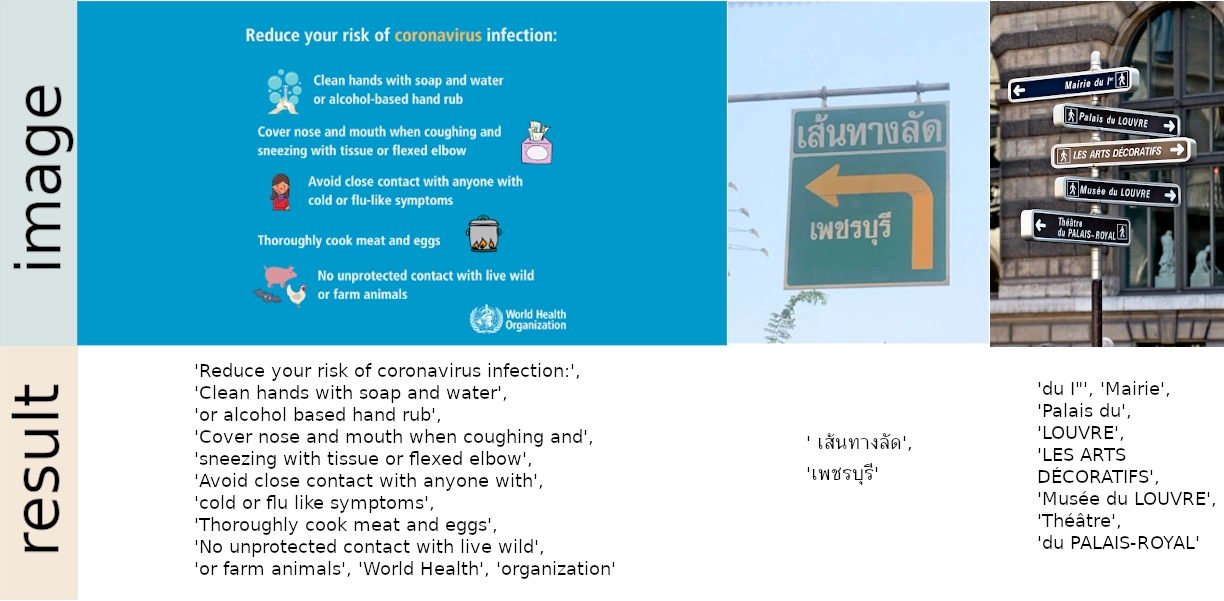
EasyOCR supports more than 80 languages, including English, Chinese, Japanese, Korean, Arabic, Hindi, and many other languages across different writing systems.
EasyOCR is licensed under the Apache License 2.0, which permits free use, modification, distribution, and commercial use, provided that the license and required notices are retained.
Best General-Purpose VLMs for OCR
General-purpose VLMs can also perform OCR while offering broader visual understanding and reasoning capabilities. Below are several open-source VLMs that can be used for OCR.
All the models mentioned below are readily available as workflow blocks in Roboflow Workflows, allowing you to integrate OCR directly into your vision pipelines without managing a separate OCR deployment. You can also try various other VLMs for OCR on Roboflow Playground.
1. Qwen 3.5
Qwen3.5 is a family of open-source vision-language models designed for general-purpose multimodal understanding. Unlike dedicated OCR models such as PaddleOCR-VL and GLM-OCR, Qwen3.5 is designed to handle a much broader range of tasks, including image understanding, visual question answering, document analysis, mathematical reasoning, chart interpretation, and multimodal reasoning.
The Qwen3.5 family is available in multiple sizes, ranging from compact models such as Qwen3.5-0.8B and Qwen3.5-2B to larger models such as Qwen3.5-9B and Qwen3.5-35B-A3B. This range allows developers to choose between computational efficiency and more advanced visual reasoning capabilities.
For OCR applications, Qwen3.5 can be prompted to extract text from images and documents, answer questions about document contents, interpret tables and charts, and return information in structured formats, as shown below.
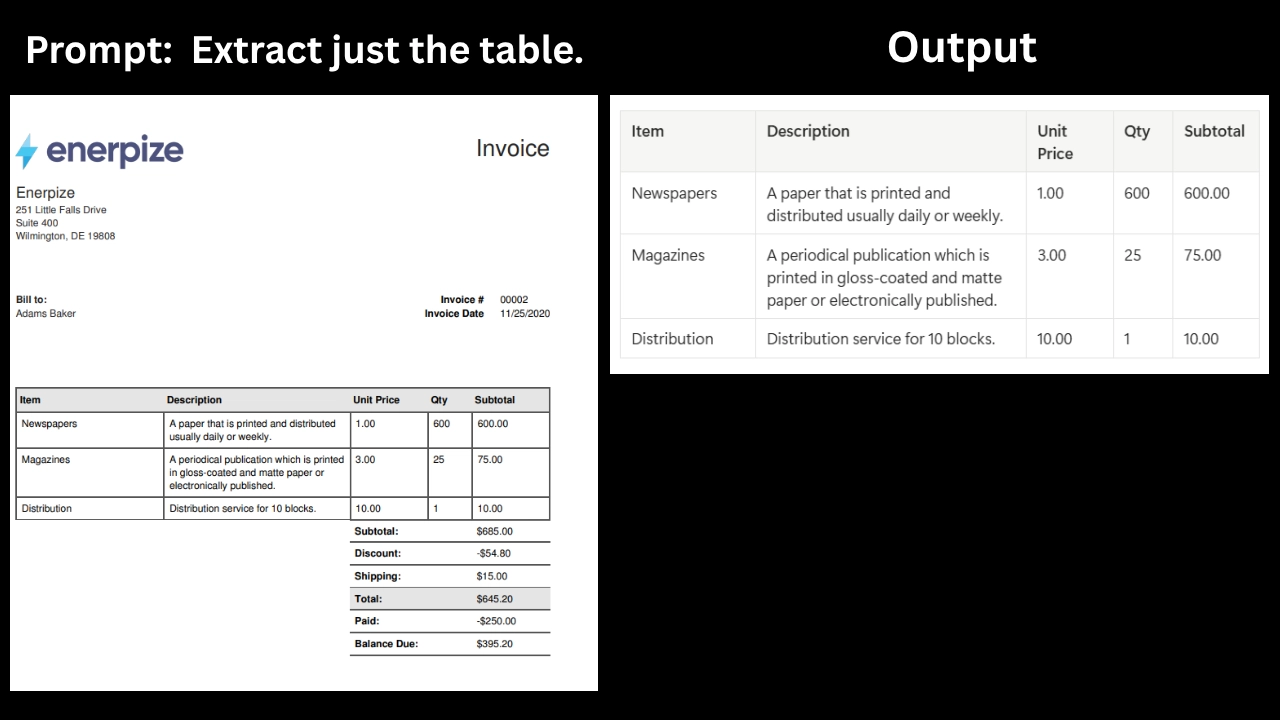
A key strength of Qwen3.5 is its reasoning capability. Instead of simply extracting text from a document, it can use the extracted visual information to answer questions, compare information, interpret visual relationships, and perform reasoning over the document. This makes it more flexible than a conventional OCR pipeline.
Qwen3.5 is therefore best suited to applications that require both OCR and broader visual reasoning, rather than high-volume text extraction alone.
All Qwen3.5 models are licensed under the Apache License 2.0, which permits free use, modification, distribution, and commercial use, subject to the terms of the license.
2. Florence-2
Florence-2 is Microsoft's compact vision-language model designed to perform a wide range of computer vision and vision-language tasks using a unified architecture. It is available in 0.23B-parameter base and 0.77B-parameter large variants, making it considerably smaller than many modern general-purpose VLMs.
Florence-2 can perform vision tasks such as image captioning, object detection, phrase grounding, image segmentation, and OCR.
For OCR tasks, Florence-2 can perform text recognition with visual localization. Instead of simply returning the text contained in an image, it can identify the location of text regions and return their corresponding coordinates. This makes it useful for applications where both the text and its position within the image are important.
For example, Florence-2 can be used to identify text on product labels, signs, screenshots, documents, and other images while also providing information about where the detected text appears.
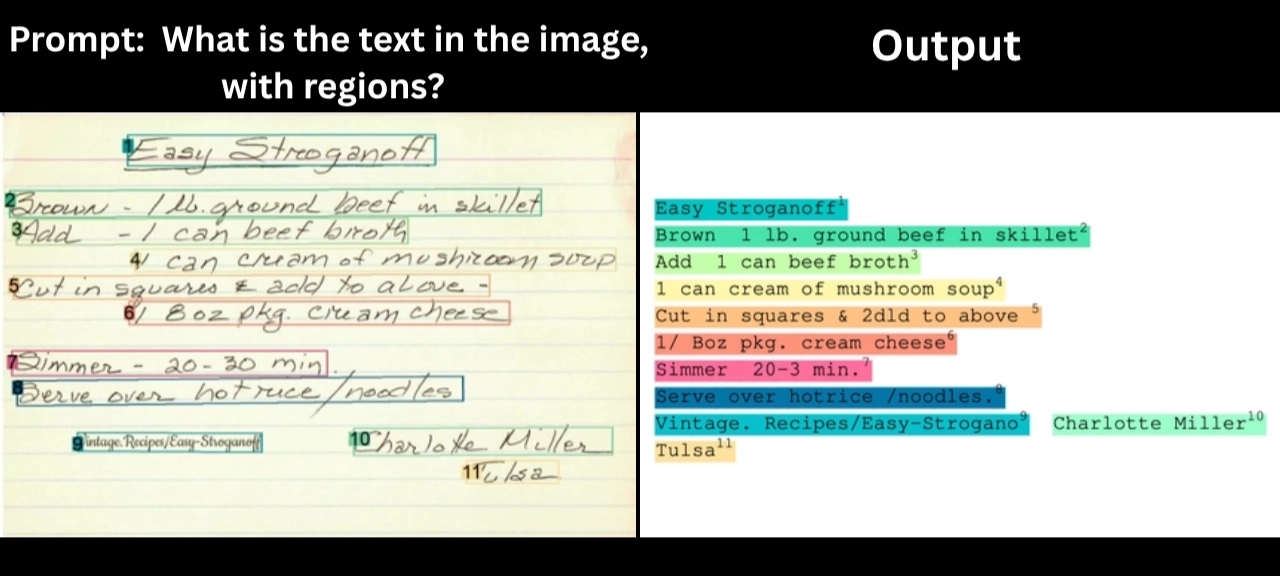
However, unlike document-focused OCR models, Florence-2 is not primarily designed for complex document reconstruction, table parsing, formula recognition, or comprehensive document understanding.
Its compact size makes Florence-2 particularly attractive for applications where inference efficiency is important. The base model contains approximately 0.23B parameters, while the large model contains approximately 0.77B parameters.
Florence-2 is therefore a useful middle ground between traditional OCR engines and much larger VLMs. It provides OCR and visual localization capabilities while remaining small enough for relatively lightweight deployments.
Florence-2 is licensed under the MIT License, which permits free use, modification, distribution, sublicensing, and commercial use, provided that the copyright and license notices are retained.
3. Smol VLM2
SmolVLM2 is a family of compact open-source vision-language models developed by Hugging Face for efficient multimodal understanding. The family includes 2.2B, 500M, and 256M parameter variants, allowing it to run in environments where larger VLMs would be impractical.
SmolVLM2 can perform tasks such as visual question answering, image captioning, document understanding, and text extraction. Its ability to combine visual inputs with natural-language instructions makes it possible to use the model for OCR by prompting it to extract or interpret text contained in an image.
The 2.2B-parameter SmolVLM2 model achieves a score of 72.9% on OCRBench, 79.98 % on DocVQA, and 73.21% on TextVQA, demonstrating that the model can recognize and reason about text in visual content. However, its OCR performance is below that of specialized document OCR models such as PaddleOCR-VL and GLM-OCR. Its advantage lies in combining multimodal reasoning capabilities with a compact model size.
The family also includes a 500M model and an even smaller 256M model, allowing multimodal applications to be deployed on significantly more constrained hardware than larger VLMs. Its strength lies in providing OCR capabilities in a small, efficient model while retaining the versatility of a general-purpose VLM for real-world applications.
The example below demonstrates this capability by using SmolVLM2 to read a serial number from an image of a metallic rim component.
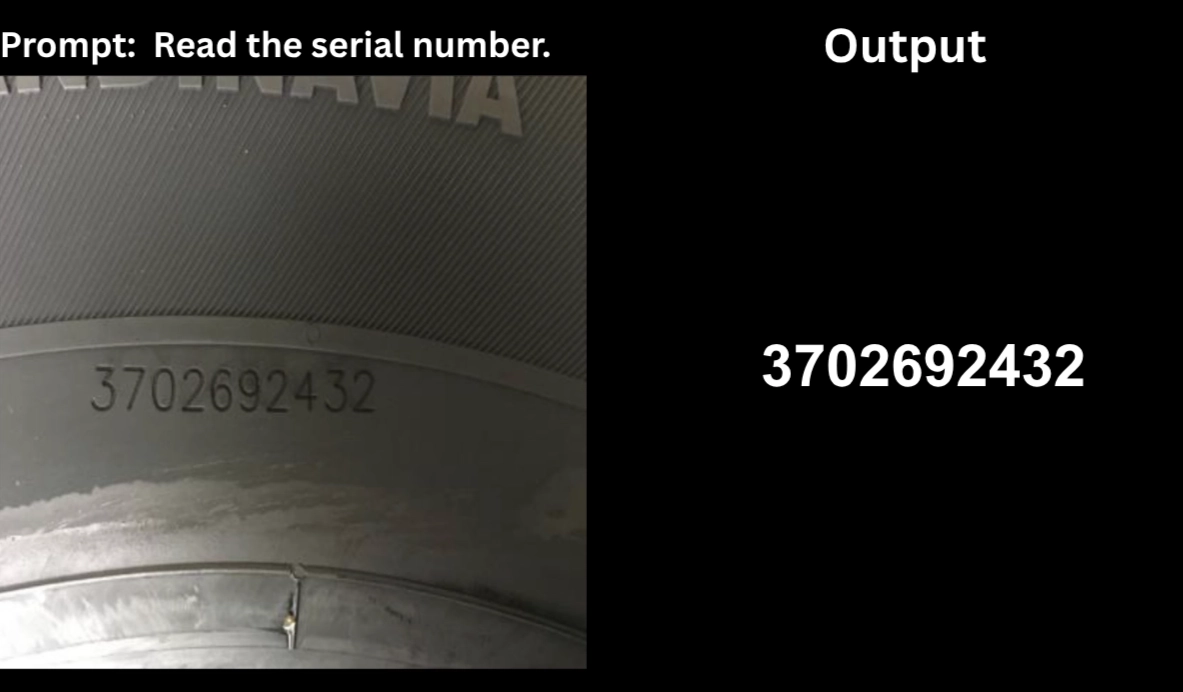
SmolVLM2 can therefore be useful for lightweight OCR and document-understanding applications where deploying a large VLM is unnecessary. It can read text from photographs, answer questions about documents, and perform OCR on resource-constrained or edge devices.
SmolVLM2 is licensed under the Apache License 2.0, which permits free use, modification, distribution, and commercial use, subject to the terms of the license.
Integrate Open-Source OCR Models into Computer Vision Workflows with Roboflow Agent
Roboflow Workflows is a visual, low-code platform for building computer vision workflows by connecting AI models, image processing operations, and custom logic through a drag-and-drop interface.
You don’t need to deploy models individually or build common image processing operations from scratch. Instead, you can assemble, customize, and connect the components of your computer vision workflow using readily available workflow blocks, then deploy your workflow with just a few clicks.
Popular open-source OCR models, such as PP-OCR and GLM-OCR, are also available as Workflow blocks, allowing you to drag and drop them directly into your workflow and integrate OCR capabilities without building the underlying model infrastructure yourself.
You can also use Roboflow Agent, available in your workspace after you log in, to generate workflows from natural language prompts.
Roboflow Agent provides a conversational interface for Roboflow tools such as Workflows. Rather than manually adding and connecting blocks, you can describe the workflow you want to build in natural language. The Agent then generates the workflow, which you can review, edit, and customize in the Workflow Editor. This gives you a fast way to get started while maintaining full control over the resulting workflow.
For example, you can ask Roboflow Agent to create a workflow that uses an open-source OCR model to extract text from an input image:
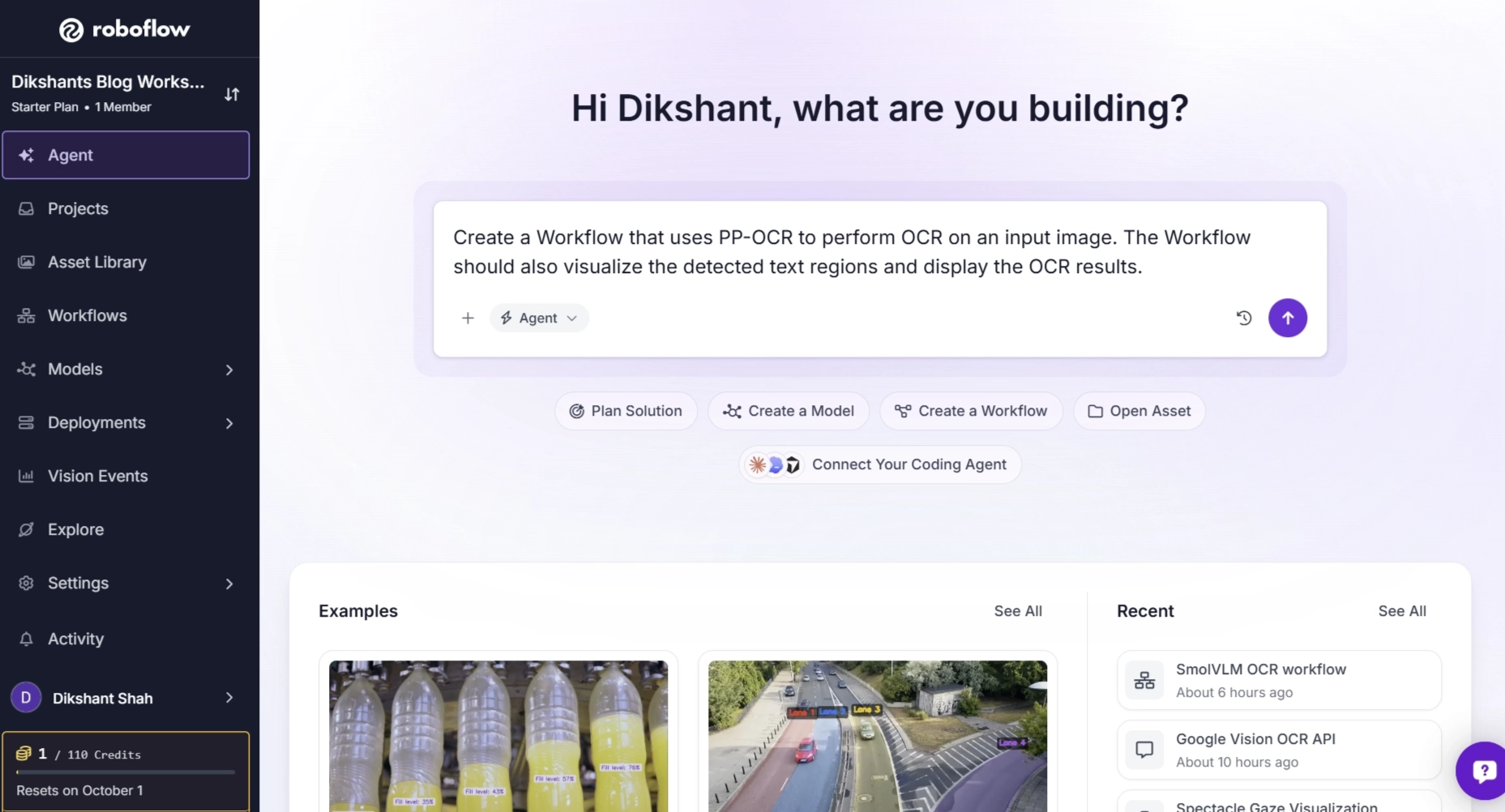
Roboflow Agent automatically generates the workflow for you, connecting the required components as shown below. You can then review the generated workflow, modify its components, and customize the processing logic to fit your specific requirements. Try this workflow.

The Agent also provides an interface for testing your workflow directly. You can upload an image, run the workflow, and inspect the results without having to build a separate testing interface.

For example, the image below shows the workflow output, visualizing the text generated by the OCR model.

This makes Roboflow Agent useful for quickly experimenting with open-source models and incorporating them into larger computer vision workflows without manually configuring every component from scratch.
Benefits of Open-Source OCR Models
- Lower Cost: Avoid recurring API fees and reduce OCR costs, especially when processing large volumes of documents.
- Data Privacy: Keep sensitive documents and extracted text within your own infrastructure instead of sending them to third-party services.
- Full Control: Control the model, inference environment, preprocessing pipeline, and deployment without depending on a third-party provider.
- On-Premise Deployment: Run OCR models on local servers, edge devices, or private cloud infrastructure where internet connectivity or external APIs are not suitable.
- Language Support: Many open-source OCR projects support a wide range of languages and can be extended to support additional languages.
- Customization: Fine-tune or modify open-source OCR models to perform better on specific document types, languages, fonts, or layouts.
- No Vendor Lock-In: Organizations can switch models, modify the software, or move their infrastructure without being tied to a specific OCR provider.
What Makes a Good Open-Source OCR Model?
Open-source OCR models can perform very differently depending on the document type, language, hardware, and whether the task is simple text extraction or full document understanding. A strong OCR model should therefore be evaluated across several dimensions:
- OCR Accuracy: How accurately the model detects and recognizes text, including small, distorted, handwritten, low-quality, or complex text.
- Document Understanding: How well it preserves document structure, including layouts, tables, formulas, columns, reading order, images, and other document elements.
- Language Support: The breadth of languages and scripts supported, especially multilingual documents and non-Latin writing systems.
- Speed & Efficiency: How quickly the model processes documents and how efficiently it uses GPU, CPU, VRAM, RAM, and other computational resources.
- Ease of Deployment: How easily the model can be installed, integrated into applications, and deployed locally, on-premise, or in the cloud.
- Hardware Requirements: Whether it can run on CPUs, consumer GPUs, or edge devices, or requires high-end GPUs and substantial memory.
- Customization: Whether developers can fine-tune the model, adapt it to domain-specific documents, or integrate it into custom OCR pipelines.
- License: Whether the license allows commercial use, modification, redistribution, and deployment without significant restrictions.
Conclusion
Ultimately, the best OCR model depends on the application. Dedicated OCR models are generally the better choice for high-volume document processing, structured extraction, and efficient deployment, while general-purpose VLMs are better suited to applications requiring OCR alongside broader visual reasoning.
With Roboflow Workflows and Roboflow Agent, you can also integrate open-source OCR models into computer vision pipelines without building the entire inference infrastructure from scratch. Try Roboflow for free.


Cite this Post
Use the following entry to cite this post in your research:
Dikshant Shah. (Aug 3, 2026). Best Open-Source OCR Models. Roboflow Blog: https://blog.roboflow.com/best-open-source-ocr-models/