

OCR rankings shift with every model release, so static lists can become outdated. This post shows how to compare 63 current OCR models in Roboflow Playground on your own images, and what the live leaderboard says about accuracy, speed, and cost. Small VLMs like GPT-5 Mini and Gemini Flash lead on scene text, while dedicated models like GLM-OCR win on documents.
Optical character recognition (OCR) allows text in images to be understandable by machines, allowing programs and scripts to process the text. OCR is commonly seen across a wide range of applications, but primarily in document-related scenarios, including document digitization and receipt processing.
While solutions for document OCR have been heavily investigated, the current state-of-the-art for OCR on non-document applications, occasionally referred to as "focused scene OCR", like reading license plates or serial numbers, is less clear.
There is also a practical problem with any static answer to "which OCR model is best" since new vision models ship every few weeks and the rankings reshuffle just as fast. So this post does two things. It shows you how to compare the latest OCR models yourself using Roboflow Playground, and it walks through what the current results say about accuracy, speed, and cost.
Run OCR Through a Hosted API
If you want to use OCR in an application, several of the models tested below are available through the Roboflow serverless API, with no infrastructure to provision:
from inference_sdk import InferenceHTTPClient

client = InferenceHTTPClient(
    api_url="https://serverless.roboflow.com",
    api_key="YOUR_ROBOFLOW_API_KEY"
)

result = client.ocr_image("image.jpg")  # DocTR by default; model="trocr" is also supported
print(result)
In production OCR systems, the highest-accuracy pattern is the one we use in the methodology below: a detection model localizes each text region, then an OCR model reads the crops. Grab your API key from your workspace settings, or create a free account to get one and build the full pipeline.
Compare OCR Models with Roboflow Playground
Roboflow Playground is a free tool for testing and comparing vision models. For OCR, it gives you four ways to evaluate models against each other:
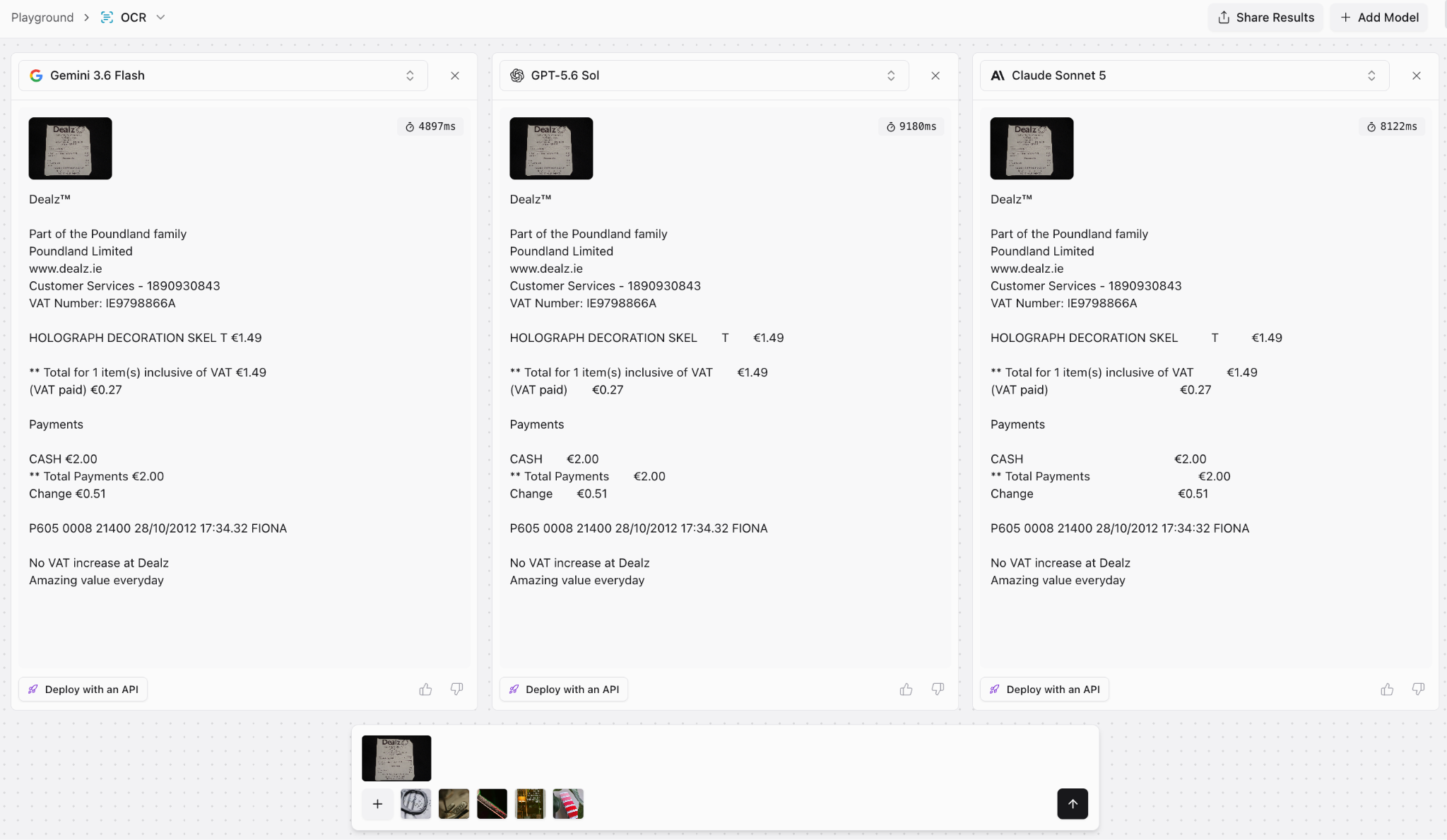
Run models on your own images. In the OCR playground, you upload an image and run it through multiple models at once. Each model returns its transcription next to the others, so you can see immediately which one reads your text correctly. This matters because OCR performance is domain-specific. A model that reads receipts perfectly can fail on embossed tire codes. Testing on your own images is the fastest way to find out what actually works for your use case.
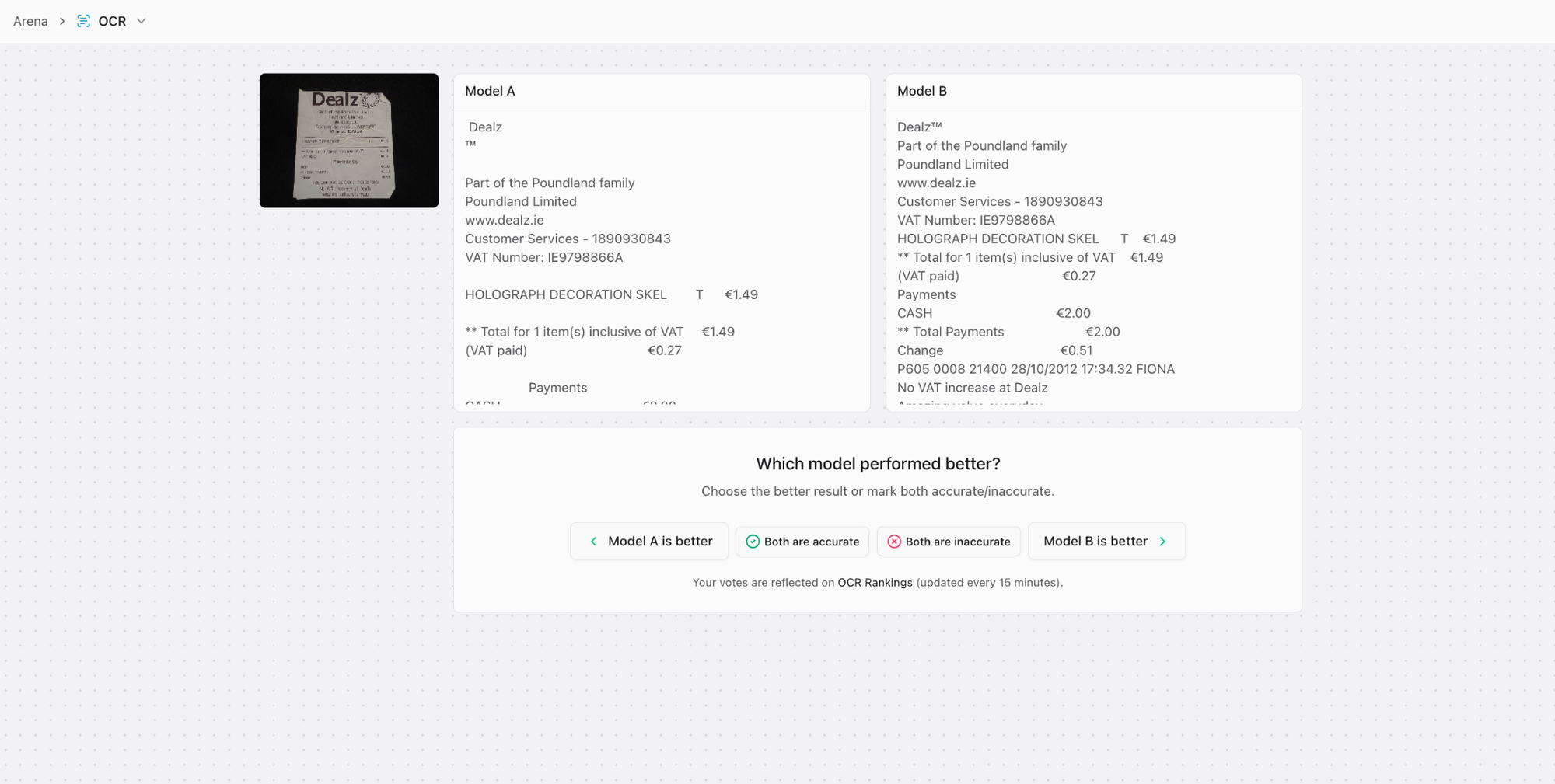
Vote in the Arena. The OCR Arena runs blind battles between two anonymous models. You upload an image with text, both models transcribe it, and you vote for the better result before the model names are revealed. Your votes, along with everyone else's, power the rankings.
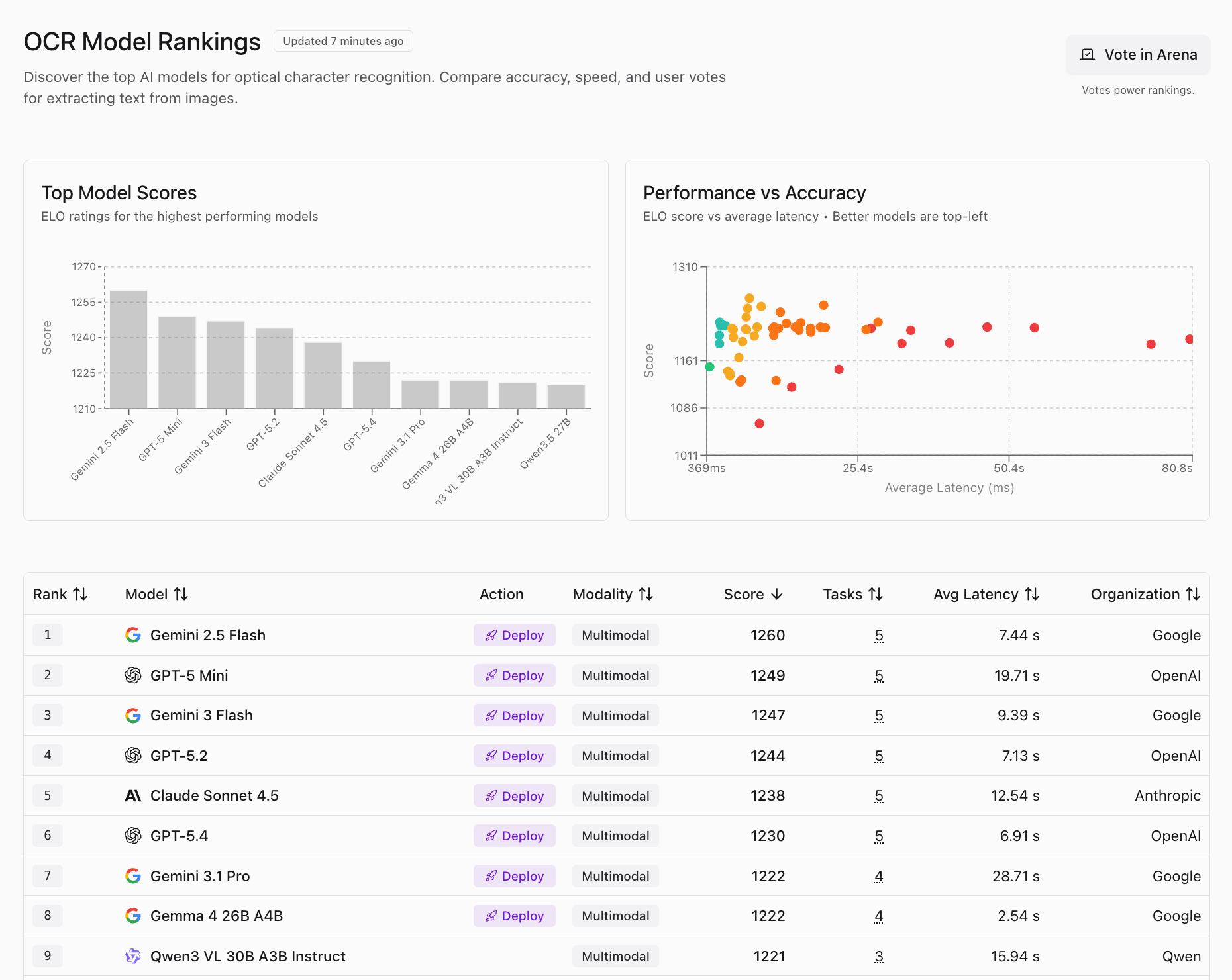
Check the leaderboard. The OCR Leaderboard ranks over 50 models by an ELO score computed from Arena votes, with average latency listed for each. It updates continuously as votes come in, so it reflects the current model landscape rather than a single test run.
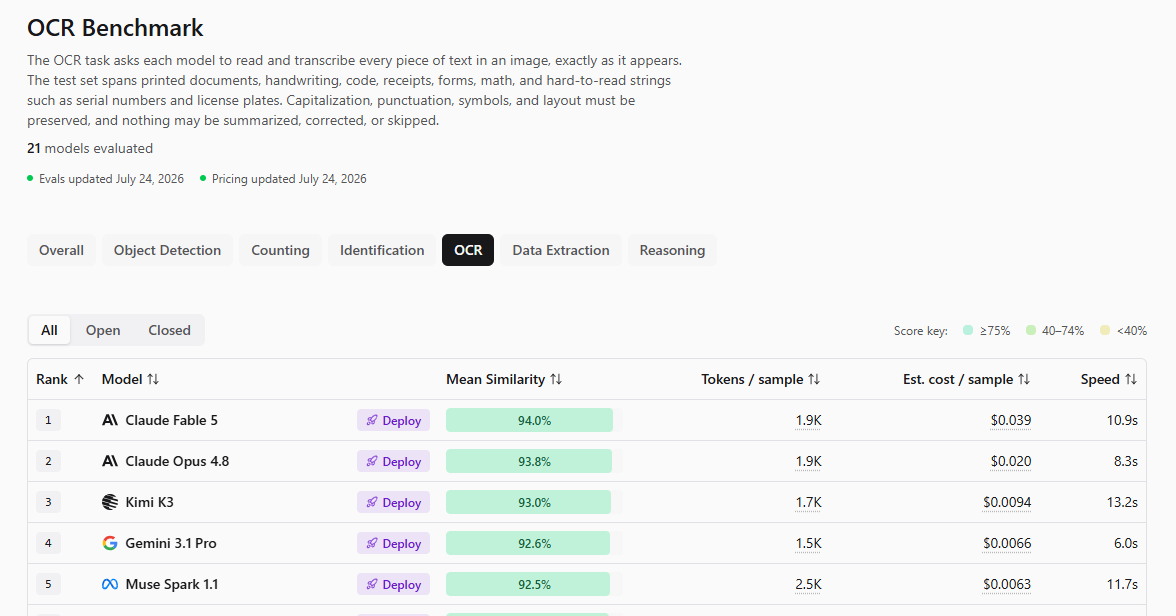
Review Vision Evals. Vision Evals is an objective benchmark where every model gets the same image tasks, including reading text from photos and understanding documents, and is scored on whether it got each one right. There aren’t any votes or subjective judgments. It’s just pass or fail. Evals also track measured token usage and estimated cost per task, which is useful when you are planning a high-volume deployment.
Together, these give you crowd-sourced rankings, objective scores, and a way to sanity check both against your own data.
Which OCR Models Lead Right Now
Currently, the top of the OCR Leaderboard looks like this:
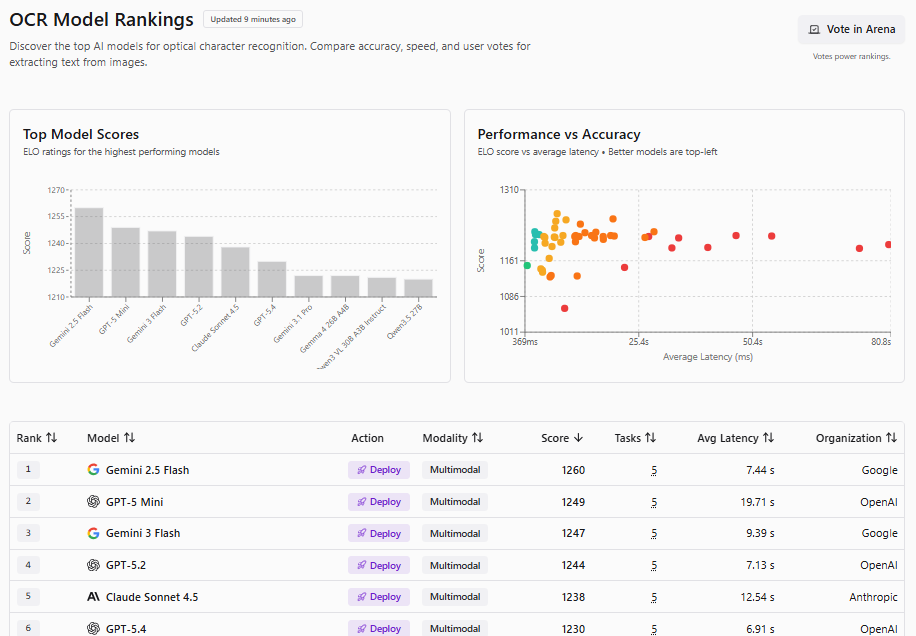
The top five (Gemini 2.5 Flash, GPT-5 Mini, Gemini 3 Flash, GPT-5.2 and Claude Sonnet 4.5) sit within about 22 ELO points of each other, and the top two trade places as votes come in. Any of these models will read the most focused scene text correctly. The differences show up on hard cases like low contrast, unusual fonts, curved or occluded text.
You also don't need the biggest model. GPT-5 Mini outranks the full GPT-5, and Gemini's Flash variants outrank Gemini 2.5 Pro. The flagship reasoning models mostly add latency, not accuracy.
Open models are close behind. Qwen3-VL, Qwen3.5, Gemma 4, Llama 4 Scout, and Mistral's models all rank near the proprietary leaders. Gemma 4 26B A4B holds a top-ten ELO with a 2.5 second average latency, one of the fastest VLMs on the board.
Rankings shift as new models release and votes accumulate, so check the live leaderboard for the current standings before you commit to a model.
Open-Source OCR Models
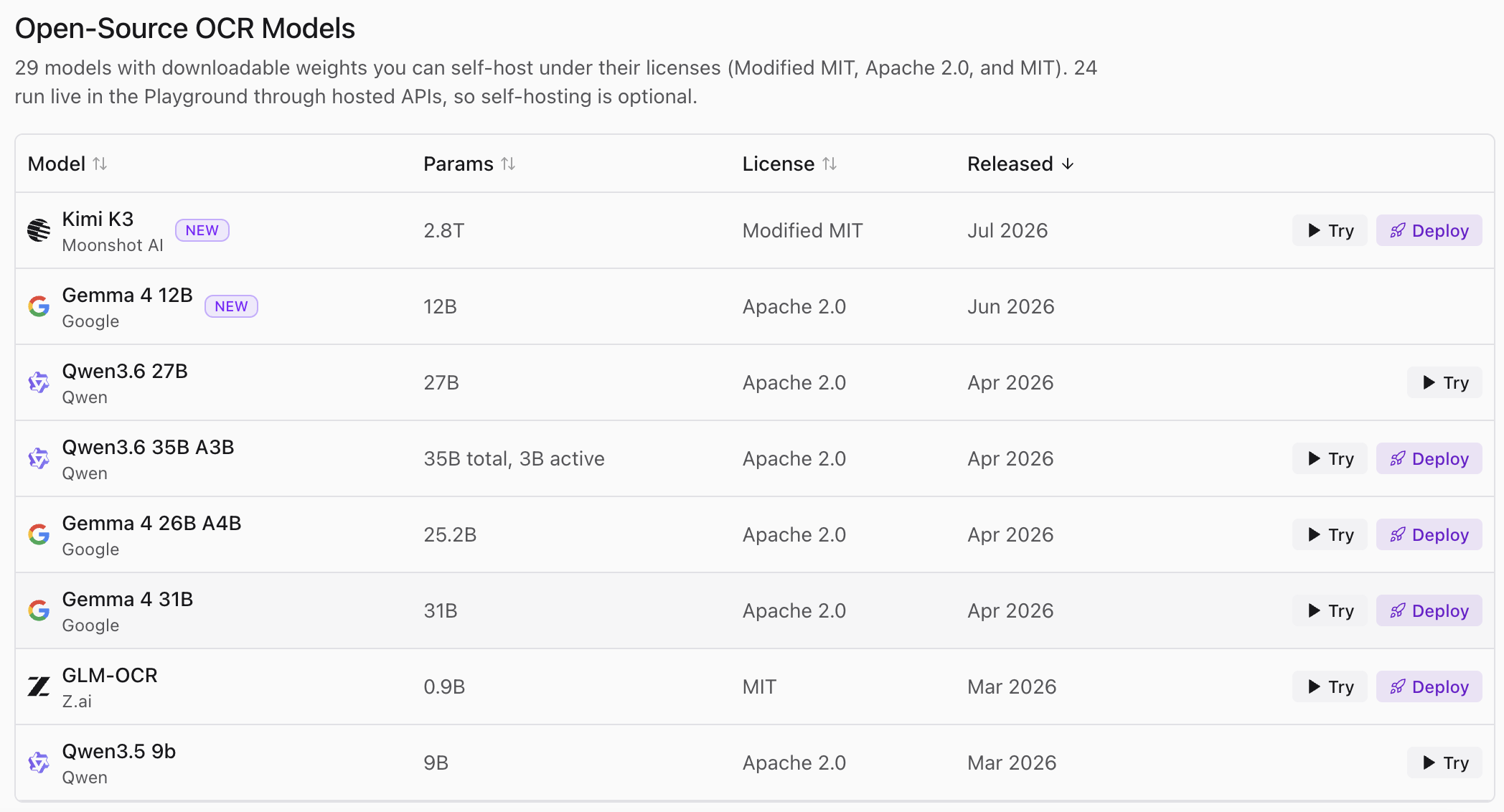
If you need weights you can download and self-host, there are a lot of open-source OCR models as well: 29 models on the Playground leaderboard ship under permissive licenses (MIT, Modified MIT, or Apache 2.0), and 24 of them also run live in the Playground through hosted APIs, so you can evaluate before committing to your own infrastructure.
The newest models top the list: Moonshot AI's Kimi K3, a 2.8T-parameter model released in July 2026 under a Modified MIT license, arrived alongside Google's Gemma 4 12B (Apache 2.0) in June. The spring 2026 wave covers most practical size classes: Qwen3.6 in 27B dense and 35B A3B mixture-of-experts variants, Gemma 4 at 26B A4B and 31B, and Qwen3.5 9B, all Apache 2.0.
Dedicated OCR Models vs VLMs
General-purpose VLMs now handle most OCR tasks well, but a wave of dedicated OCR models has raised the bar on document parsing specifically. These are small, open models trained to do nothing but read and structure text:
- GLM-OCR (Zhipu AI) scores 94.6 on OmniDocBench v1.5 and 94.0 on OCRBench, ahead of Gemini 3 Pro and GPT-5.2 on the same document parsing benchmark. And it's available under an MIT license.
- PaddleOCR-VL 1.5 (Baidu) scores 94.5 on OmniDocBench v1.5 with only about 0.9B parameters, and covers 100+ languages.
- DeepSeek-OCR 2 scores 91.1 and uses a mixture-of-experts decoder built for high-throughput batch processing, released under an MIT license.
- dots.ocr (RedNote) scores 88.4, also MIT-licensed.
The takeaway is that for full-page documents, tables, and formulas, dedicated models now beat the general VLMs while being far cheaper to run. For focused scene OCR on cropped, real-world text, the large VLMs and fast hosted services still tend to lead.
Traditional options remain relevant too. EasyOCR and TrOCR are useful when you need a lightweight local model with no API dependency, and Google Vision OCR is the fastest hosted option on the leaderboard at 869 ms per request, several times quicker than any VLM.
Other models you can test in Playground include Qwen2.5-VL, Florence-2, and Pixtral, alongside the full OpenAI, Gemini, and Anthropic families. Earlier rounds of our own testing covered models like GPT-4.5 that have since been retired or superseded, which is exactly why live comparisons beat static benchmarks.
How to Test OCR the Right Way
Most OCR benchmarks are designed for reading entire pages of text. Industrial use cases rarely look like that. From deploying computer vision in physical world environments, we have found it works better to skip the built-in text detection step and instead use a custom-trained object detection model to find and crop the text region, then pass the crop to an OCR model. Cropping matters more than it sounds. A license plate photo, for example, should be cropped to just the identifying numbers and letters, without the state name, taglines, or registration stickers, or those extras end up in the transcription.
The same principle applies to evaluation. Test models on cropped, localized text from your actual domain, compare predictions against a hand-checked ground truth, and score with a Levenshtein distance ratio, which measures how far each prediction is from the correct string.
We built a focused scene OCR dataset this way, covering twenty industrial domains with images pulled from open-source datasets on Roboflow Universe.
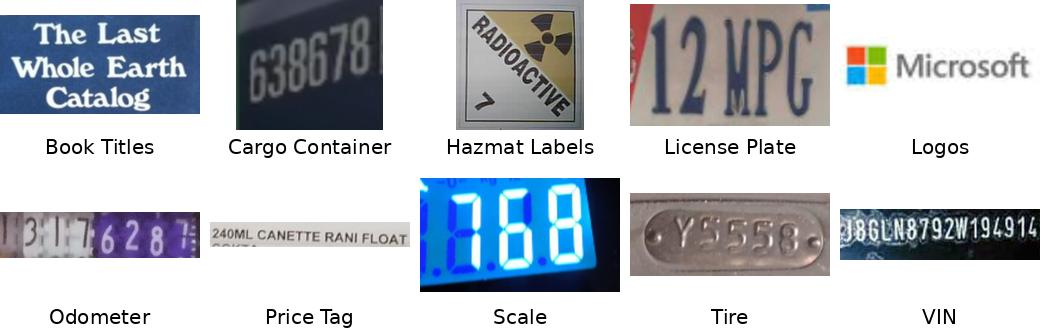
The dataset is available on Universe if you want to run your own evaluation against it.
Speed and Cost
Accurate OCR is important, but speed and cost decide whether a model works in production.
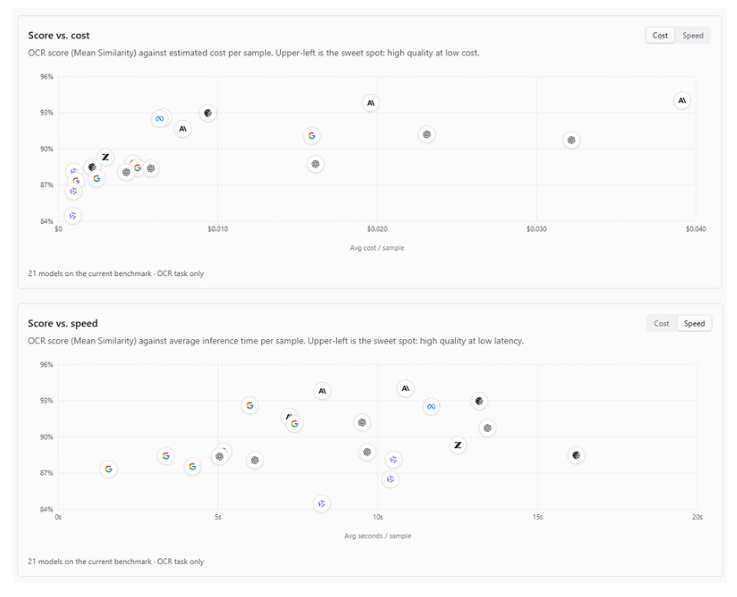
On speed, the leaderboard's latency column is one to look thoroughly through. Google Vision OCR averages 869 ms per request. Among VLMs, the small variants lead like Qwen3 VL 235B A22B, GPT-5.4 Mini, Gemma 4 26B A4B, and Gemini 2.5 Flash-Lite, who average under 3 seconds, while reasoning-heavy flagships like GPT-5, Gemini 3.1 Pro, and GPT-5.6 Sol can take 30 to 80 seconds per image. If you are processing a video stream or a high-volume pipeline, that difference alone decides which model you can use.
On cost, Vision Evals tracks measured token usage per task and multiplies it by each provider's published pricing, so you can compare estimated cost per request across models on identical work. The lightweight variants (Flash-Lite, Mini, Nano, Haiku) deliver most of the accuracy of their larger siblings at a fraction of the price, and dedicated OCR models and local packages undercut all of them at volume.
A fast model with terrible accuracy is not useful, so the right way to read these numbers is accuracy per second and accuracy per dollar.
Conclusion
The OCR landscape splits into three practical tiers. Frontier VLMs from Google, OpenAI, and Anthropic lead on focused scene OCR, and their small, fast variants often match or beat the flagships. Dedicated open OCR models like GLM-OCR and PaddleOCR-VL lead on structured document parsing at a fraction of the cost. And lightweight local options like EasyOCR remain the most cost-efficient choice when accuracy demands allow it.
Because those tiers reshuffle with every model release, the most reliable answer to "which OCR model is best" is a live one. Compare accuracy, speed, and user votes for extracting text from images anytime with the OCR Leaderboard, and test the top candidates on your own images in Roboflow Playground.


Cite this Post
Use the following entry to cite this post in your research:
Aarnav Shah, Leo Ueno. (Jun 1, 2026). Best OCR Models for Text Recognition in Images. Roboflow Blog: https://blog.roboflow.com/best-ocr-models-text-recognition/