

Use traditional rules-based machine vision for fixed industrial checks, specialized computer vision models for detection and segmentation, and vision-language models for open-ended visual interpretation. Start with your own images in Roboflow Playground, compare models, and combine the right tools in Roboflow Workflows to build, test, and deploy your application.
Building a system to detect defects, track inventory, or guide a robot starts with understanding how it will interpret images. You’ll encounter three overlapping terms: machine vision, computer vision, and vision AI. Understanding what they describe helps you choose the right tools for your application.
This guide compares machine vision, computer vision, and vision AI through three practical approaches: traditional machine vision systems that use programmed rules for industrial checks, specialized computer vision models trained for tasks such as detection and segmentation, and vision-language models that interpret images using natural-language prompts.
These approaches can work together in a single system. With Roboflow, you can test models on your images, train them for your use case, and connect detection, segmentation, and visual reasoning in a production workflow.
This guide explains where the terms overlap, how rules-based inspection differs from learned models, and how to choose an approach based on your task, production conditions, and performance requirements.
What Is Vision AI?
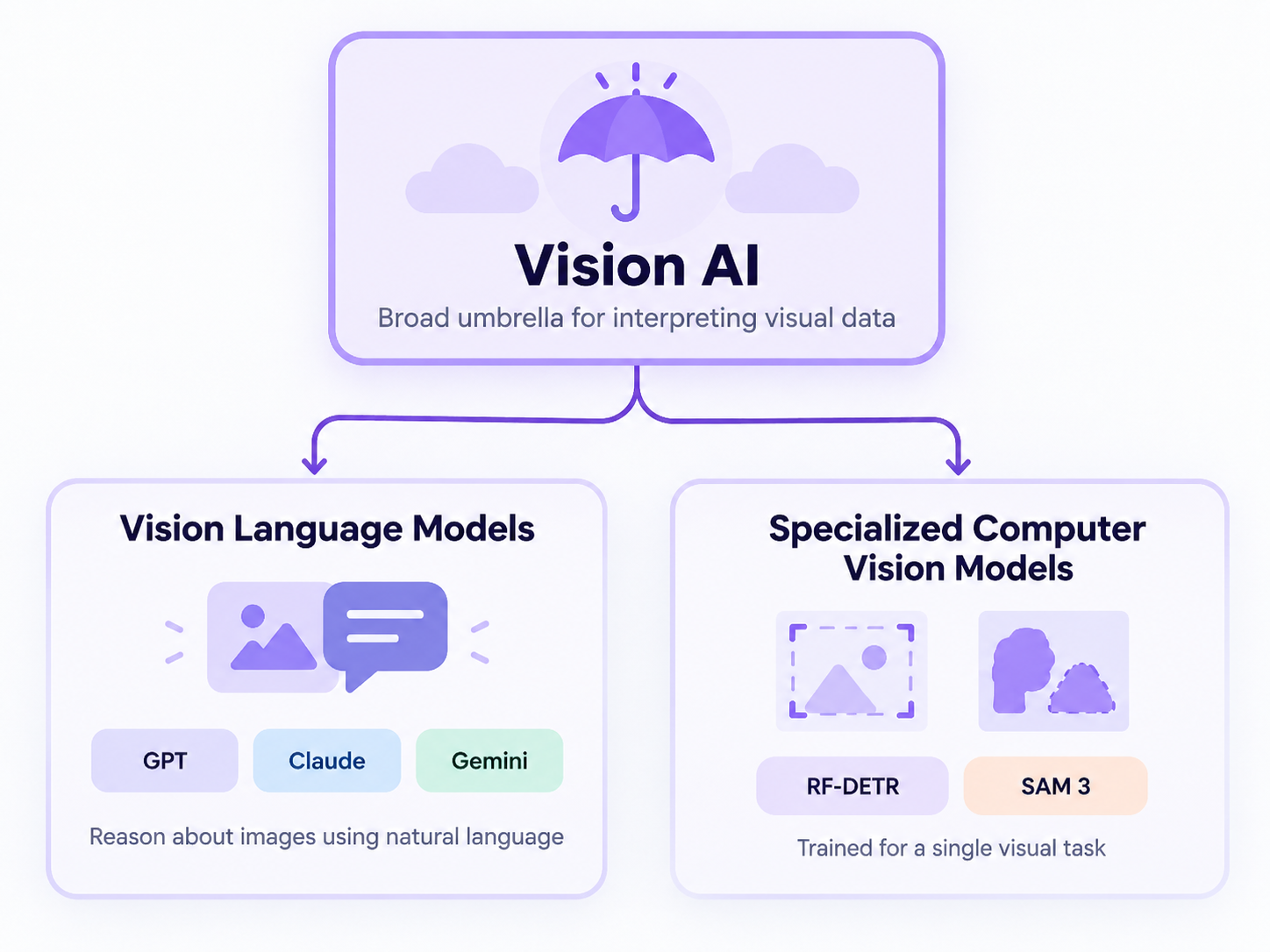
Vision AI is the broadest of the three terms, the umbrella covering anything that interprets visual data, regardless of how it does it. Under that umbrella sit two distinct families of models.
Vision language models such as GPT, Claude, and Gemini reason about images using natural language. You can show one a photo and ask it an open-ended question in plain English.
Specialized computer vision models such as RF-DETR and SAM 3 are trained for specific visual tasks such as detection and segmentation. But they run faster and cheaper at those tasks than a general-purpose VLM ever will.
Vision AI is also the term most vendors have gravitated toward in marketing over the last few years, which can cause confusion, since it's broad enough to describe almost anything visual without committing to specifics.
Roboflow Playground lets you test both families side by side, including specialized computer vision models like RF-DETR and YOLO26, alongside multimodal VLMs like Gemini 3.1 Pro and GPT-6 Astra.
What Is Computer Vision?
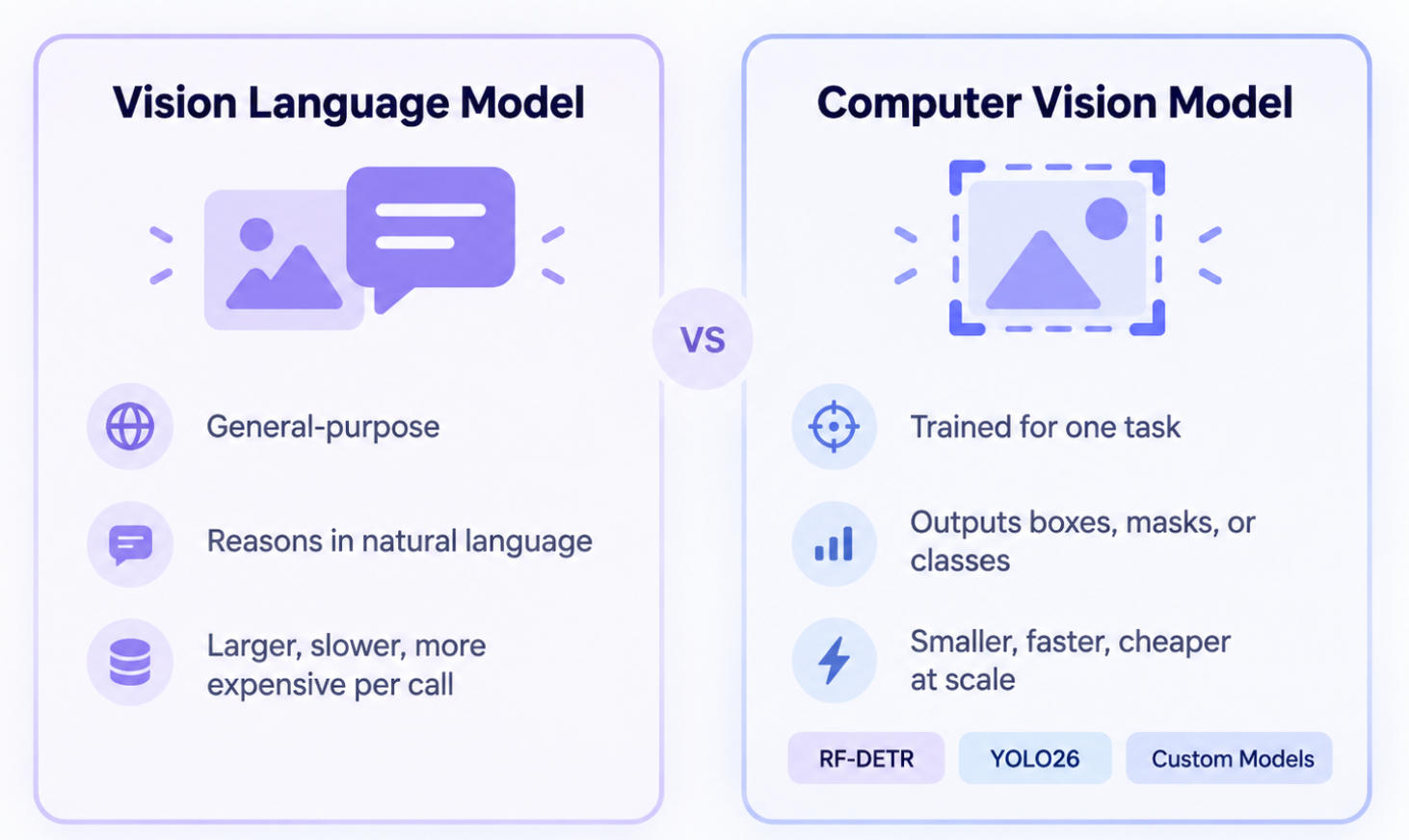
Computer vision is the specialized family living inside the vision AI umbrella: models trained to do one specific visual task well such as object detection, segmentation, classification, and keypoint detection.
Unlike a general-purpose VLM that can answer almost any question about an image, a computer vision model is narrow by design. It does one job, and it does that job faster and cheaper than a VLM at production scale, since it isn't carrying the overhead of general language reasoning.
This is also the term used more precisely in engineering and research contexts, where computer vision refers specifically to this kind of task-specific model rather than the broader vision AI umbrella.
What Machine Vision Is
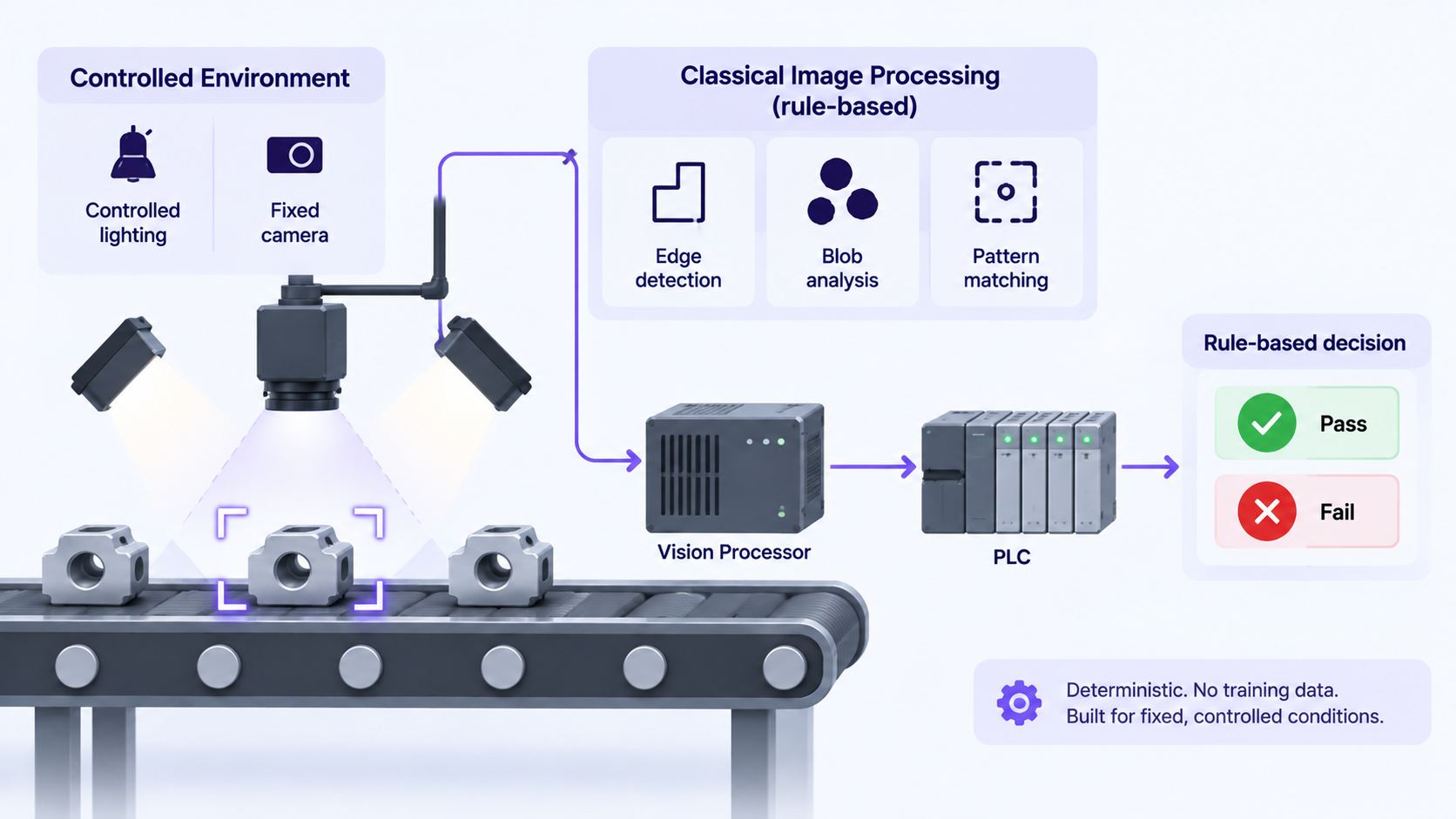
Machine vision is the oldest method of the three terms, rooted in decades of industrial automation rather than modern AI. It relies on rule-based, classical image processing, edge detection, blob analysis, pattern matching, deterministic techniques where a human programs the exact logic a system follows, rather than a model learning that logic from data.
It's built around fixed cameras, controlled lighting, and dedicated hardware, tightly integrated with PLCs on a factory floor. Within a narrow, unchanging set of conditions, a machine vision system performs its check the same way every time, with no training data and no drift.
The Core Tradeoff: Rule-Based vs. Learned
Every choice between these approaches comes down to one question: How much does the environment and problem vary?
Traditional machine vision systems work well in controlled, repetitive environments but break down quickly when lighting shifts, cameras get bumped, or products change, requiring time-consuming recalibration and reprogramming each time.
Deep learning-based computer vision addresses these failures by learning from diverse data rather than relying on fixed rules, making it far more tolerant of the variability that manufacturing and industrial environments produce.
Roboflow's platform supports this approach with tools for retraining on updated data and cloud-based deployment that minimizes production disruption.
| Comparison | Rule-Based Image Processing | Learned Vision Models |
|---|---|---|
| How it decides | Applies programmed rules, measurements, reference patterns, and thresholds. | Uses patterns learned during training to classify, detect, segment, or interpret visual content. |
| Reliability | Works well when inspection conditions and acceptance criteria match the configured rules. | Depends on model capability, representative training data, and validation under actual operating conditions. |
| Handling variation | Handles variation covered by its rules and tolerances. Unexpected changes may require adjustments. | Can generalize across visual variation, but unfamiliar conditions can still reduce accuracy. |
| Setup requirements | Configure imaging, define inspection regions, and tune rules and thresholds. | Select and evaluate a pretrained model, or collect data and train a model for the task. |
| Adapting to change | Update affected rules, reference images, or tolerances, then retest. | Update training data, retrain or replace the model, or adjust prompts where supported, then retest. |
| Best fit | Clearly defined measurements and checks in controlled environments. | Variable appearances, complex defect patterns, or tasks that require visual interpretation. |
How to Choose Based on What You're Building
Which of the three fits depends on how fixed your conditions are and how much judgment the check requires.
| Comparison | Rules-Based Inspection | Specialized Vision Models | Vision-Language Models (VLMs) |
|---|---|---|---|
| Example check | Is this hole within the specified position and size tolerances? | Which part types are present, and where are they? | What visible issues appear in this image? Describe them. |
| Setup work | Configure lighting, calibrate measurements, and program inspection rules. | Evaluate a pretrained model or label images and train a custom model. | Select a model, develop prompts, and evaluate responses on representative images. |
| Operating cost | Simple checks can require little compute. Hardware, software, and maintenance still contribute to cost. | Efficient models can support high-volume inference. Cost depends on model size, hardware, and throughput. | Cost depends on the model, image resolution, output length, and hosting method. Benchmark for your workload. |
| Adding a new category | Add or adjust rules and reference patterns, then validate. | For a fixed-class model, add representative labeled examples and retrain, or select a suitable pretrained model. | Try updating the prompt or examples, then validate whether the model can recognize the new category reliably. |
| Handling ambiguity | Requires explicit rules for acceptable variation and exceptions. | Handles learned visual variation within its task; uncertain cases may require review. | Supports open-ended questions and descriptions, but responses can be incorrect or inconsistent. |
| Best starting point | A measurable condition with clear tolerances. | A repeatable detection, segmentation, or classification task. | A task requiring flexible questions or natural-language interpretation. |
In practice, projects can sit across more than one column. A single inspection station might need a fast, well-defined detection model for one check and a more flexible VLM for another, reading a label, describing an anomaly in plain language, judging something that doesn't fit a fixed class list.
How to Build a Vision Application With Roboflow
Start with the decision your application needs to make: identify a missing component, locate a defect, read a label, or describe an unexpected condition. Then test the approach on images from your actual environment.
- Compare models on your images. Use Roboflow Playground to test specialized vision models and vision-language models. Check whether the outputs provide the locations, labels, masks, or descriptions your application needs.
- Train for your specific task. If an existing model does not recognize your products or defects reliably, use Roboflow to organize and label production images, then train a custom model.
- Build the application logic. In Roboflow Workflows, connect models with image processing, confidence filters, and conditional logic. For example, detect a component, crop its label, and pass that crop to a model for reading or interpretation.
- Validate and deploy. Test the complete workflow on representative images, including difficult cases. Measure accuracy, processing time, and operating cost before connecting it to your application or production process.
You can combine multiple approaches in one workflow, choosing the model or processing step that fits each part of the task. Here's an example.
Build an Inspection Workflow With RF-DETR and a VLM
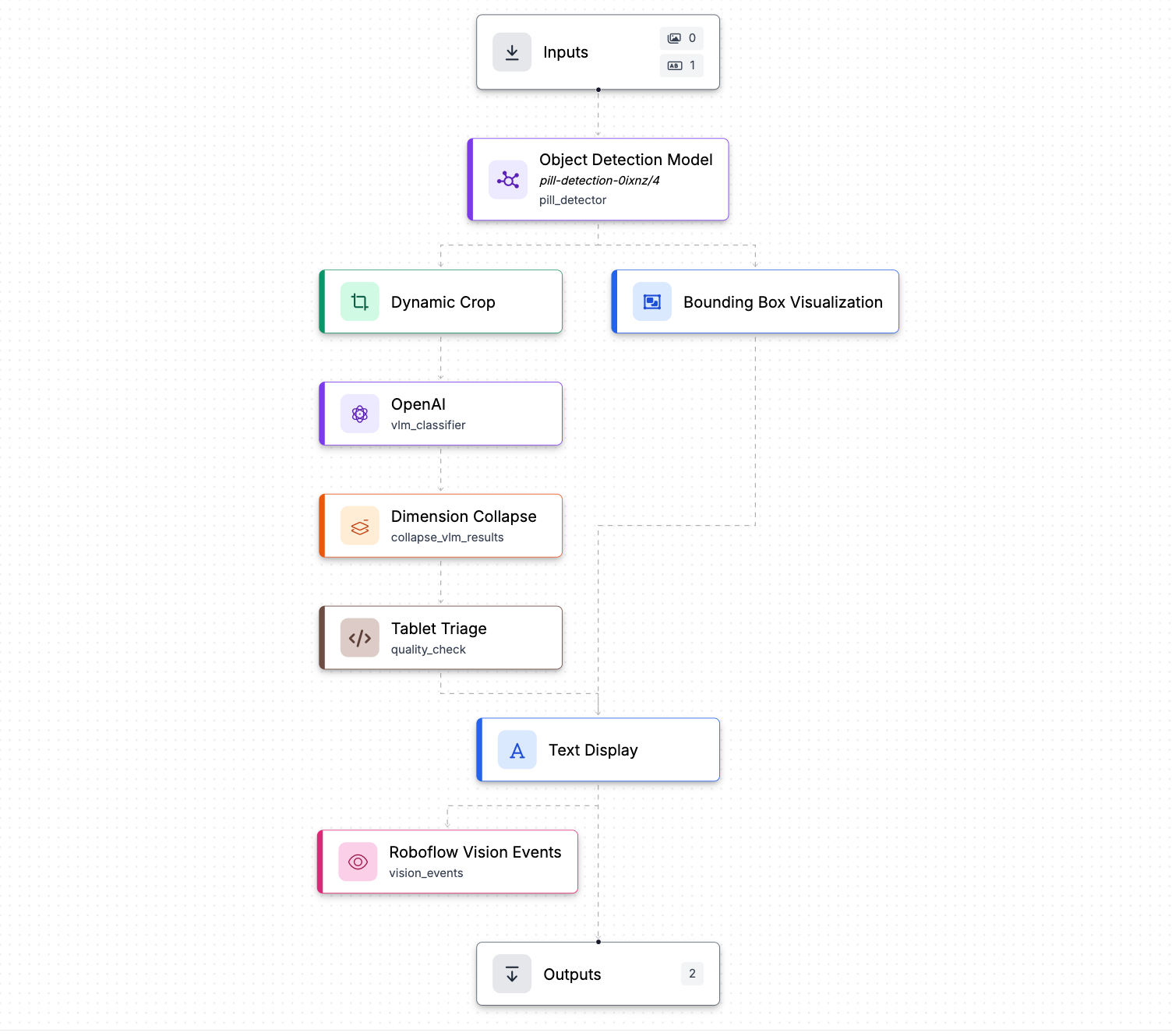
Put these approaches together in a practical inspection application. In our tablet defect inspection tutorial, RF-DETR locates each tablet, a crop isolates it, and a vision-language model classifies visible defects. Roboflow Workflows connects these steps and converts the classifications into a pass/fail result with a structured report. Here's the workflow you'll create.
Start Building with Roboflow
Machine vision describes an industrial application, computer vision provides the techniques, and Vision AI brings learned models into the system. Your application may use all three.
Start by uploading a representative image to Roboflow Playground and comparing models for your task. Then bring the approach into Roboflow Workflows, add the logic your application needs, and test it on real operating conditions.
Further reading:


Cite this Post
Use the following entry to cite this post in your research:
Mostafa Ibrahim. (Aug 29, 2026). Machine Vision vs. Computer Vision vs. Vision AI. Roboflow Blog: https://blog.roboflow.com/machine-vision-vs-computer-vision-vs-vision-ai/