

YOLO27 succeeds YOLO26 with four sizes (N, S, M, L) and seven tasks: detection, instance segmentation, semantic segmentation, depth estimation, classification, pose, and oriented detection. Preliminary numbers put YOLO27l at 60.4 mAP on COCO, and the compact N and S models use a new two-scale detection head. The models are in final R&D with no launch date, weights, or license announced. Roboflow RF-DETR covers detection and segmentation and Depth Anything V2 covers monocular depth, both in Roboflow Workflows today.
YOLO models are a family of real-time computer vision models designed to handle a wide range of tasks, including object detection, segmentation, pose estimation, classification, and oriented object detection.
A launch of YOLO27 is anticipated later this year. But as of mid-September no date has been set and no weights, configs, or code have been released. We do know a bit about architecture details and preliminary benchmarks.
In this blog, we'll cover what YOLO27 is, what the new 3D perception models mean for real-world applications, what remains unknown ahead of release, and what you can use today to achieve even better results.
What Is YOLO27?
YOLO27 is the next generation of the YOLO model family. YOLO27 is a full generation refresh: four sizes (N, S, M and L), seven tasks, and two different detection architectures that both run through the same YOLO Python class.
The seven tasks are object detection, instance segmentation, semantic segmentation, depth estimation (YOLO27-Depth in four sizes), classification, pose estimation, and oriented object detection.
Two headline numbers from the preview: YOLO27l reaches 60.4 mAP on COCO at 640 pixels. YOLO27n runs at 42.3 mAP in 0.62 ms on an NVIDIA RTX PRO 6000. However these are preliminary research results that may change before release.
YOLO27 Model Sizes and Tasks
YOLO27 comes in four sizes: Nano, Small, Medium, and Large. There is no Extra Large variant listed, a change from YOLO26 and earlier generations that ran N through X. Every task ships in all four sizes, so the planned lineup is 28 model files.
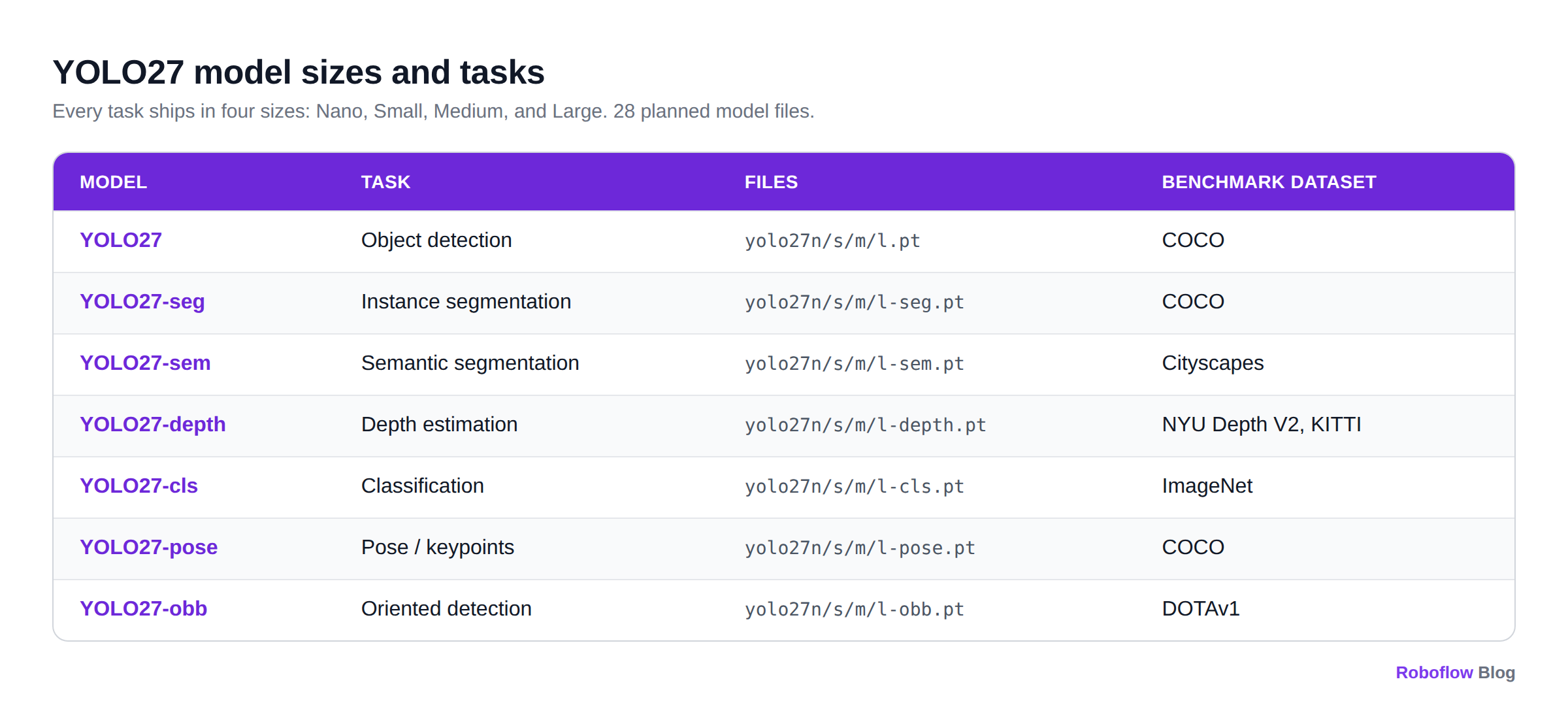
All seven tasks support train, val, predict, and export. Detect, seg, pose, and OBB models also work with multi-object tracking across video frames.
Two Architectures, One Interface
The most interesting design decision in YOLO27 is that the detection models split into two architectures by size. The N and S models use a streamlined CNN. The M and L models use a query-based, transformer-decoder design that needs no NMS. All other tasks (segmentation, depth, pose, classification, OBB) use the CNN design at every size.
Both run through the same YOLO class, and the right train, val, predict, and export pipeline is picked automatically from the model file. Code written for yolo27n.pt runs unchanged on yolo27l.pt.
Dual-scale detection (N and S)
Standard YOLO detectors predict on three feature maps: fine, medium, and coarse. YOLO27 N and S drop the medium map and predict only on the fine map (small objects) and the coarse map (large objects), with a fixed scaling on the fused features to keep the two balanced.
Small-object detection (N and S)
The early, high-resolution feature stage is widened to capture more fine detail. Paired with the surviving fine prediction map, this is aimed at small-object localization, historically the weakest spot for compact models.
Foreground alignment supervision (N and S)
YOLO26 introduced a one-to-one head for NMS-free inference, but it lost accuracy relative to the one-to-many head used in training: 0.9 mAP on YOLO26n and 0.8 on YOLO26s. YOLO27 adds a training-only branch that learns object versus background at every location. The branch is stripped at export, so it adds nothing at inference.
N and S default to the one-to-many head with NMS. You pass nms=False to get the NMS-free head, and the published speed numbers use that setting.
Query-based detection without NMS (M and L)
YOLO27m and YOLO27l replace dense prediction with a transformer decoder that refines a fixed set of object queries and outputs final detections directly. That is the same family of idea behind DETR-style models such as RF-DETR.
YOLO27m pairs the decoder with a YOLO26-style convolutional backbone. YOLO27l keeps the same FPN/PAN neck but swaps in a backbone:UltraViT, which uses self-attention in its deepest stage for global context.
YOLO27 Benchmarks (Preliminary)
Preliminary numbers have been published for every task. Detection is measured on COCO val at 640 pixels. GPU latency is on an NVIDIA RTX PRO 6000 with TensorRT 11 at FP16, and CPU latency is on an AMD EPYC 9655 with ONNX Runtime at FP32.
Object detection (COCO, 640px)
| Model | mAP 50-95 | CPU ONNX (ms) | RTX PRO 6000 TensorRT (ms) | Params (M) | FLOPs (B) |
|---|---|---|---|---|---|
| YOLO27n | 42.3 | 16.1 | 0.62 | 3.0 | 7.2 |
| YOLO27s | 49.6 | 33.2 | 0.79 | 11.8 | 28.2 |
| YOLO27m | 55.8 | 67.2 | 1.39 | 22.8 | 65.0 |
| YOLO27l | 60.4 | 149.6 | 2.32 | 72.3 | 165.3 |
YOLO27l also hits 61.2 mAP at 800 pixels in 2.9 ms on the same GPU. The N and S models improve on YOLO26n and YOLO26s accuracy.
Instance segmentation (COCO, 640px)
| Model | mAP box | mAP mask | CPU (ms) | GPU (ms) | Params (M) | FLOPs (B) |
|---|---|---|---|---|---|---|
| YOLO27n-seg | 41.8 | 35.4 | 22.0 | 0.73 | 3.0 | 11.2 |
| YOLO27s-seg | 50.0 | 42.5 | 45.8 | 0.96 | 11.6 | 43.1 |
| YOLO27m-seg | 53.2 | 45.0 | 109.3 | 1.46 | 25.4 | 139.6 |
| YOLO27l-seg | 57.7 | 47.9 | 248.3 | 2.86 | 67.5 | 361.9 |
Pose (COCO, 640px)
| Model | mAP pose 50-95 | mAP pose 50 | CPU (ms) | GPU (ms) | Params (M) | FLOPs (B) |
|---|---|---|---|---|---|---|
| YOLO27n-pose | 58.0 | 84.1 | 19.6 | 0.67 | 3.1 | 9.2 |
| YOLO27s-pose | 64.3 | 87.0 | 36.6 | 0.80 | 11.2 | 31.1 |
| YOLO27m-pose | 69.0 | 89.9 | 76.6 | 1.29 | 22.8 | 86.2 |
| YOLO27l-pose | 72.2 | 91.3 | 181.1 | 2.45 | 61.7 | 242.3 |
Oriented detection (DOTAv1, 1024px)
| Model | mAP test 50-95 | mAP test 50 | CPU (ms) | GPU (ms) | Params (M) | FLOPs (B) |
|---|---|---|---|---|---|---|
| YOLO27n-obb | 54.0 | 80.3 | 42.6 | 0.83 | 3.0 | 19.7 |
| YOLO27s-obb | 55.8 | 81.6 | 88.2 | 1.30 | 10.9 | 76.6 |
| YOLO27m-obb | 55.9 | 82.6 | 188.0 | 1.92 | 22.8 | 221.7 |
| YOLO27l-obb | 57.2 | 82.7 | 455.8 | 4.33 | 68.7 | 622.6 |
Semantic segmentation (Cityscapes, 1024x2048)
| Model | mIoU val | CPU (ms) | GPU (ms) | Params (M) | FLOPs (B) |
|---|---|---|---|---|---|
| YOLO27n-sem | 78.8 | 95.6 | 0.89 | 2.0 | 34.0 |
| YOLO27s-sem | 81.2 | 169.6 | 1.43 | 7.8 | 131.5 |
| YOLO27m-sem | 82.4 | 336.9 | 2.71 | 16.1 | 385.4 |
| YOLO27l-sem | 83.8 | 787.1 | 6.43 | 44.8 | 1085.8 |
Classification (ImageNet, 224px)
YOLO27n-cls at 0.28 ms GPU with 2.9M params, up to YOLO27l-cls at 0.69 ms with 32.8M params.
YOLO27-Depth: Monocular Depth Estimation
YOLO27-Depth predicts depth from a single camera. Monocular depth estimation takes a standard 2D image and produces a depth map, an image where every pixel value corresponds to distance from the camera.
The appeal of monocular depth is hardware cost. A single RGB camera is the cheapest, most widely deployed sensor in the world. If a model can extract usable depth from cameras already installed on a production line, in a warehouse, or on a vehicle, teams get 3D understanding without new sensors or new capex.
The tradeoff, historically, is that monocular depth is relative rather than absolute. Models like Depth Anything V2 predict which pixels are closer and which are farther with impressive consistency, but converting that to real-world units requires calibration.
Preliminary numbers for YOLO27-depth are in. The models are pretrained on a multi-dataset mix and evaluated at 768 pixels on NYU Depth V2 (indoor) and KITTI (driving). The metric is delta1, the share of pixels whose predicted depth lands within 25% of ground truth, so higher is better and 1.0 is perfect.
Depth estimation (NYU Depth V2 and KITTI, 768px)
| Model | delta1 NYU | delta1 KITTI-580 | delta1 bench mean | CPU (ms) | GPU (ms) | Params (M) | FLOPs (B) |
|---|---|---|---|---|---|---|---|
| YOLO27n-depth | 0.8314 | 0.8256 | 0.7238 | 47.2 | 0.79 | 5.4 | 49.3 |
| YOLO27s-depth | 0.8682 | 0.7835 | 0.7454 | 72.1 | 0.97 | 13.0 | 77.3 |
| YOLO27m-depth | 0.8652 | 0.7746 | 0.7476 | 120.2 | 1.34 | 23.4 | 143.6 |
| YOLO27l-depth | 0.8711 | 0.8041 | 0.7527 | 253.7 | 2.65 | 59.3 | 341.8 |
The Nano model runs at 0.79 ms on GPU with 5.4M parameters, which is the size class that makes depth practical on Jetson-grade edge hardware. Second, the Nano model scores highest on KITTI while the Large model scores highest on NYU, so the scaling is not clean across indoor and outdoor scenes.
It remains unclear whether YOLO27-depth outputs metric depth or relative depth.
YOLO-StereoDepth: A Camera-Native Alternative to Lidar
YOLO-StereoDepth uses binocular disparity, the same principle as human vision. Two cameras at a known distance apart capture the same scene, and the model computes depth from the difference between the two views. Because the camera baseline is known, stereo depth produces absolute distances rather than relative ones.
YOLO-StereoDepth is a camera-native alternative to lidar for robotics. Lidar still holds advantages in low light, low-texture scenes, and long range, so camera-native depth is unlikely to replace it everywhere. But for cost-sensitive robotics, AMRs, and indoor automation, a strong stereo depth model running on commodity hardware would expand what is practical to build.
Which YOLO27 Model Should I Use?
YOLO27n and YOLO27s: edge devices, drones, and real-time video. They are the fastest models in the family and carry the dual-scale head and small-object improvements.
YOLO27m: the GPU sweet spot.
YOLO27l: accuracy-critical work. 60.4 mAP at 640 pixels and 61.2 at 800 pixels while staying real-time on a datacenter GPU, at the cost of 72.3M parameters and 149.6 ms on CPU.
For anything you are building today, we recommend using YOLO26 or RF-DETR.
What We Don't Know Yet About YOLO27
As of this writing, we have not seen:
- Benchmarks: no final accuracy or latency numbers for YOLO-Depth or YOLO-StereoDepth, and no comparisons against existing depth models like Depth Anything V2
- Licensing: YOLO27 licensing terms have not been announced. Previous similar releases shipped under AGPL-3.0, which requires open-sourcing derivative works unless you purchase a commercial license. If you are evaluating models for commercial deployment, this is worth confirming before you build on it.
- A paper: There are not indicated plans for a formal research paper for YOLO27.
We will update this post as more information is released.
How to Use YOLO27
YOLO27 is intended as a drop-in swap for YOLO26: same YOLO class, same train, val, predict, and export API, with the CNN or query-based pipeline selected automatically from the model file.
How to Use Depth Estimation Today
You do not need to wait for YOLO27 to add depth to a vision pipeline. Depth Anything V2, a state-of-the-art monocular depth estimation model, is available today as a block in Roboflow Workflows. You can chain it with detection and segmentation models to measure object distance from a camera, build depth-aware effects, or add spatial reasoning to robotics applications, all from a single RGB camera.
RF-DETR is faster and more accurate than YOLO26 for object detection and instance segmentation, and it ships with commercial-safe licensing. Pair it with Depth Anything V2 in a single Workflow for detection plus depth today.
YOLO27 Alternatives
While YOLO27 is not yet available, several models cover the same ground today and are actively benchmarked on the object detection leaderboard.
RF-DETR
RF-DETR, developed by Roboflow, is a family of real-time models supporting object detection, segmentation, and classification. RF-DETR outperforms YOLO26 across benchmarks and generalizes well across domains, and it is small enough to run on the edge using Inference. Core models (Nano through Large) and all code are released under the Apache 2.0 license. For teams choosing a detection or segmentation model right now, RF-DETR is the model we recommend.
Depth Anything V2
Depth Anything V2 is the current standard for monocular depth estimation, trained with a teacher-student pipeline across tens of millions of images. It generalizes well to real-world scenes without camera-specific calibration and runs in Roboflow Workflows today. When YOLO-Depth ships, this is the model its benchmarks will be measured against.
SAM 3
SAM 3 handles promptable segmentation across open-vocabulary inputs, useful when the objects you care about were not in your training set.
YOLO27 Conclusion
YOLO27 reflects where vision applications are heading: from understanding what is in a frame to understanding the physical space around a camera. That matters for robotics, logistics, manufacturing, and any system that needs to act in the real world, not just observe it.
Until release, the practical path to depth-aware applications is available now: RF-DETR for detection and segmentation, Depth Anything V2 for depth, combined in Roboflow Workflows and deployed to cloud, edge, or on-prem.
You might also be interested in:


Cite this Post
Use the following entry to cite this post in your research:
Contributing Writer. (Jun 10, 2026). What Is YOLO27?. Roboflow Blog: https://blog.roboflow.com/what-is-yolo27/