

Roboflow's OpenRouter integration adds a single Workflow block that routes to any of 300+ VLMs, including every major commercial model and a broad selection of open-source options, without requiring separate auth, request adapters, or retry logic for each provider. Practical patterns this enables inside Roboflow Workflows include using a VLM as a defect-or-shadow judge on cropped RF-DETR detections, running multi-model voting for higher reliability, and cost routing that escalates to a more expensive model only when a cheaper one returns low confidence.
Starting today, Roboflow's integration of OpenRouter gives you access to over 300 models, including every major VLM plus specialized and open-source options, all from a single interface. Pick the right model for the job today, and change your mind later without rewriting your pipeline.
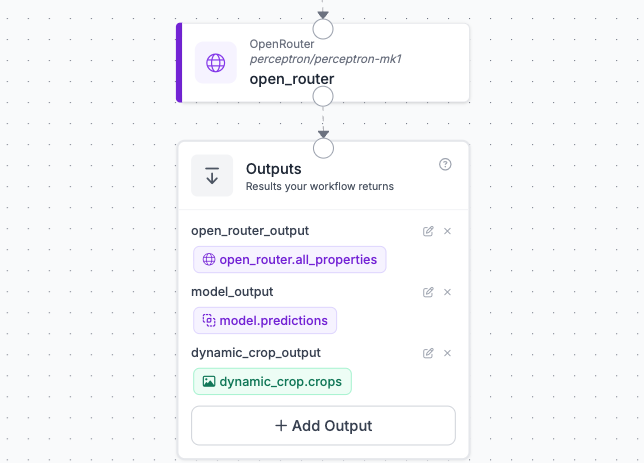
A common pattern in building visual AI pipelines: you ship a workflow that uses one VLM to read text from cropped detections, and three months later you want to try a different model for the same step. Maybe a new release just topped the benchmarks. Maybe you found a cheaper variant that works well enough. Now, you can make these changes immediately in your production applications with no downtime.
Using Roboflow and OpenRouter
When building and running multi-model pipelines, one of the biggest pains is making adapters for every provider you want to try. Each one has its own auth, its own request shape, its own cost reporting, its own retry semantics. You spend the first sprint of every new model launch wiring it up, and by the time you're actually calling the model, a new model comes out.
With the OpenRouter block, the wiring is done. The decisions left are the interesting ones: which model is best for the step you're running, what does it cost per call at your volume, and is it fast enough for the deployment target.
A few patterns this unlocks:
- A VLM-as-judge step. Run RF-DETR to detect, crop each region, send the crop to an OpenRouter VLM with a short prompt asking whether the region is a defect or a shadow.
- Multi-model voting. Same crop, three different models, majority wins. Useful when you need higher reliability than any single model gives you and you're willing to pay for it.
- Cost routing. Try a cheap model first, escalate to a more expensive one only when the cheap model's confidence is low. The Workflow conditional blocks make this a few clicks.
There are cases where the OpenRouter block is the wrong choice.
- The model is one we serve natively on Roboflow Inference (SAM 3, CLIP, SmolVLM, and the rest of the open VLMs). Native blocks skip the OpenRouter hop and give you per-request control over batching, GPU placement, and offline deployment. If you're running at the edge or on your own GPU cluster, the native block is the right call.
- You need deterministic latency under SLA. OpenRouter pools traffic across providers, which is great for cost but adds a step. For sub-100ms vision pipelines, host the model yourself.
Outside those two cases, the OpenRouter block is a great choice for quickly getting into production with new models.
Conclusion
The model landscape will keep shifting. New VLMs will ship, prices will move, benchmarks will get reshuffled, and the model that's best for your use case today probably won't be the best one a year from now.
Build the pipeline around the problem you're solving, plug in whatever model is winning this month, and swap it out the week after when something better lands. Try it today in Roboflow.


Cite this Post
Use the following entry to cite this post in your research:
Trevor Lynn. (May 20, 2026). Launch: 300+ OpenRouter models available in Roboflow. Roboflow Blog: https://blog.roboflow.com/roboflow-openrouter-integration/