

This guide reviews the best pose estimation models available today, from edge-optimized frameworks like MediaPipe to cutting-edge transformer architectures like ViTPose and DETRPose. For production teams needing real-time performance and the ability to easily fine-tune on custom skeletons, we recommend RF-DETR Keypoint as the strongest end-to-end solution.
Pose estimation has become essential across industries, from fitness tracking and sports analytics to healthcare rehabilitation. With rapid advancements in transformer architectures and vision language models, the landscape of pose estimation has evolved dramatically.
Modern models such as Roboflow's RF-DETR Keypoints and specialized architectures deliver unprecedented accuracy while maintaining real-time performance on edge devices.
In this guide, we explore the best pose estimation models available today, from established frameworks to cutting-edge innovations, and show how to deploy them efficiently. Whether you're building a fitness app, analyzing athletic performance, or enabling human-computer interaction, we'll help you choose the right model for your application.
For a real-time model you can fine-tune to your own skeleton and take to production, RF-DETR Keypoint is the model we recommend.
What Is Pose Estimation?
Pose estimation, also called keypoint detection, is a computer vision technique that identifies specific anatomical landmarks (keypoints) on human bodies in images and videos to understand their poses. While pose estimation can be applied to animals or other objects, human pose estimation dominates due to its wide range of practical applications.
The process involves:
- Keypoint Detection: Identifying the locations of joints (e.g., elbows, knees, wrists, shoulders) in pixel coordinates
- Skeleton Formation: Connecting keypoints to form a skeletal representation of the body
- Pose Analysis: Interpreting body orientation and movement patterns
Modern pose estimation models can detect multiple people simultaneously, handle occlusions where body parts are hidden, and work in real time on consumer hardware.
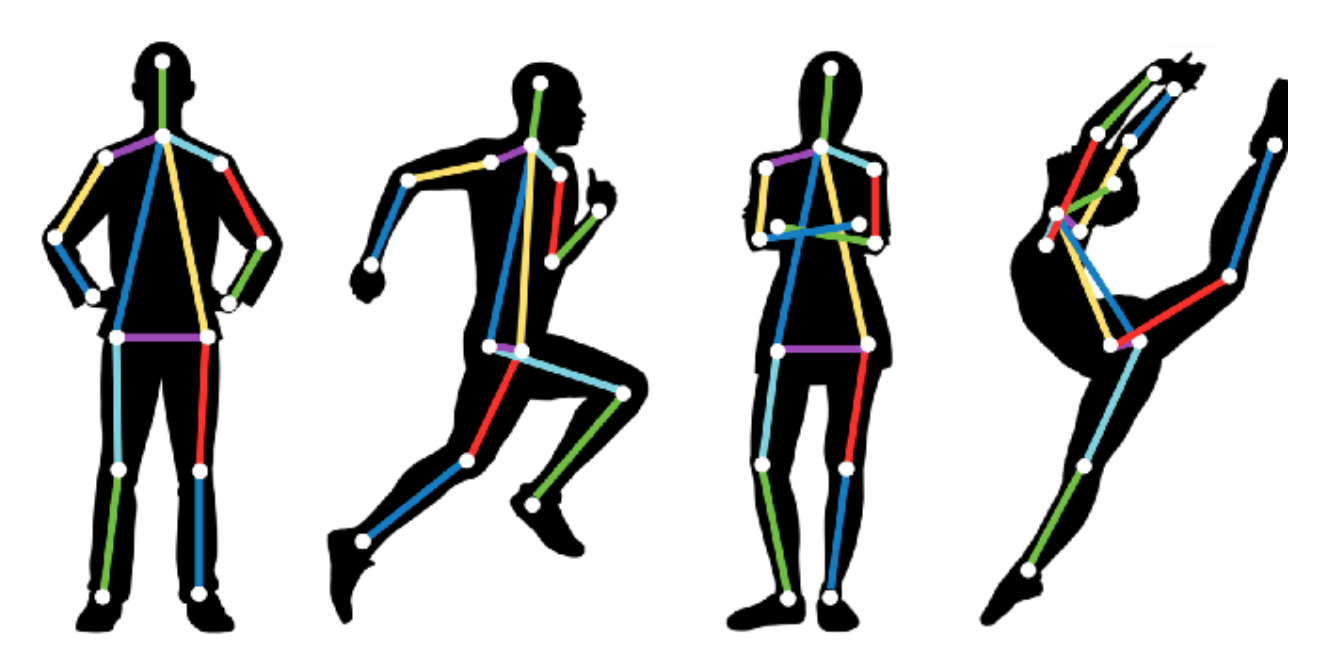
Methods of Pose Estimation
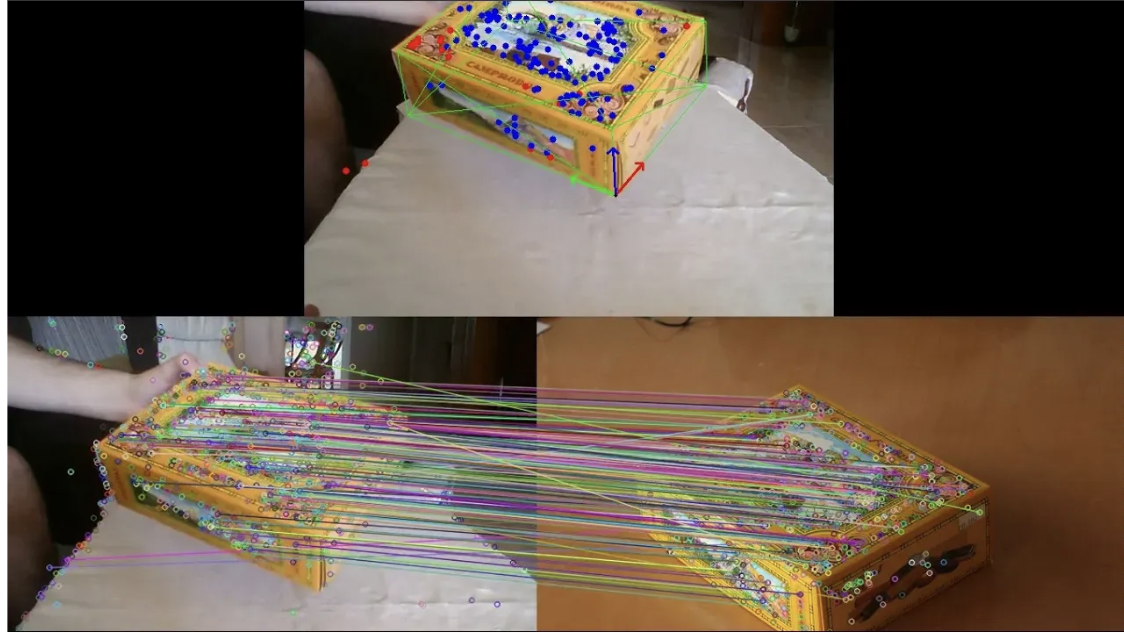
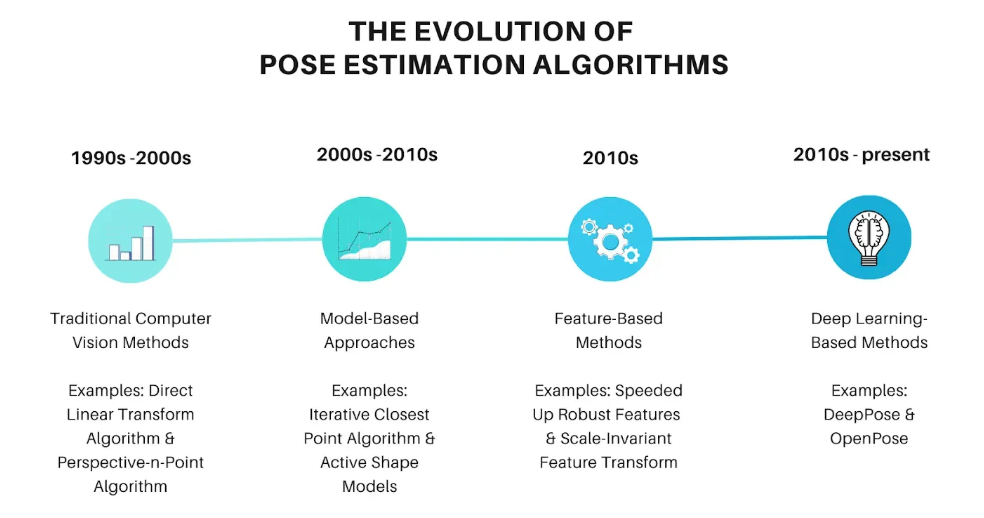
Pose estimation approaches have evolved significantly over the decades. For a comprehensive history of these advancements, see our detailed article on pose estimation algorithms and their evolution.
Traditional Computer Vision Methods (1990s-2000s)
Early approaches relied on geometric calculations and feature-based methods. The Direct Linear Transform (DLT) and Perspective-n-Point (PnP) algorithms estimated camera pose using known 3D-2D correspondences. While effective with manual calibration, these methods required extensive preprocessing and struggled with occlusions.
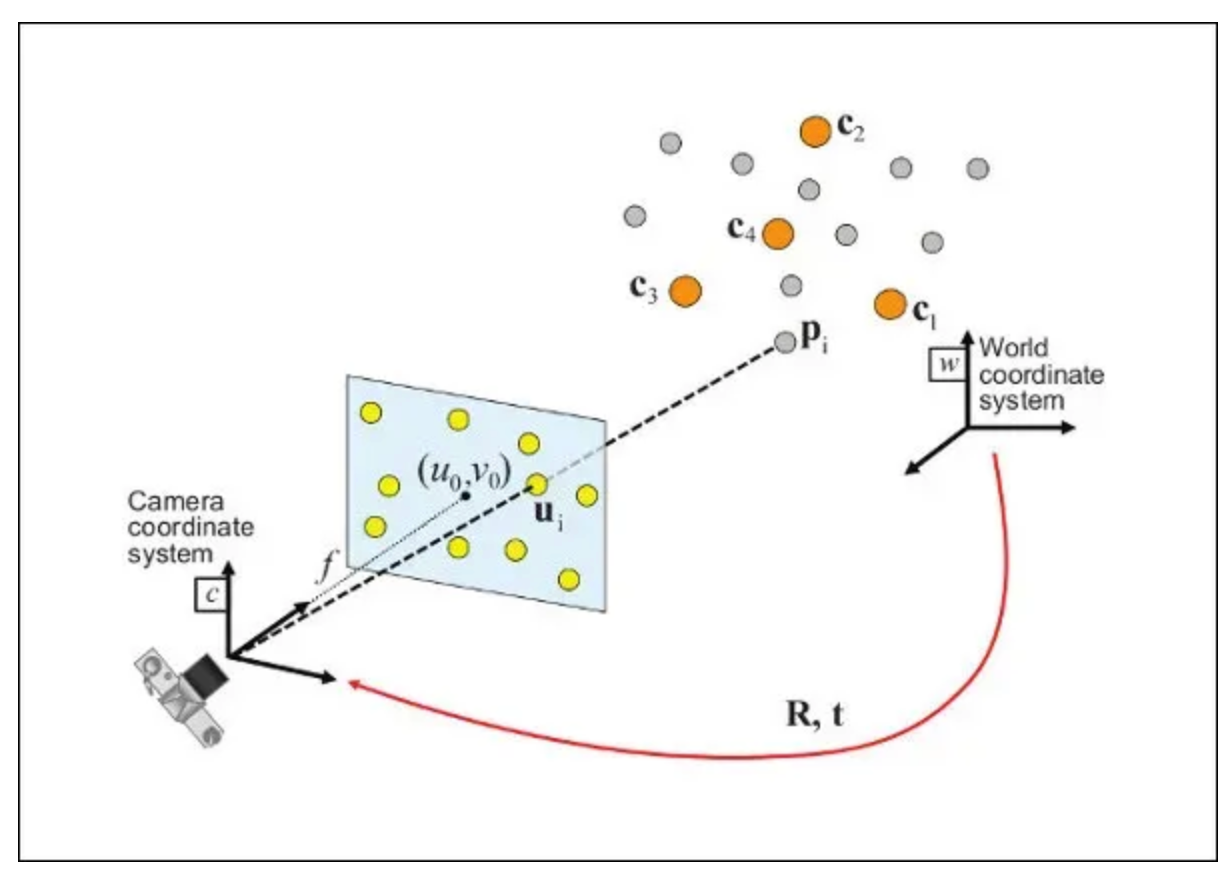
Model-based Approaches (2000s-2010s)
Model-based methods used predefined skeletal models and iterative alignment. The Iterative Closest Point (ICP) algorithm aligned point clouds.
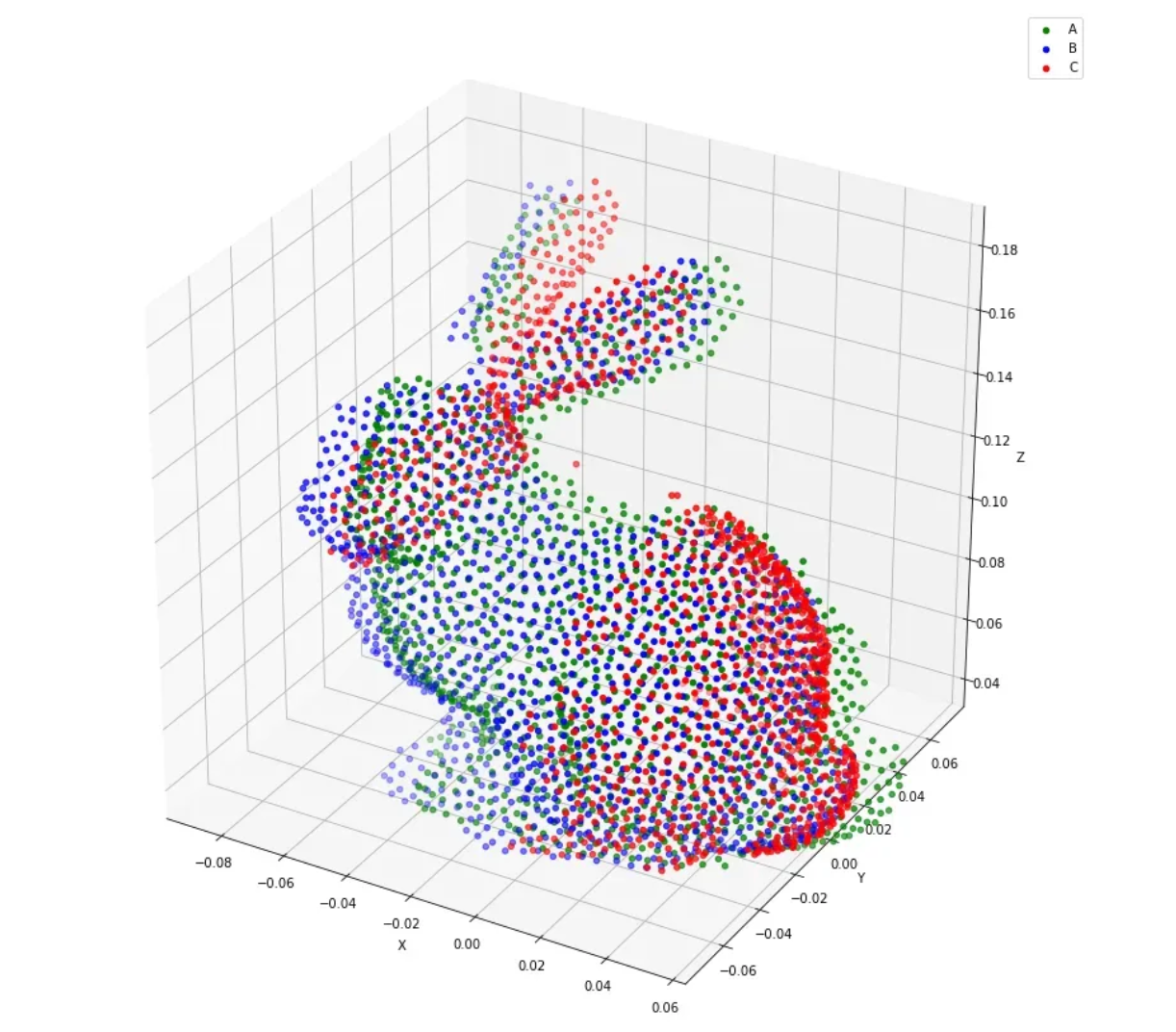
While Active Shape Models (ASM) combined statistical shape information with image features. These approaches improved robustness but remained computationally expensive.
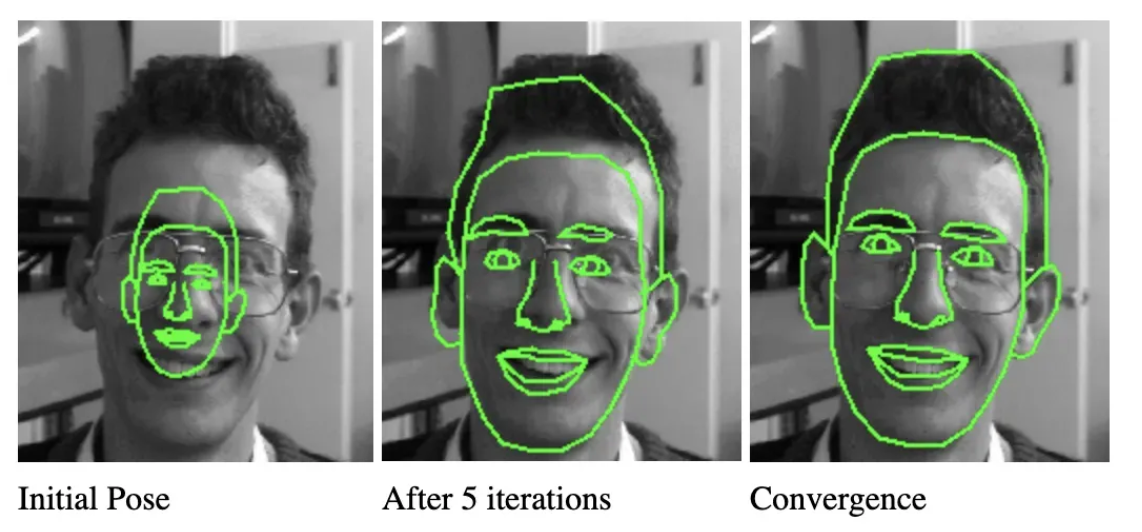
Feature-Based Methods (2010s)
Feature extraction algorithms such as SIFT (Scale-Invariant Feature Transform) and SURF (Speeded Up Robust Features) identify distinctive key points and their descriptors. While fast, these methods often missed complex body structures and struggled in crowded scenes.
Deep Learning-Based Methods (2010s-Present)
Deep learning revolutionized pose estimation. Early pioneers like DeepPose introduced CNNs for direct joint regression. OpenPose pioneered multi-person detection using Part Affinity Fields (PAFs), while modern transformer-based architectures capture fine-grained spatial relationships with unprecedented accuracy.
Today's state-of-the-art models leverage:
- Convolutional Neural Networks (CNNs): Efficient feature extraction from images
- Transformer Architectures: Capturing long-range dependencies between keypoints
- Attention Mechanisms: Focusing on relevant features and handling occlusions
- Heatmap Regression: Predicting confidence maps for each keypoint location
- Vision Transformers (ViT): End-to-end spatial reasoning without convolutions
Best Pose Estimation Models Criteria
Here are the criteria we used to select these pose estimation models:
1. Accuracy on Standard Benchmarks
Models should demonstrate strong performance on industry-standard benchmarks like COCO Keypoints and MPII Human Pose. We prioritize models achieving high Object Keypoint Similarity (OKS) scores, indicating reliable detection across different body sizes and visibility conditions.
2. Real-time Performance
The model should achieve inference speeds suitable for live applications, typically processing images at 20+ FPS on standard hardware (NVIDIA T4, edge devices). This ensures viability for interactive applications and video processing.
3. Multi-person Detection
Modern applications require detecting multiple people simultaneously in complex scenes. We favor architectures that handle crowded environments, occlusions, and overlapping subjects without performance degradation.
4. Deployment Flexibility
Models should support diverse deployment targets, from cloud GPUs to edge devices like Raspberry Pi and NVIDIA Jetson. Lightweight variants enable mobile and embedded applications.
5. Ease of Integration
Support for popular frameworks (PyTorch, TensorFlow, ONNX) and production-ready tools ensures practitioners can move from research to deployment smoothly.
6. Customization Capabilities
The ability to train on custom datasets and adapt to domain-specific poses (sports, medical, industrial) is essential for specialized applications.
The Best Pose Estimation Models
Here's our list of the best pose estimation models.
1. RF-DETR Keypoint
RF-DETR Keypoint is a real-time, transformer-based keypoint model that extends RF-DETR, the architecture that is state of the art for object detection and instance segmentation. It predicts bounding boxes and keypoint coordinates in a single forward pass, with no non-maximum suppression and no heatmaps. Each keypoint comes with a confidence score and an uncertainty ellipse derived from a learned covariance matrix, so you can tell how sure the model is about each joint, not just where it placed it.
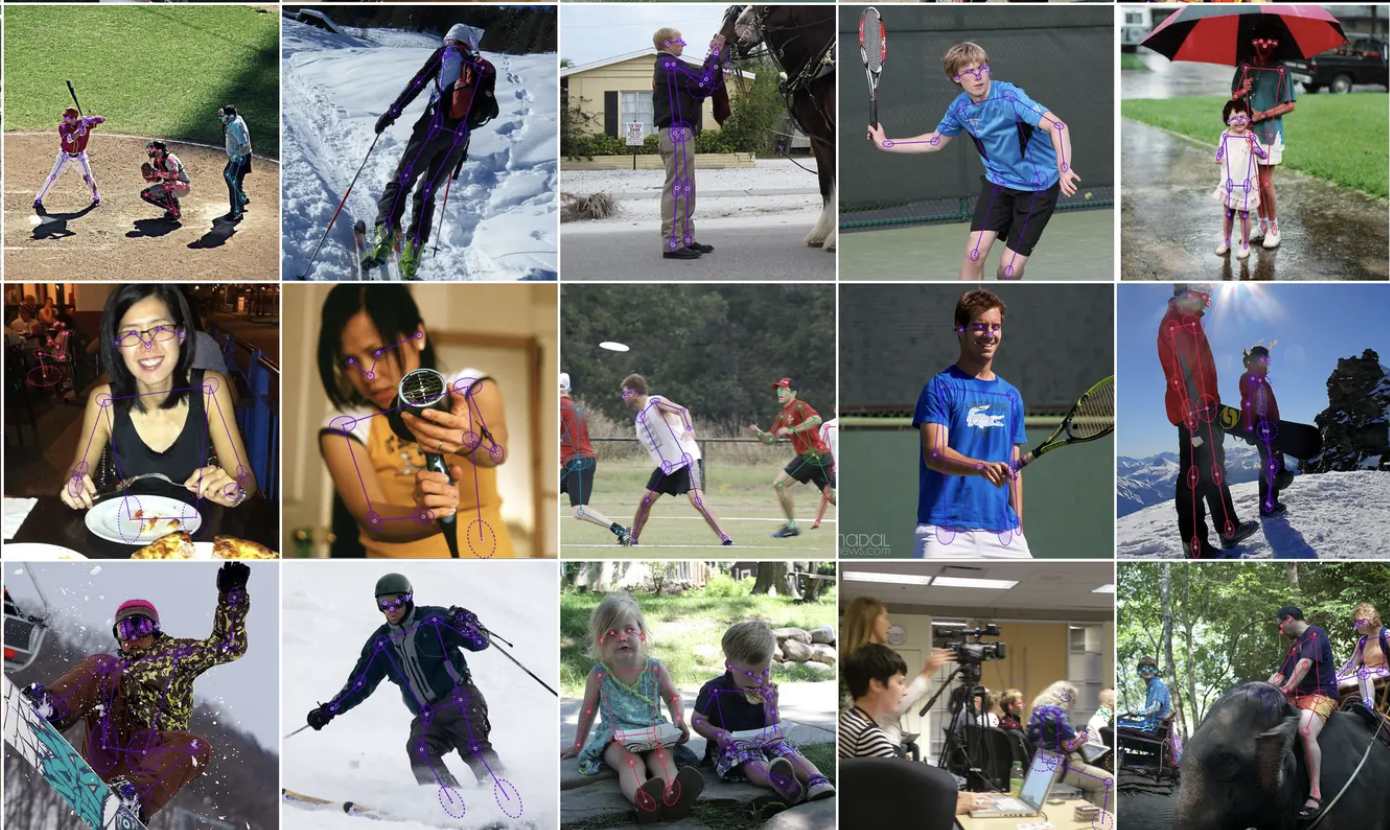
The default checkpoint is trained on COCO person pose with 17 keypoints, but RF-DETR Keypoint is not tied to that skeleton. You can fine-tune it on any keypoint layout attached to any object class, which is what makes it a fit for domain-specific work: 33 landmarks on a basketball court, joint sets for animals, or custom body points for ergonomic analysis.
Key strengths:
Real-time transformer accuracy without the post-processing that slows other approaches, since there is no NMS step. Per-keypoint uncertainty, which is useful for filtering weak joints and for downstream geometry like homography. Custom skeletons of any size on any class, not just human bodies. A permissive path to production, since RF-DETR is open source under an Apache 2.0 license. And two training paths: no-code in the Roboflow platform, or the open source rfdetr Python package.
You can run the COCO-pretrained checkpoint in a few lines with the open source package before you train anything. Install the SDK:
pip install "rfdetr[train,visual]>=1.8.1" "supervision>=0.29.1"Then predict and visualize keypoints on an image:
import cv2
import supervision as sv
from rfdetr import RFDETRKeypointPreview

model = RFDETRKeypointPreview()
key_points = model.predict("image.jpg", threshold=0.5).with_nms()

image = cv2.imread("image.jpg")
edge_annotator = sv.EdgeAnnotator(color=sv.Color.ROBOFLOW, thickness=2)
vertex_annotator = sv.VertexAnnotator(radius=4, color=sv.Color.ROBOFLOW)
image = edge_annotator.annotate(scene=image, key_points=key_points)
image = vertex_annotator.annotate(scene=image, key_points=key_points)
sv.plot_image(image)
The supervision library handles drawing the skeleton and the uncertainty ellipses. To train on your own skeleton, see the step-by-step guide to fine-tuning RF-DETR Keypoint on custom data.
2. MediaPipe Pose
MediaPipe Pose is Google's optimized framework specifically designed for single-person pose estimation with exceptional performance on resource-constrained devices. Using a two-stage pipeline, person detection followed by keypoint localization, MediaPipe Pose achieves remarkable accuracy while maintaining blazing-fast inference speeds.
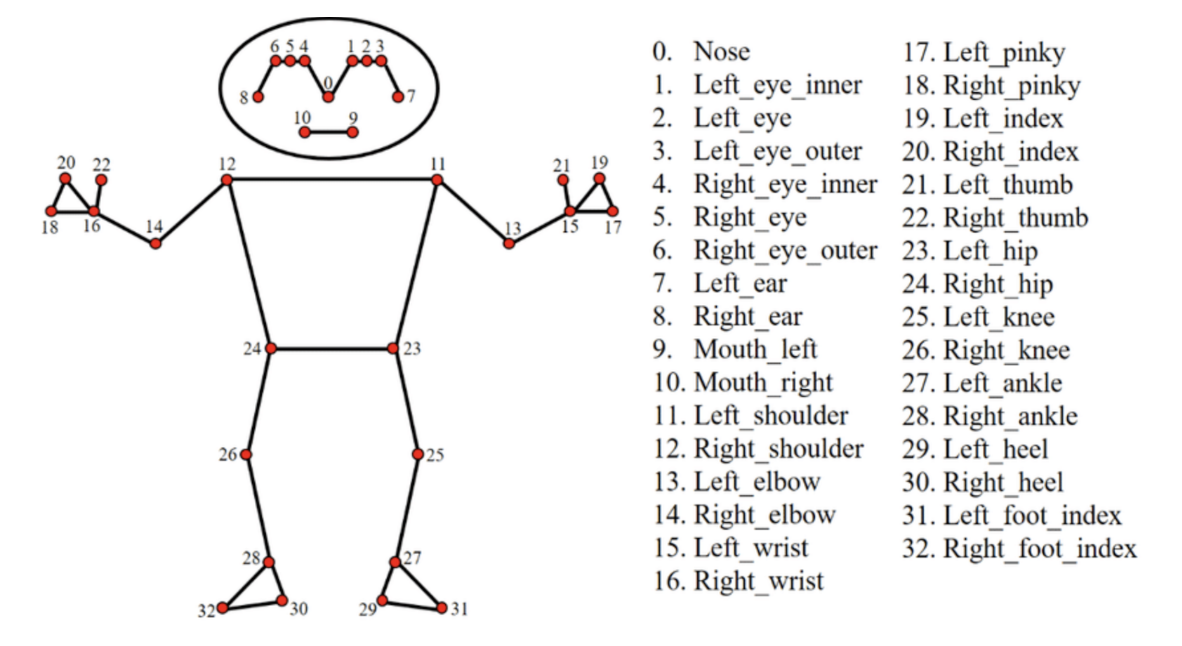
What distinguishes MediaPipe Pose is its comprehensive keypoint topology. Rather than limiting itself to the standard 17 COCO keypoints, MediaPipe Pose identifies 33 landmark locations across the entire body, including:
- Full-body joints (i.e., shoulders, hips, elbows, knees, ankles)
- Hand keypoints (e.g., finger landmarks)
- Foot keypoints (detailed ankle and toe positions)
- Face-related landmarks (for a more complete body context)
This extended keypoint set enables sophisticated pose-analysis tasks like detailed hand-gesture recognition and fine-grained movement tracking.
Key strengths:
- Lightning-Fast Inference: Capable of processing images at 30+ FPS on CPU alone, without requiring GPU acceleration.
- Mobile-Optimized: Achieves excellent real-time performance on Android and iOS devices.
- Robust Tracking: Includes temporal smoothing across frames for stable video-based pose analysis.
- Efficient Model Size: Enables edge‐deployment with very small model footprints.
- Cross-Platform Support: Runs seamlessly across desktop, mobile, and web platforms.
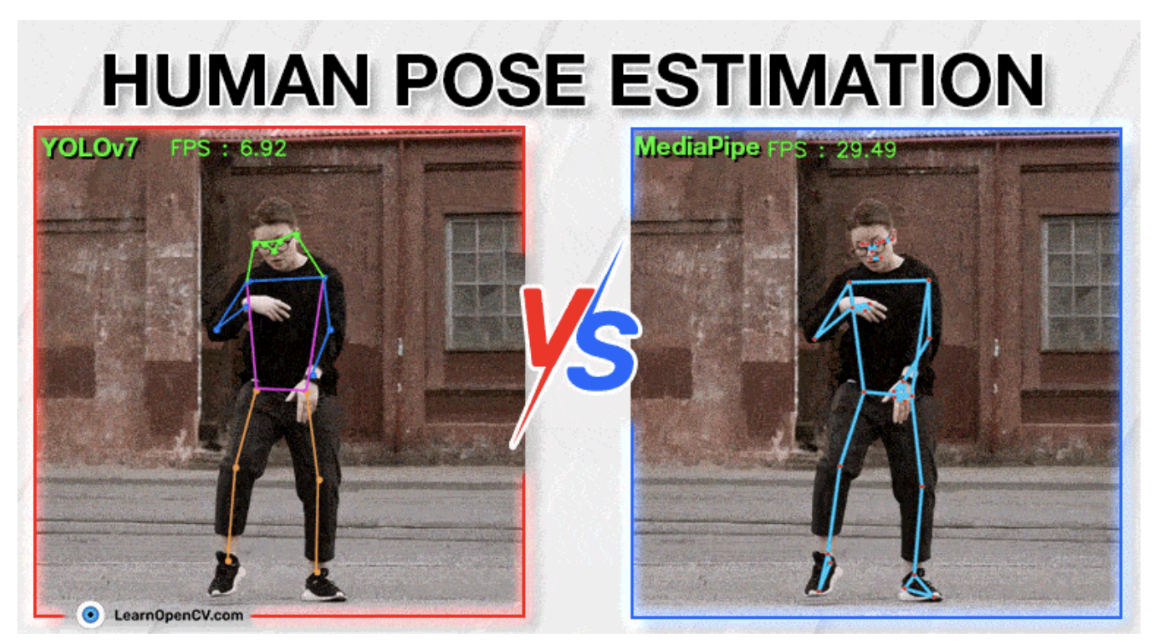
Deployment options:
Python via MediaPipe Python package, Web via MediaPipe JavaScript/Web solutions, Mobile via native Android and iOS SDKs, Self-hosted via Docker containers.
MediaPipe Pose particularly excels in the following areas:
- Fitness applications - real-time workout form analysis and exercise tracking
- Rehabilitation / physical therapy - movement monitoring, feedback, and recovery tracking
- Gaming - motion-controlled interactive experiences
- Live streaming & AR - real-time pose effects and augmented reality overlays
- Accessibility - sign-language recognition and assistive technologies
The framework's two-stage approach prevents unnecessary keypoint detection when no person is present, improving efficiency in sparse scenes. Recent integrations with Google's ML Kit bring on-device machine learning capabilities directly to mobile applications, making it an excellent choice for privacy-conscious deployments.
3. HRNet (High-Resolution Network)
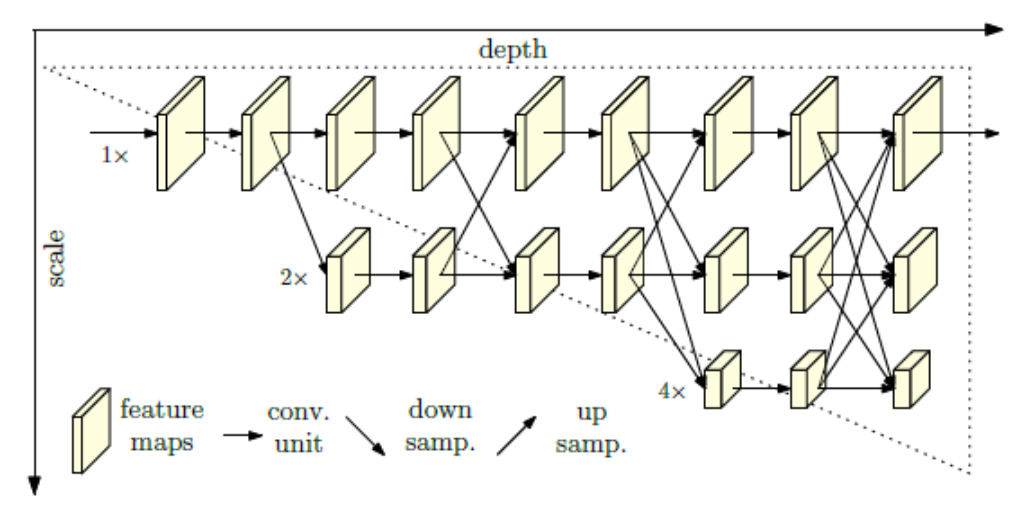
HRNet introduces a significant shift in pose-estimation architecture: instead of following the conventional path of progressively down-sampling feature maps (losing spatial resolution) and then up-sampling, it maintains high-resolution representations throughout the network while also incorporating multi-scale context through parallel branches.
- It starts with a high-resolution sub-network as the first stage.
- It then gradually adds lower-resolution branches in parallel, rather than serially chaining high-to-low resolution only.
- Frequently, the multiple parallel branches exchange information (multi-scale fusion) so that high-resolution streams benefit from contextual cues and low-resolution streams benefit from fine spatial detail.
Traditional CNN-based pose estimation models often lose fine spatial detail due to repeated down-sampling, which impairs the localization of small body parts (e.g., fingers, toes) and reduces the precision of keypoint localization. HRNet addresses this limitation by preserving high-resolution data throughout the network, resulting in improved spatial precision and better keypoint heatmap prediction.
Key strengths:
- Superior Accuracy: Achieves 89.0% mAP@0.5 on COCO Keypoints; among the highest-performing models at release.
- Precise Localization: Excels at detecting small joints (e.g., fingers, toes) with pixel-level accuracy.
- Efficient Design: Maintains competitive inference speeds despite its high accuracy.
- Proven Robustness: Effectively handles occlusions and complex body configurations.
- Transfer Learning: Pre-trained weights adapt well to domain-specific pose estimation tasks.
Architectural variants:
- HRNet-W32: A “lighter” width variant suitable for scenarios with more constrained resources.
- HRNet-W48: The standard version that balances accuracy and speed.
- HRNet-W64: A higher-capacity variant aimed at maximum accuracy, usually for offline or batch processing rather than real-time edge inference.
HRNet shines in applications requiring precise key point localization, such as detailed movement analysis for sports biomechanics and technique evaluation, medical assessment for gait analysis and rehabilitation evaluation, and industrial ergonomics for workplace posture monitoring and injury prevention. It also provides fine-grained gesture recognition for capturing subtle hand and finger movements.
More recent work builds on HRNet’s high-resolution concept: for example, the “Detail-Enhanced HRNet” (DE-HRNet) introduces modules to recover low-level features and improve scale-variation handling. Also, lightweight variants (e.g., Lite-HRNet) aim to bring HRNet-level accuracy into resource-constrained environments.
4. MoveNet
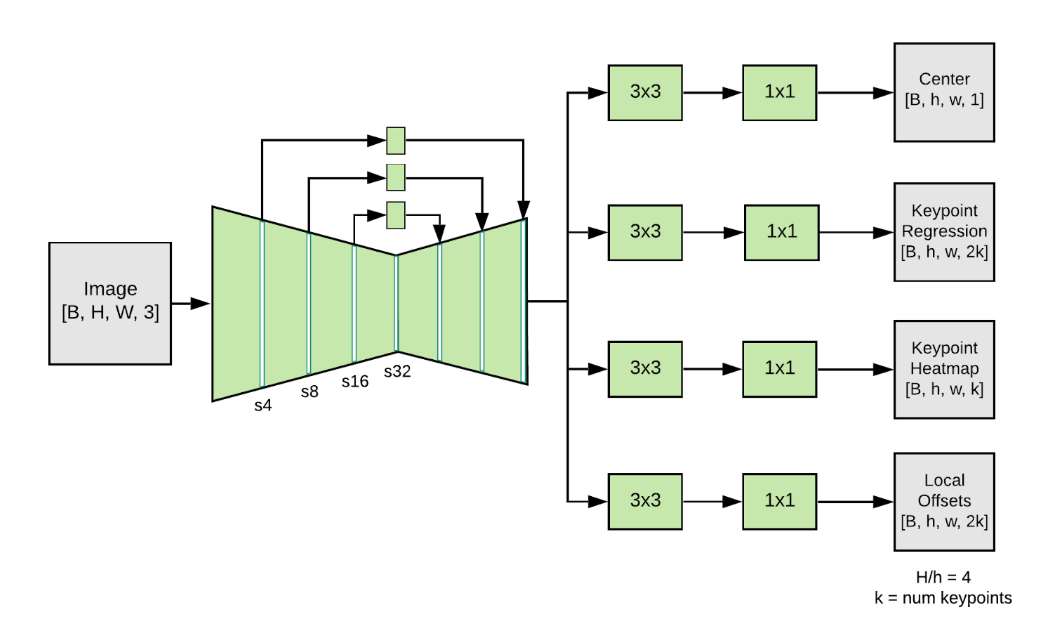
MoveNet, developed by Google and trained on the PoseTrack dataset, represents a lightweight yet highly accurate approach to human pose estimation. Optimized for edge deployment, MoveNet demonstrates that efficient models don't require sacrificing accuracy.
The model offers two variants for different deployment scenarios:
Lightning is an ultra-lightweight variant achieving 192×256 resolution inference in under 7ms on mobile devices. Thunder is a higher-accuracy variant that processes 256×256 resolution images in approximately 20ms on devices.
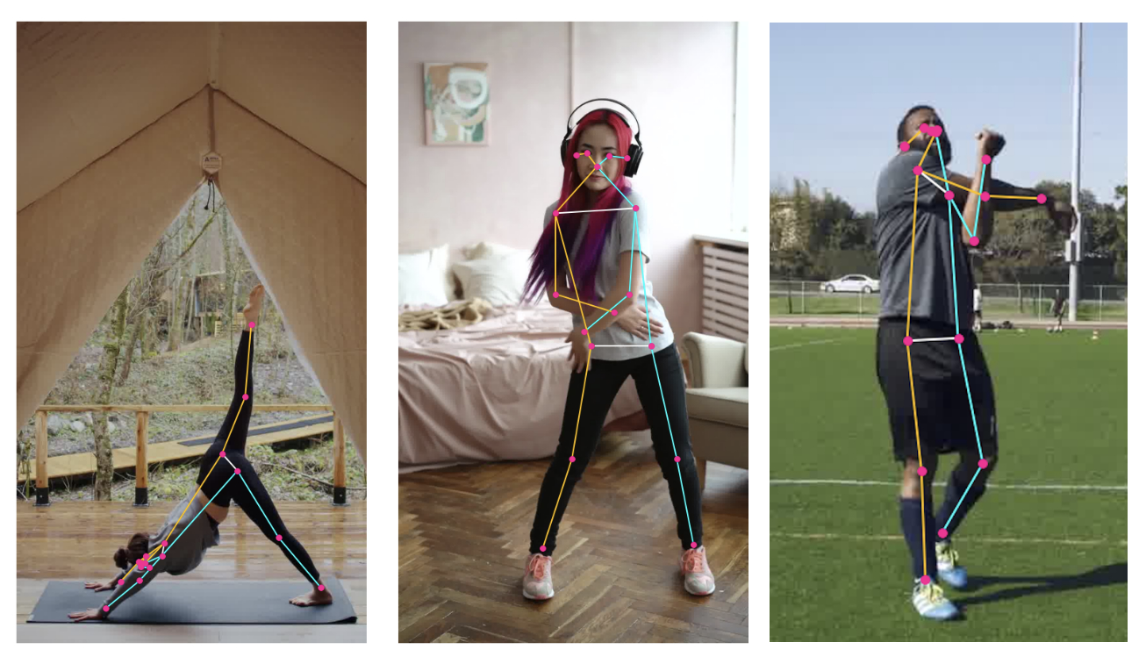
Key strengths:
Extreme Efficiency runs on mobile phones, Raspberry Pi, and embedded devices without GPU acceleration. High Accuracy remains competitive with much larger models despite minimal model size. Fast Inference sub-10ms latency enables real-time interactive applications. Single-Person Focus optimizes for primary subject detection with a clean background. Browser Support via TensorFlow.js enables web-based deployment.
Performance characteristics:
- Lightning variant: ~7ms inference on mobile CPU
- Thunder variant: ~25-35ms inference on mobile CPU
- Achieves 65%+ accuracy on PoseTrack dataset across both variants
MoveNet excels in mobile-first applications such as fitness apps for workout form correction with minimal battery drain, web applications for browser-based pose detection without server costs, IoT devices for edge computing scenarios with minimal computational resources. It also provides real-time feedback for interactive pose coaching with sub-100ms latency.
The framework integrates seamlessly with TensorFlow and TensorFlow.js, enabling deployment from cloud to browser in minutes. Recent developments show strong integration with on-device ML systems, particularly for real-time rep counting and exercise classification on Android devices using TensorFlow Lite quantization.
5. ViTPose
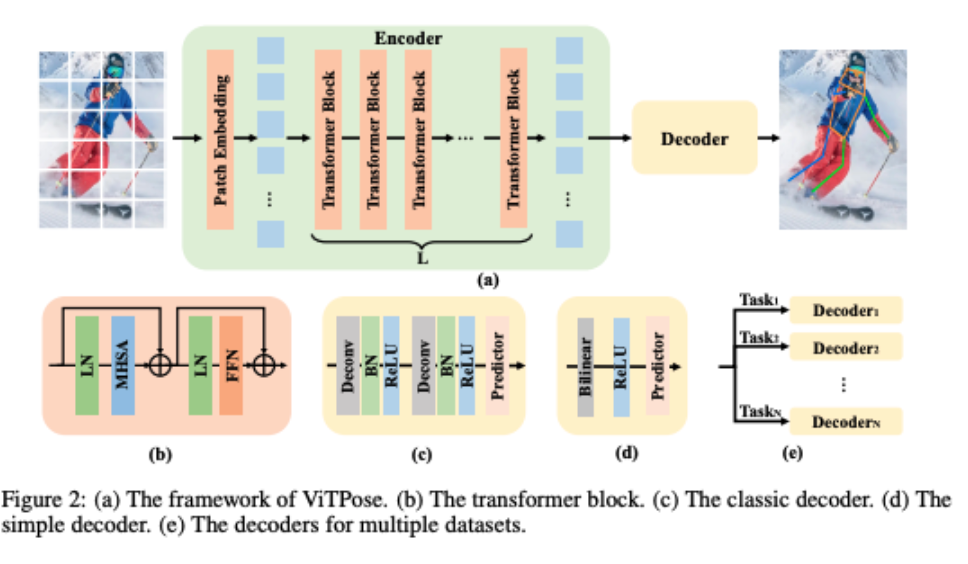
ViTPose represents the cutting edge of transformer-based pose estimation architectures, demonstrating that plain vision transformers can achieve state-of-the-art performance for human pose estimation. Unlike CNN-based approaches that progressively downsample features, ViTPose uses self-attention mechanisms to capture global relationships between joints with unprecedented flexibility.
ViTPose employs plain, non-hierarchical vision transformers as backbones to extract features for a given person instance and a lightweight decoder for pose estimation. It can be scaled from 100M to 1B parameters by taking advantage of the transformers' scalable model capacity and high parallelism.
Key strengths:
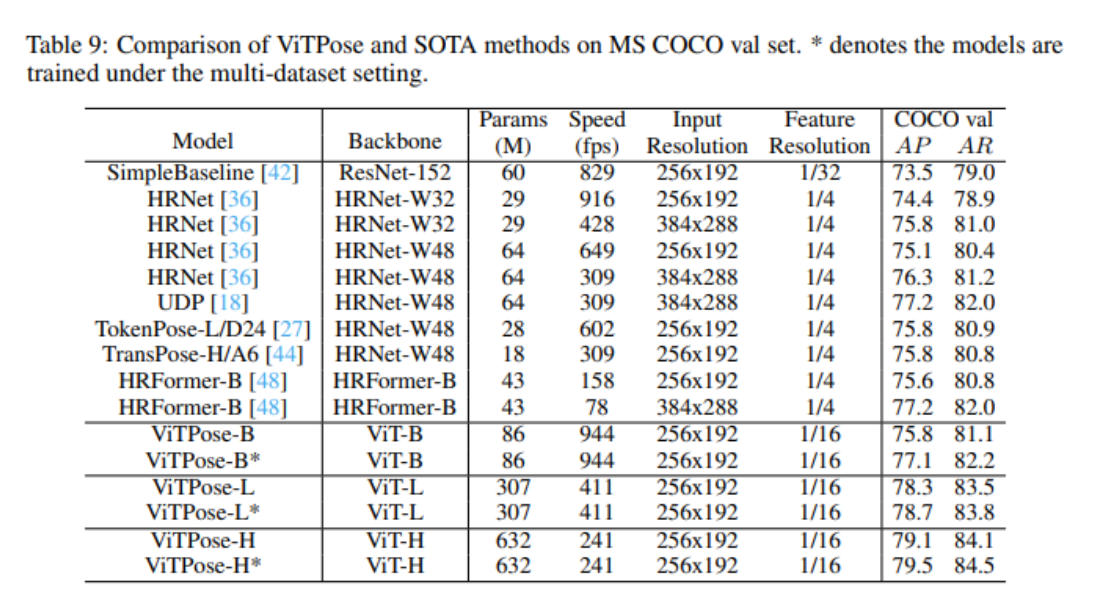
- State-of-the-art accuracy: ViTPose achieves competitive COCO results (single-model top rows: 80.9 AP with ViTAE-G; ensemble 81.1 AP).
- Scalability: model sizes span small → huge (e.g., ViTPose-B ≈ 86M params up to ViTPose-H ≈ 632M params), so you can pick a variant to match compute limits.
- Flexibility: works with different attention types, input resolutions, pre-training strategies (ImageNet/MAE/downstream pretraining), and multi-dataset fine-tuning. Performance improves at higher input resolutions.Transferability: large→small knowledge transfer is supported via a simple knowledge token (token-based distillation) to boost smaller models with little extra memory.
- Practical trade-offs: larger backbones give higher AP but reduce throughput; ViTPose aims for a good throughput/accuracy tradeoff on modern GPUs.
Model variants:
- ViTPose-B (Base): 86M parameters with balanced performance
- ViTPose-L (Large): 307M parameters with enhanced accuracy
- ViTPose-H (Huge): 632M parameters with maximum performance
ViTPose particularly excels in research applications where maximum accuracy justifies computational cost, complex scenario testing for validating approaches in extreme conditions with occlusions and unusual poses, advanced research exploring novel loss functions and architectural innovations, and high-precision applications where accuracy is paramount over speed.
Recent advancements include efficient attention mechanisms like window attention and pooling-window attention that reduce computational overhead while maintaining accuracy, making ViTPose-derived models viable for practical deployments.
6. DETRPose
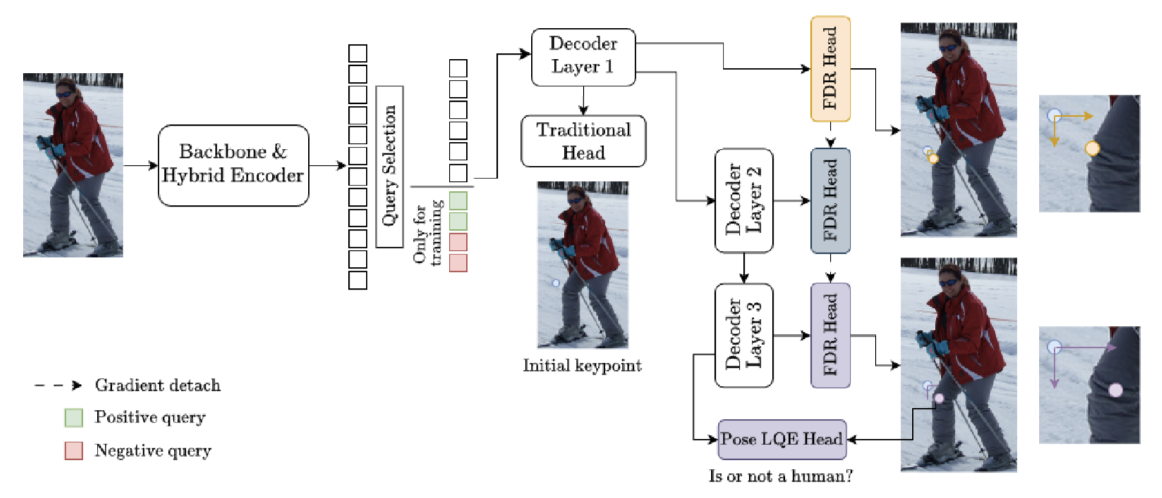
DETRPose represents the first real-time transformer-based model specifically designed for multi-person pose estimation, released in 2025 as a breakthrough addressing previous limitations of transformer-based approaches. Unlike CNN-based single-stage methods, DETRPose achieves real-time performance without quantization libraries while maintaining competitive accuracy.
The key innovation is Pose Denoising, a novel technique adapted from object detection but tailored for keypoint estimation. This approach generates both positive and negative query samples during training, improving model robustness and accelerating convergence.
Key strengths:
- Real-time detection: Processes full images in real-time without quantization.
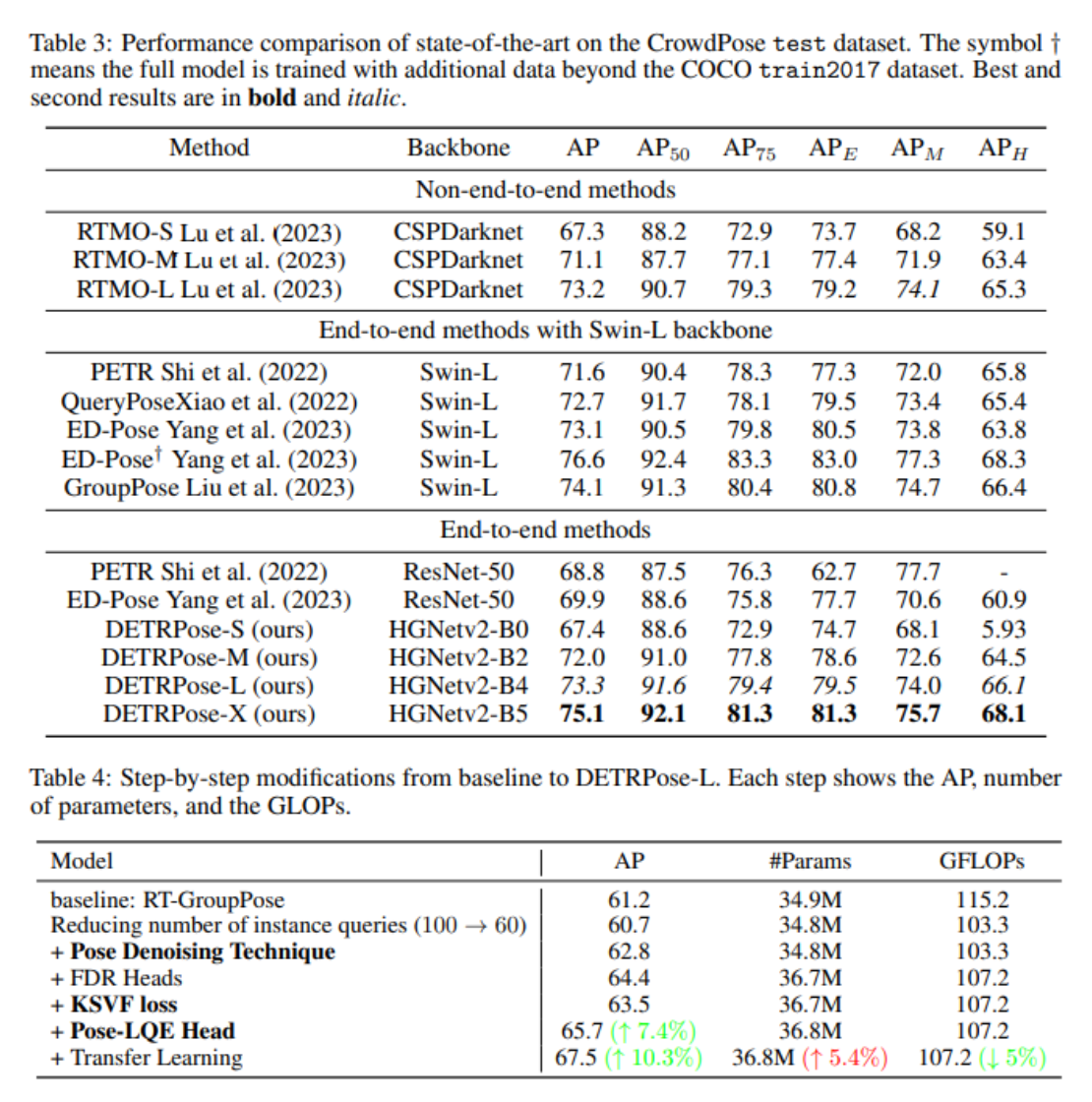
- High accuracy: Outperforms YOLO11-X and YOLOv8-X on COCO test-dev and CrowdPose.
- Efficient parameters: Matches or exceeds larger models with fewer parameters.
- Fast training: Requires 5–10x fewer epochs than comparable transformer models.
Performance highlights:
- Outperforms YOLO11-X on benchmark datasets
- Fewer parameters than competing XL-variant models
- Faster inference speed than previous transformer approaches
- Achieves state-of-the-art results on CrowdPose for occlusion handling
DETRPose excels in crowd analysis for detecting poses in stadiums and public events, research applications where cutting-edge transformer approaches are valuable, and complex scene understanding, where end-to-end training provides advantages over traditional bottom-up approaches.
Real-World Pose Estimation Applications
Modern pose estimation models enable transformative applications across industries:
- Fitness & Wellness: Provides real-time form correction during workouts, personalized exercise coaching, and injury prevention through posture monitoring.
- Sports Analytics: Enables biomechanical analysis for technique improvement, instant replay analysis for referees, and athlete performance metrics.
- Healthcare: Supports rehabilitation progress tracking, movement disorder assessment, gait analysis for physical therapy, and surgical training simulations.
- Entertainment: Includes motion capture for animation and gaming, interactive fitness experiences, and virtual reality integration.
- Industrial: Enables workplace safety monitoring, ergonomic assessment, worker fatigue detection, and accident prevention.
- Accessibility: Includes sign language recognition, gesture-based interfaces, and assistive technology for individuals with disabilities.
- Surveillance: Supports anomaly detection, activity recognition, crowd behavior analysis, and public safety applications.
Train a Custom Keypoint Model with RF-DETR Keypoint
Pretrained human-pose models cover the common case, but a lot of real work needs a skeleton that does not exist off the shelf: sport-specific body points, court or field landmarks, animal joints, or industrial ergonomic points. Roboflow gives you end-to-end keypoint detection support to train RF-DETR Keypoint on exactly that.
Define your skeleton, then label keypoints in Roboflow Annotate, marking each point visible when it appears and occluded when it is hidden but geometrically known. Generate a dataset version in COCO Keypoint format so the visibility flags export correctly.
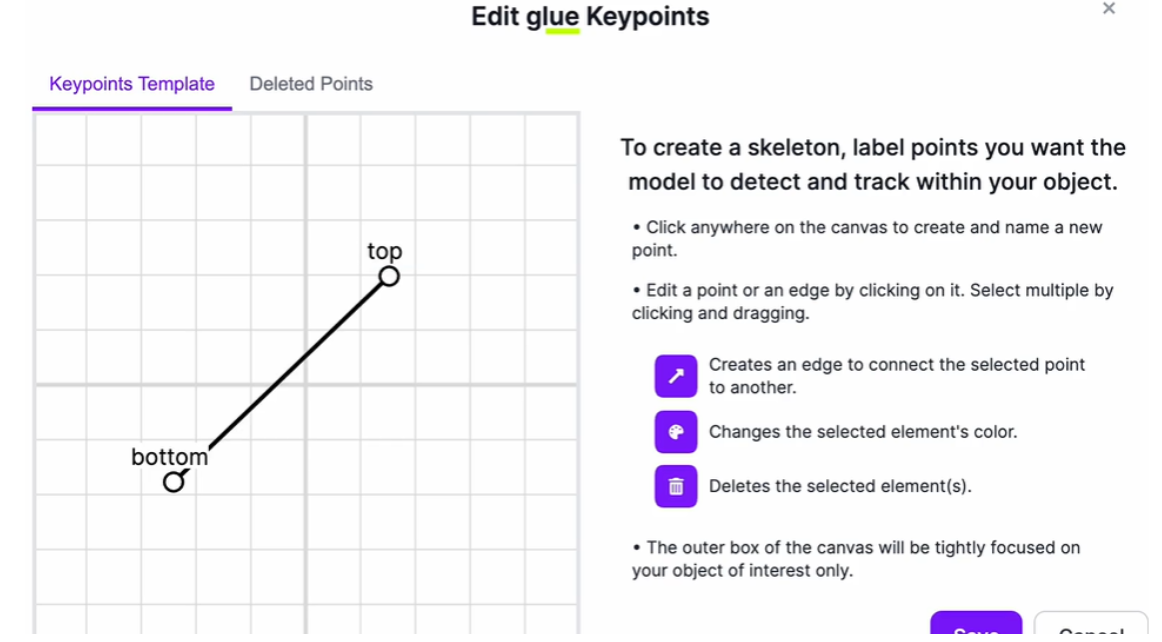
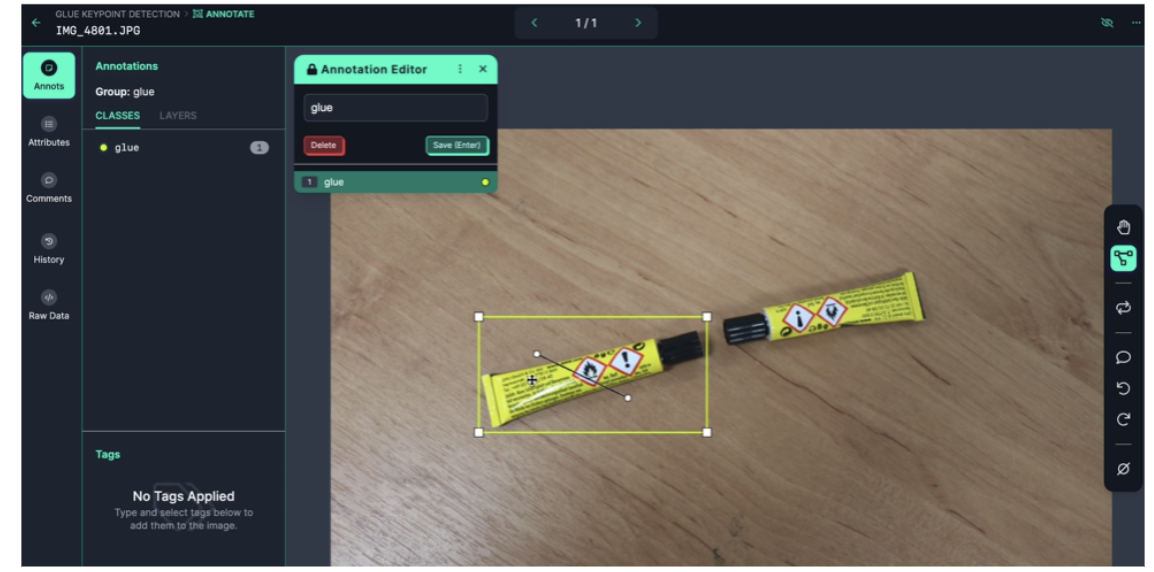
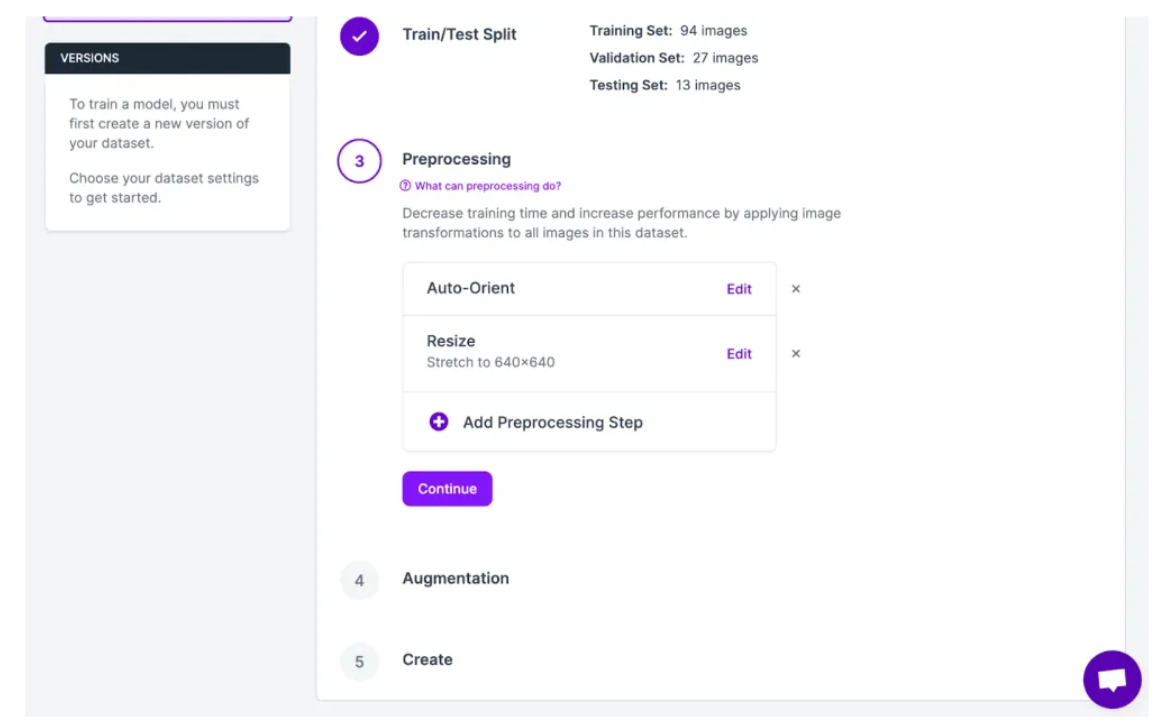
Then train one of two ways. For a no-code run, open the Train tab, select the RF-DETR Preview architecture, apply auto-orient and resize to 576x576 to match the model's input, and start training on Roboflow's managed GPUs while you watch keypoint mAP, precision, and recall live.

The platform handles the infrastructure and hyperparameter optimization automatically. As the model trains, you can monitor live progress charts tracking keypoint mAP, Precision, Recall, and various loss metrics. You can let the training run for the full duration or use the Early Stop feature if the metrics stabilize. Once training is complete, your model is immediately available for deployment via the Roboflow API.
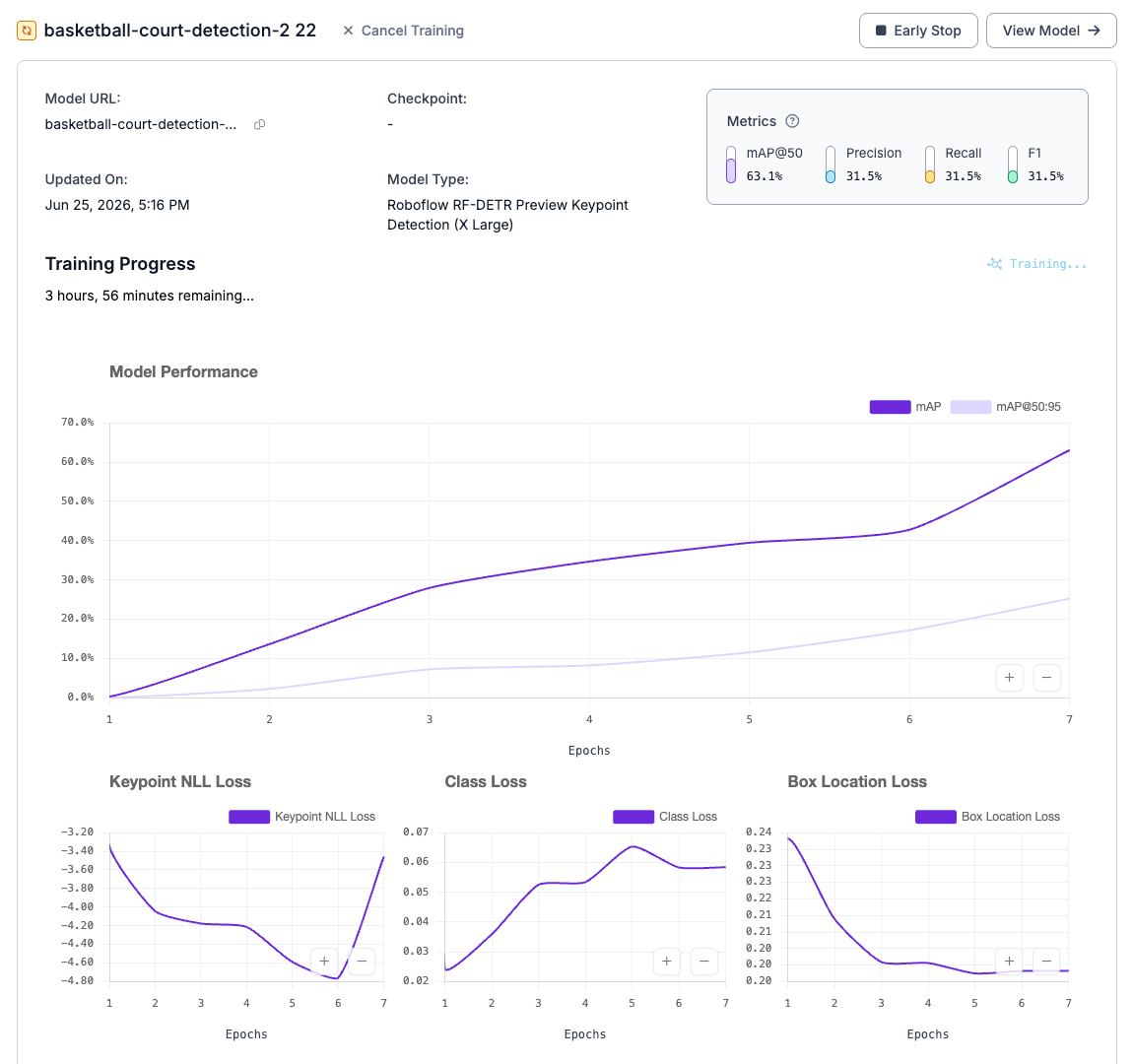
For full control, fine-tune with the open source rfdetr package, which reads your class names and keypoint counts straight from the COCO annotations so nothing is hard-coded. The full walkthrough is in How to Fine-Tune RF-DETR Keypoints on Custom Data.
Once trained, deploy through Roboflow Inference, the open source engine that runs on the cloud, on-prem, or on edge devices like NVIDIA Jetson.
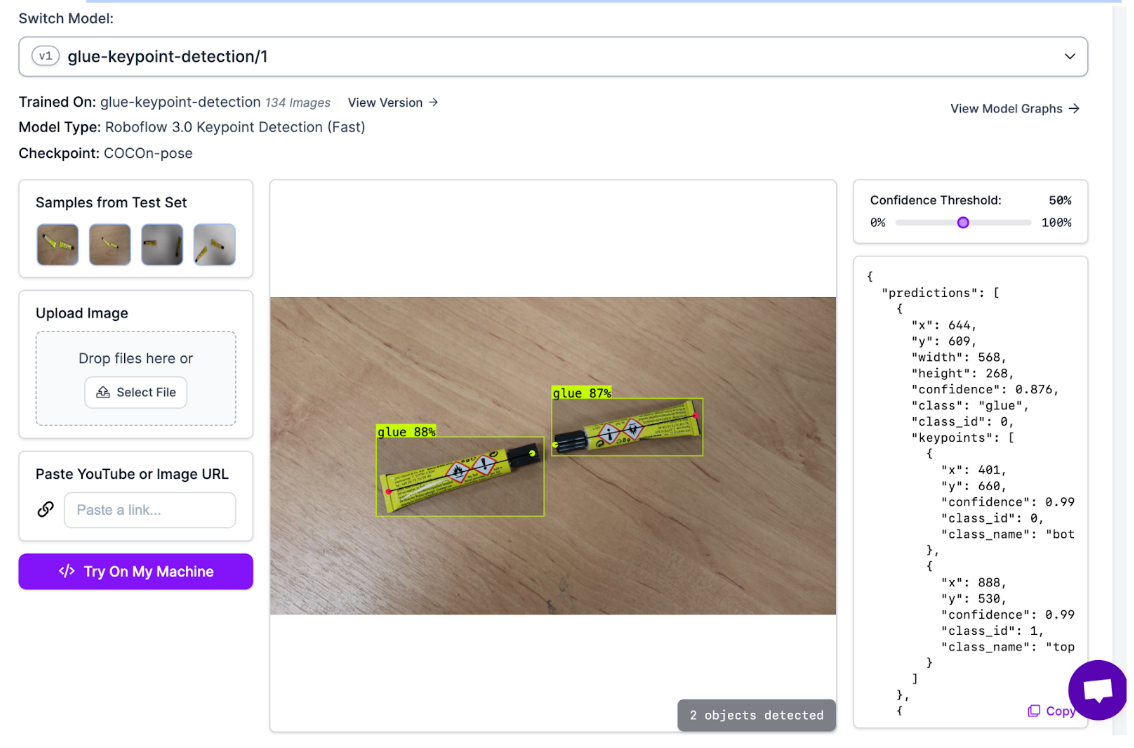
For detailed instructions on labeling, training, and deploying keypoint detection models on Roboflow, see the complete guide on keypoint detection
Which Pose Estimation Model Should You Use?
Match the model to the deployment:
For a custom skeleton or production real-time keypoints, train RF-DETR Keypoint. It fine-tunes to any object and any keypoint layout, runs in real time without NMS, gives per-joint uncertainty, and ships under a permissive license with a direct path to deployment.
For real-time on mobile or CPU-only devices, MediaPipe Pose and MoveNet Lightning are hard to beat on efficiency. For maximum accuracy on high-end hardware where speed is secondary, ViTPose leads. For dense multi-person crowds, DETRPose is built for the case. And for offline, pixel-precise joint localization, HRNet holds up.
For most teams building something specific, the deciding factors are custom skeleton support, real-time speed, and licensing, which is why RF-DETR Keypoint is our default recommendation.
How many keypoints can these models detect?
It varies by model and task. Standard human pose uses the 17 COCO keypoints; MediaPipe Pose tracks 33 body landmarks. RF-DETR Keypoint defaults to 17 for person pose but supports any number when you fine-tune, for example 33 landmarks for a basketball court.
Can I train a pose estimation model on my own dataset?
Yes. Define your skeleton and label keypoints in Roboflow Annotate, export a dataset version in COCO Keypoint format, and train RF-DETR Keypoint either no-code in the Roboflow platform or with the open source rfdetr package. A few hundred well-labeled images is often enough to start.
Get Started with Pose Estimation
You can train a custom keypoint model on your own images and skeleton today, then deploy it to the cloud or the edge. Create a free Roboflow account and follow the RF-DETR Keypoint fine-tuning guide to build your first model.


Cite this Post
Use the following entry to cite this post in your research:
Aarnav Shah. (Apr 6, 2026). Best Pose Estimation Models. Roboflow Blog: https://blog.roboflow.com/best-pose-estimation-models/