4 May 2026 • 4 min read How to Use the Detectron2 Model Zoo for Object Detection Use the Detectron2 model zoo: train Faster R-CNN from a COCO checkpoint, swap architectures with a one-line config change, and evaluate mAP.
1 May 2026 • 11 min read What is Mean Average Precision (mAP) in Object Detection? What is mean average precision? How do we calculate mAP?
1 May 2026 • 13 min read How to Train a YOLO26 Oriented Bounding Box (OBB) Model Learn how to train a YOLO26 Oriented Bounding Boxes model with a dataset labeled on Roboflow.
1 May 2026 • 12 min read Luxonis OAK-D: Deploy a Custom Object Detection Model with Depth Train a custom object detection model and deploy it to the Luxonis OAK-D: RF-DETR on the host, depth per detection, and on-device options.
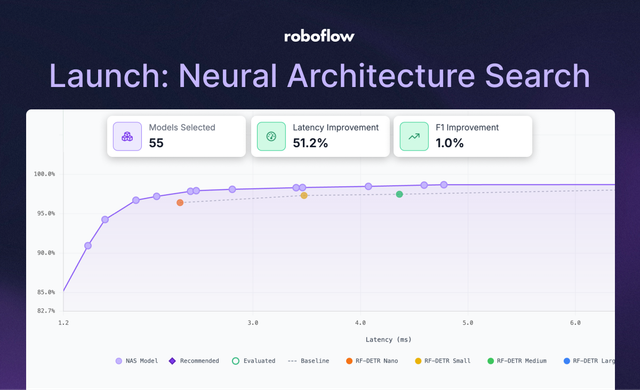
27 Apr 2026 • 5 min read Neural Architecture Search: Train the best vision model for your data Balancing inference speed and accuracy just got easier. Learn how Neural Architecture Search evaluates thousands of configurations simultaneously to deliver the highest-performing model for your target hardware.
6 Apr 2026 • 15 min read Best Pose Estimation Models Pose estimation is transforming how we understand human movement, powering everything from fitness tracking and sports analytics to healthcare rehabilitation. This guide explores the best pose estimation models, and shows how to deploy them efficiently across mobile, edge, and cloud environments.
2 Apr 2026 • 6 min read Using Videos as Training Data Turn video files into training data. Learn how to extract frames, set sampling rates, and use Roboflow to speed up computer vision labeling.
24 Mar 2026 • 4 min read How to Create a TFRecord File for Computer Vision and Object Detection How to create a TFRecord file for object detection: what it is, when you need it, and how to export one from a labeled dataset in Roboflow.
16 Mar 2026 • 25 min read Gemini 3 Guide: Master Google’s Deep Think Model in Roboflow Explore Gemini 3’s native multimodality and Deep Think reasoning. Learn how to deploy Gemini 3.1 Pro for object detection, OCR, and VQA using Roboflow Workflows and Playground.
13 Mar 2026 • 7 min read What Is ResNet-50? Architecture Explained Learn what ResNet-50 is, how it works, and how ResNet models of various levels perform on image classification.
11 Mar 2026 • 18 min read Training a TensorFlow Faster R-CNN Object Detection Model on a Custom Dataset Train a Faster R-CNN style detector on a custom dataset in your browser: no GPU, no code. Label, train RF-DETR, and deploy from cloud to edge.
11 Mar 2026 • 4 min read The Importance of Blur as an Image Augmentation Technique Learn about the efficacy of blur as an image augmentation step in computer vision model training.
5 Mar 2026 • 7 min read How to Train a Custom TensorFlow Lite (Now LiteRT) Object Detection Model Learn how to train a custom TensorFlow Lite object detection model with a custom dataset.
2 Mar 2026 • 7 min read How to Train YOLOv4 on a Custom Dataset Want to train YOLOv4? Train a custom object detector without Darknet, a config file, or a GPU: Learn how with Roboflow.
2 Mar 2026 • 10 min read How to Train an EfficientDet Object Detection Model with a Custom Dataset Learn how to train an EfficientDet object detection model with a custom dataset.
25 Feb 2026 • 8 min read How to Train a VGG-16 Image Classification Model on Your Own Dataset The VGG16 model explained: 16 layers, 3x3 filters, 92.7% ImageNet top-5, plus how to train an image classifier on your own data, no GPU.
23 Feb 2026 • 15 min read Roboflow Training Graphs Guide Learn how to read Roboflow training graphs. Understand what each curve means, how the underlying metrics are computed, and how to diagnose common training problems.
21 Feb 2026 • 5 min read Why and How to Implement Random Crop Data Augmentation Learn how to apply a random crop data augmentation to images for use in training computer vision models.
12 Feb 2026 • 5 min read Liquid Neural Networks in Computer Vision Excitement is building in the artificial intelligence community around MIT's recent release of liquid neural networks. The breakthroughs that Hasani and team have made are incredible. In this post, we will discuss the new liquid neural networks and what they might mean for the vision field.
11 Feb 2026 • 7 min read EfficientDet vs YOLO for Object Detection EfficientDet vs YOLO compared on architecture, speed, accuracy, and licensing, plus why RF-DETR is the stronger detector to deploy today.
9 Feb 2026 • 10 min read Training a TensorFlow MobileNet Object Detection Model with a Custom Dataset Train a TensorFlow object detection model on a custom dataset the modern way: label, train RF-DETR, and deploy in Roboflow, no TFRecords.
4 Feb 2026 • 7 min read Best Multimodal Models in 2026 From SAM 3’s record-breaking segmentation speed to Gemini 3’s massive 2-million-token context window, explore the top models that can "see," reason, and deploy in production today.
4 Feb 2026 • 7 min read Segment Anything This guide breaks down the SAM lineage - from SAM 1’s 50ms CPU inference to SAM 3’s open-vocabulary "GPT moment" - showing you how to deploy these foundation models into your production workflows today.
3 Feb 2026 • 9 min read How to Train an EfficientNet Model with a Custom Dataset Learn how to train an EfficientNet model with a custom dataset.