19 Aug 2022 • 8 min read How to Train YOLOv5-Classification on a Custom Dataset Learn how to train a YOLOv5 classification model on a custom dataset.
18 Aug 2022 • 6 min read How to Use S3 in Your Computer Vision Pipeline Learn how to use AWS S3 with Roboflow to store and process image data for use in training computer vision models.
16 Aug 2022 • 6 min read Building Custom Computer Vision Models with NVIDIA TAO Toolkit and Roboflow NVIDIA's TAO Toolkit provides a framework for fine-tuning popular computer vision models using your own data. In this tutorial, we'll be demonstrating how to use Roboflow to curate a high-quality computer vision dataset to use with NVIDIA's TAO Toolkit.
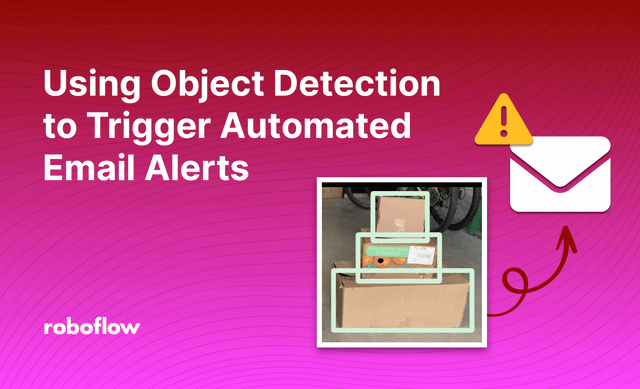
8 Aug 2022 • 4 min read How to Use Object Detection to Trigger Automated Email Alerts Learn how to trigger automated email alerts when an object detection model identifies the location of an object.
3 Aug 2022 • 8 min read Develop like a Pro with NVIDIA + Docker + VS Code + PyTorch SUMMARY Managing NVIDIA drivers and CUDA versions directly on a host machine leads to brittle environments that break when dependencies drift. This guide walks through installing NVIDIA drivers on Ubuntu 20.04, setting up Docker and nvidia-docker for GPU-accelerated containers, pulling an official PyTorch image from NVIDIA NGC,
3 Aug 2022 • 4 min read Use Raspberry Pi and Luxonis OAK to Deploy Vision Models in Robotics Learn how to use the Raspberry Pi and Luxonis OAK to run computer vision models for robotics projects.
1 Aug 2022 • 4 min read How to Deploy YOLOv7 to a Jetson Nano We'll be creating a dataset, training a YOLOv7 computer vision model, and deploying it to a Jetson Nano to perform real-time object detection.
27 Jul 2022 • 2 min read Open Source at Roboflow At Roboflow, we are on a mission to improve every industry by democratizing computer vision. Open source plays a big role in that by making the tooling accessible and reaching a wide audience. On Roboflow Universe, a community of people are already sharing over 90,000 datasets and 7000 pre-
22 Jul 2022 • 9 min read How To Train SegFormer on a Custom Dataset In this post, we will walk through how to train SegFormer on a custom dataset using Pytorch Lightning to classify every pixel in an image.
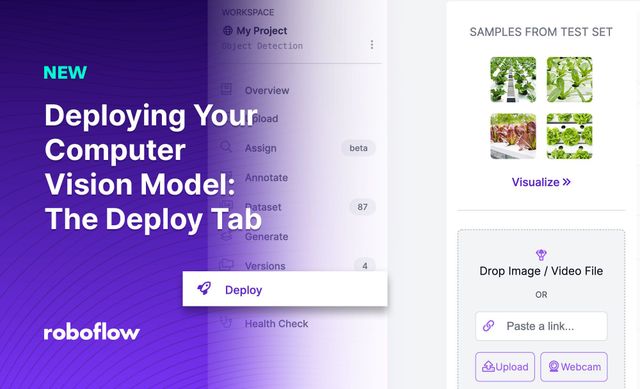
19 Jul 2022 • 4 min read Deploy a Computer Vision Model: A How-To Guide SUMMARY The Roboflow Deploy tab centralizes the options for getting a trained computer vision model into use without writing boilerplate for each target: it supports drag-and-drop inference on images and video files, live webcam inference in the browser, URL-based inference, and copy-paste code snippets for the
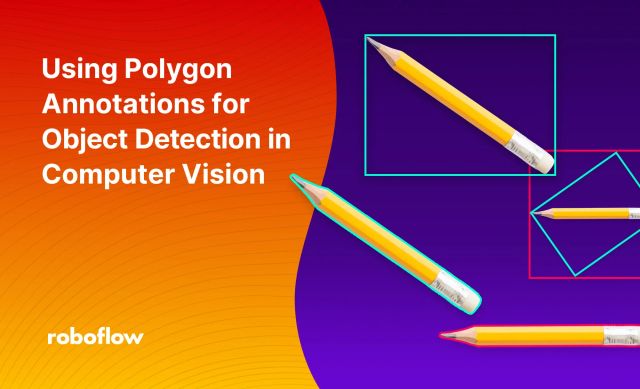
14 Jul 2022 • 4 min read Using Polygon Annotations for Object Detection in Computer Vision SUMMARY Polygon annotations improve object detection model training even when the model only outputs bounding boxes, because the extra shape data makes augmentations more accurate. Spatial transforms like rotation and cropping stay tightly fitted to the object with polygons, while bounding boxes pick up background pixels that dilute training signal.
13 Jul 2022 • 1 min read What is TensorFlow Lite? SUMMARY TensorFlow Lite (TFLite) is an open source library from Google for converting and deploying TensorFlow models on edge devices, including mobile (iOS and Android), embedded hardware, and Raspberry Pi. It converts a standard TensorFlow model to a compact .tflite format optimized for lower latency and smaller memory footprint, enabling
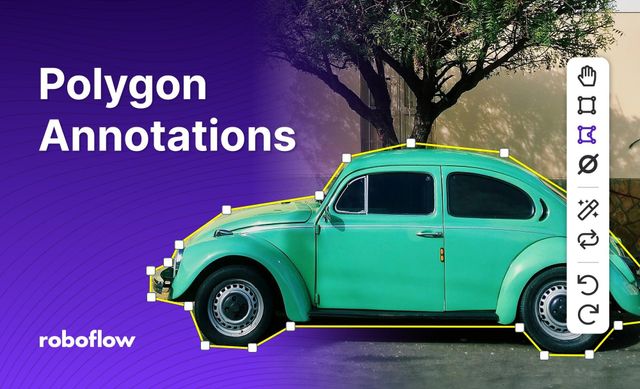
13 Jul 2022 • 3 min read How to Use Polygon Annotation and Labeling with Roboflow Polygons have traditionally been used for training image segmentation models, but they can also improve the training of object detection models. Object detection models are typically much faster and more widely supported, so they're still the best choice for solving many problems.
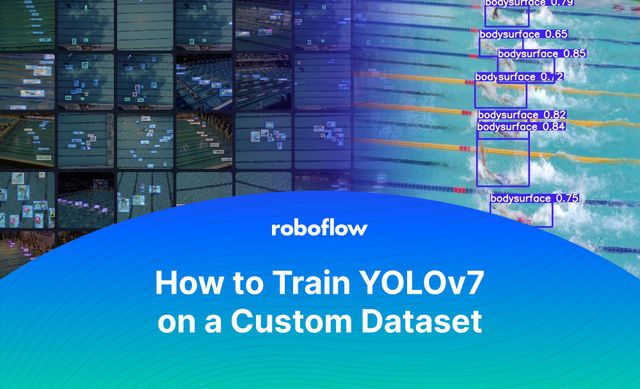
13 Jul 2022 • 6 min read How to Train a YOLOv7 Model on a Custom Dataset SUMMARY This tutorial walks through training a YOLOv7 object detection model on a custom dataset using a Google Colab notebook, covering dependency installation, loading a dataset from Roboflow Universe in YOLOv7 format, running training, evaluating results with detect.py, and deploying the model via API or to edge devices like
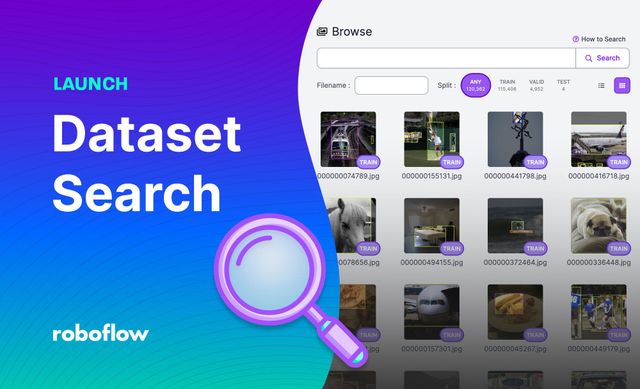
11 Jul 2022 • 3 min read Launch: Search Datasets and Assign Jobs SUMMARY Roboflow Annotate now includes a semantic image search that lets teams find unlabeled images by describing their contents in plain text, without any prior labeling or categorization of those images. The search uses natural language processing and computer vision models to index image contents from pixel data, so queries
6 Jul 2022 • 2 min read Roboflow Changelog: May & June 2022 Each month, we share a recap of product and company updates. Here's what's new for May and June in 2022!
1 Jul 2022 • 16 min read How to Train a YOLOv6 Model on a Custom Dataset Learn how to train a YOLOv6 object detection model on a custom dataset.
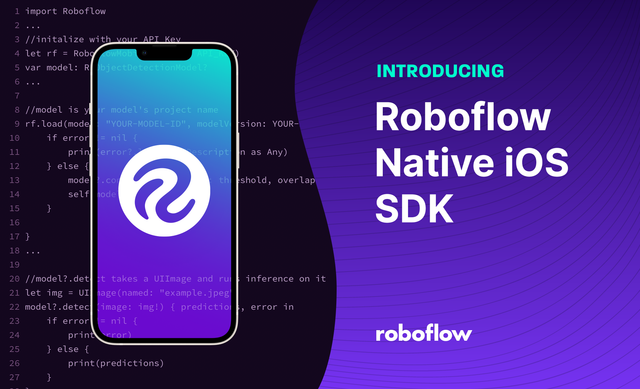
30 Jun 2022 • 3 min read Launch: Roboflow Native iOS SDK Constrained bandwith? Left without the option to extend production data beyond your local network or corporate firewall? In need of real-time inference speeds on the edge? The Roboflow Mobile iOS SDK is a great option if you are developing an iOS application.
29 Jun 2022 • 5 min read Using Gaming Datasets for Game Automation with Computer Vision SUMMARY This tutorial walks through building a computer vision model to detect Minecraft tree trunks using screenshots collected across multiple in-game biomes, annotated and trained via Roboflow. The resulting model is deployed through a Python inference script that reads frames from an OBS Studio virtual webcam, enabling real-time
29 Jun 2022 • 1 min read What is TensorFlow? Learn what TensorFlow is and how it can be used for computer vision.
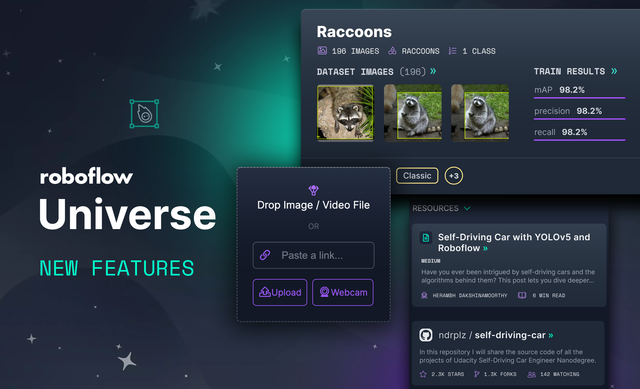
28 Jun 2022 • 4 min read Open source datasets and pre-trained models for computer vision SUMMARY Roboflow Universe grew from 50 open-source datasets at launch in August 2021 to over 90,000 datasets with 66 million labeled images and more than 7,000 pre-trained models available via API, covering object detection, segmentation, and image recognition across industries. Pre-trained models on Universe can
24 Jun 2022 • 4 min read CVPR 2022 - Best Papers and Highlights In this post, we take the opportunity to reflect on the computer vision research landscape at CVPR 2022 and highlight our favorite research papers and themes.
24 Jun 2022 • 2 min read What is cuDNN? SUMMARY cuDNN (CUDA Deep Neural Network library) is NVIDIA's GPU-accelerated library of low-level primitives, such as convolution and pooling, that frameworks like PyTorch and TensorFlow call internally to run deep learning workloads on NVIDIA GPUs. It sits on top of CUDA, which handles general-purpose GPU