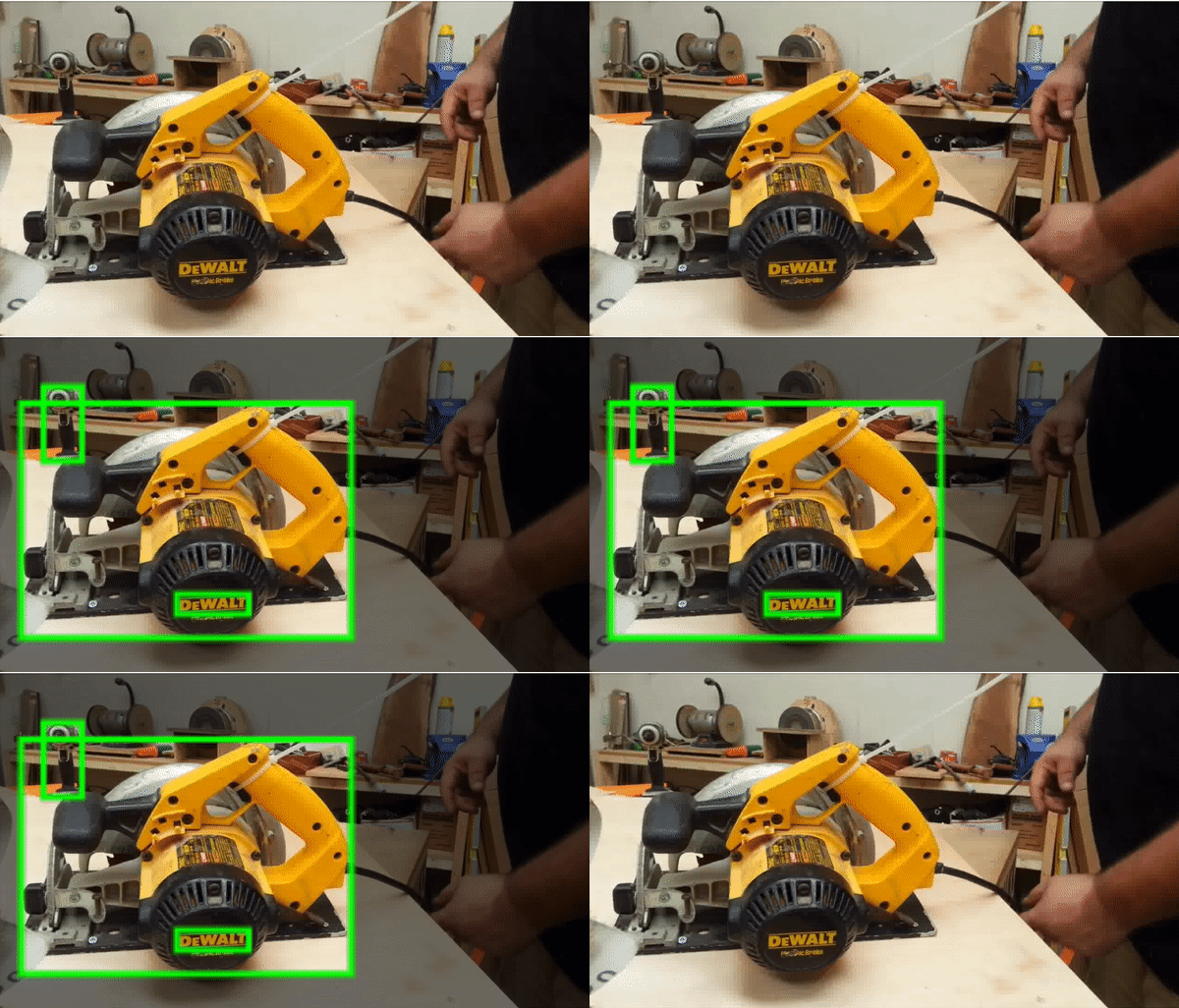
24 Jun 2020 • 9 min read How to Train Detectron2 on Custom Object Detection Data Learn how to train a Detectron2 model on a custom object detection dataset.
19 Jun 2020 • 5 min read How to Convert Annotations from PASCAL VOC to YOLO Darknet A bedrock of computer vision is having labeled data. In object detection problems, those labels define bounding box positions in a given image. As computer vision rapidly evolves, so, too, do the various file formats available to describe the location of bounding boxes: PASCAL VOC XML, COCO JSON, various CSV
18 Jun 2020 • 4 min read How to Build a Custom Open Images Dataset for Object Detection We are excited to announce integration with the Open Images Dataset and the release of two new public datasets encapsulating subdomains of the Open Images Dataset: Vehicles Object Detection and Shellfish Object Detection. In this post, we will walk through how to make your own custom Open Images dataset. Vehicles
12 Jun 2020 • 16 min read Responding to the Controversy about YOLOv5 We appreciate the machine learning community's feedback, and we're publishing additional details on our methodology. (Note: On June 14, we've incorporated updates from YOLOv4 author Alexey Bochkovskiy, YOLOv5 author Glenn Jocher, and others in the community.) Don't care about the controversy? Skip
10 Jun 2020 • 4 min read YOLOv5 is Here: State-of-the-Art Object Detection at 140 FPS Less than 50 days after the release YOLOv4, YOLOv5 improves accessibility for realtime object detection. June 29, YOLOv5 has released the first official version of the repository. We wrote a new deep dive on YOLOv5. June 12, 8:08 AM CDT Update: In response to to community feedback, we have
10 Jun 2020 • 10 min read How to Train a YOLOv5 Model On a Custom Dataset Learn how to train a YOLOv5 model on a custom dataset.
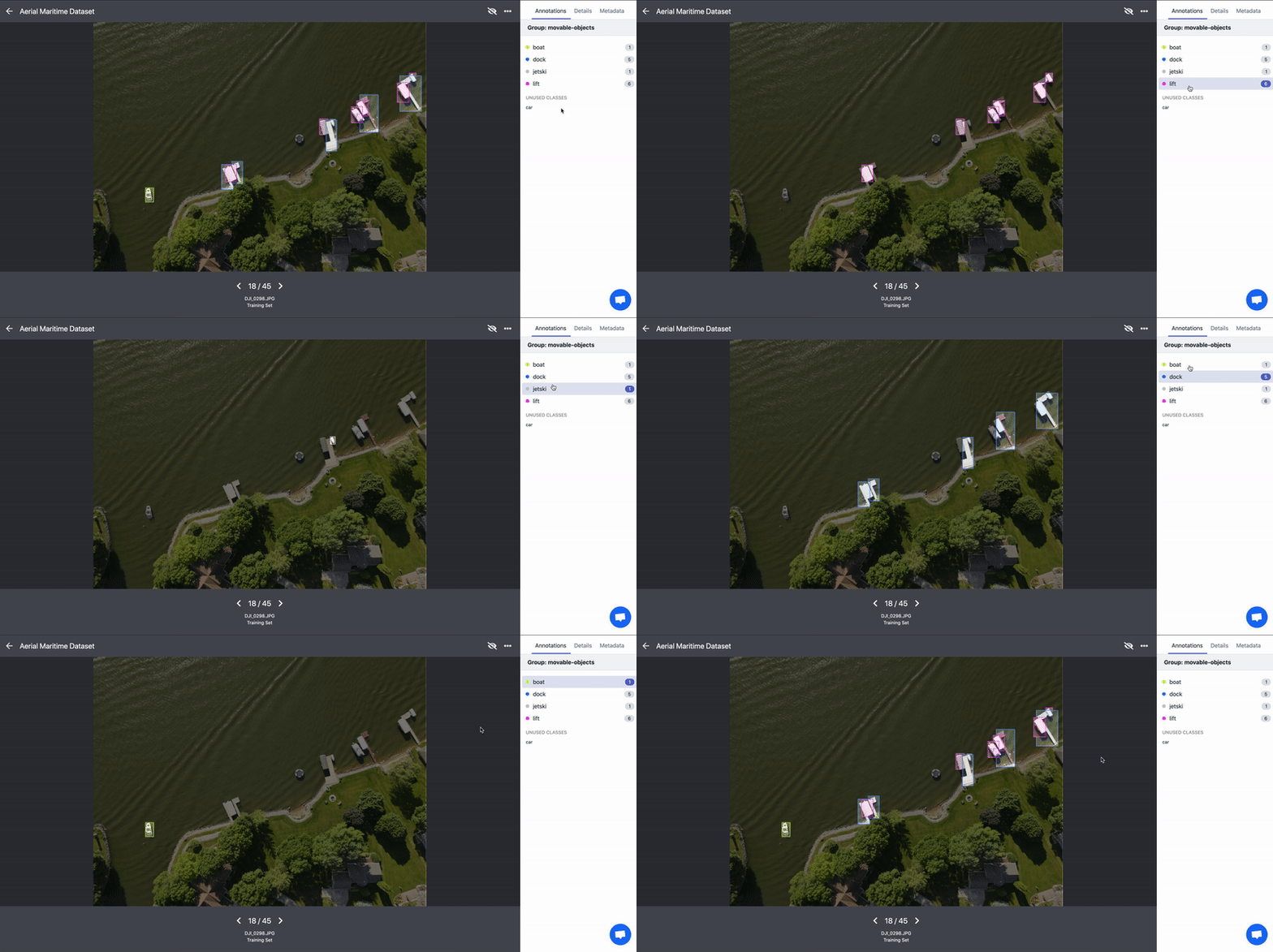
3 Jun 2020 • 3 min read Teaching a Drone to Fly on Auto Pilot with Roboflow Drones are enabling better disaster response, greener agriculture, safer construction, and so much more. Increasingly, drones are even achieving the ability to perform these tasks completely or semi-autonomously – enabling greater precision and efficiency. Thus, when Victor Antony, a data scientist from the University of Rochester, was confronted with creating the
2 Jun 2020 • 7 min read Getting Started with Data Augmentation in Computer Vision Data augmentation in computer vision is not new, but recently data augmentation has emerged on the forefront of state of the art modeling. YOLOv4, a new state of the art image detection model, uses a variety of data augmentation techniques to boost the models performance on COCO, a popular image
31 May 2020 • 1 min read A New Video Tutorial: YOLOv4 in PyTorch We heard your feedback! More video walkthroughs. Many users report that video tutorials help round out the edges of their knowledge to get the most from Roboflow. Seeing how others use Roboflow in real-time aids their own comprehension. Make YOLOv4 more accessible. YOLOv4 is a mere month old, and given
27 May 2020 • 2 min read Introducing An Even Better Way to Preview Image Preprocessing and Augmentation Knowing what preprocessing and augmentation steps to apply is hard. We've written many individual posts about the steps required to make informed resize decisions (how to resize images in image preprocessing) to random crop augmentation (how to implement random crop augmentation) and many steps in between. Show, Don&
25 May 2020 • 3 min read How to Train a VGG-16 Image Classification Model on Your Own Dataset Learn how to train a VGG-16 image classification model on a custom dataset.
24 May 2020 • 3 min read Thermal Infrared Dataset for Object Detection Computer vision is performed on a wide array of imaging data: photographs, screenshots, videos. Commonly, this data is captured in similar perception to how humans see – along the visible red, green, and blue (RGB) color spectrum. However, there's growing interest in processing images beyond the visible color scheme.
21 May 2020 • 9 min read How to Train YOLOv4 on a Custom Dataset Learn how to train a YOLOv4 model on a custom dataset.
15 May 2020 • 4 min read When to Use Contrast as a Preprocessing Step Adding contrast to images is a simple yet powerful technique to improve our computer vision models. But why? When considering how to add contrast to images and why we add contrast to images in computer vision, we must start with the basics. What is contrast? How contrast preprocessing improve our
13 May 2020 • 7 min read Data Augmentation in YOLOv4 Learn how data augmentation is used in training YOLOv4 computer vision models.
8 May 2020 • 2 min read When Should I Auto-Orient My Images? Learn when you should auto-orient images for use in training computer vision models.
4 May 2020 • 5 min read Breaking Down the Technology Behind Self-Driving Cars In May 2016, Joshua Brown died in the Tesla's first autopilot crash. The crash was attributed to the self-driving cars system not recognizing the difference between a truck and the bright sky above it. The system did not recognize the difference between a truck and the sky?! After
1 May 2020 • 6 min read YOLOv3 Versus EfficientDet for State-of-the-Art Object Detection YOLOv3 is known to be an incredibly performant, state-of-the-art model architecture: fast, accurate, and reliable. So how does the "new kid on the block," EfficientDet, compare? Without spoilers, we were surprised by these results. NOTE: YOLO v5 has been published after this publication and we have found better
29 Apr 2020 • 3 min read Breaking Down Roboflow's Health Check Dimension Insights Roboflow improves datasets without any user effort. This includes dropping zero-pixel bounding boxes and cropping out-of-frame bounding boxes to be in-line with the edge of an image. Roboflow also notifies users of potential areas requiring attention like severely underrepresented classes (as was present in the original hard hat object detection
28 Apr 2020 • 1 min read Introducing the Roboflow Model Library Over the past few months we've been building up a library of easy to use, open source computer vision models. We've now given them a home: the Roboflow Model Library. There, you can access information about each model (we will even be adding pros/cons, and
24 Apr 2020 • 4 min read The Difference Between Missing and Null Annotations A discussion of missing versus null annotations and how VOC XML and COCO JSON handle them. Preparing data for computer vision models is a tedious task. Even assuming training images are appropriately representative for inference, managing annotations quickly becomes a challenge. In some annotation formats (PASCAL VOC XML, YOLO DarkNet)
22 Apr 2020 • 7 min read EfficientDet for Object Detection In this post, we do a deep dive into the neural magic of EfficientDet for object detection, focusing on the model's motivation, design, and architecture. Recently, the Google Brain team published their EfficientDet model for object detection with the goal of crystallizing architecture decisions into a scalable framework
16 Apr 2020 • 2 min read Roboflow Presents at Open Data Science Conference (ODSC) East 2020 The Open Data Science Conference (East) looked a bit different this year. While typically 6,000+ data science professionals gather in Boston for the Expo, the team at ODSC moved the entire event online. Still, over 3,000 "attendees" gathered in a shared Slack Workspace and online livestream
15 Apr 2020 • 12 min read How to Create a Synthetic Dataset for Computer Vision The appeals of synthetic data are alluring: you can rapidly generate a vast amount of diverse, perfectly labeled images for very little cost and without ever leaving the comfort of your office. The good news is: it's easy to try! And we're about to show you how.